“My wife is a house painter… so what? What’s the problem?”
A growing number of women are entering the construction industry to build their careers, embracing their passion for their work. In an industry where 90% of jobs are held by men, what is it like for these women to work in this field?
Marion Polge, University of Montpellier; Agnès Paradas, University of Avignon ; Caroline Debray, University of Montpellier and Colette Fourcade, University of Montpellier
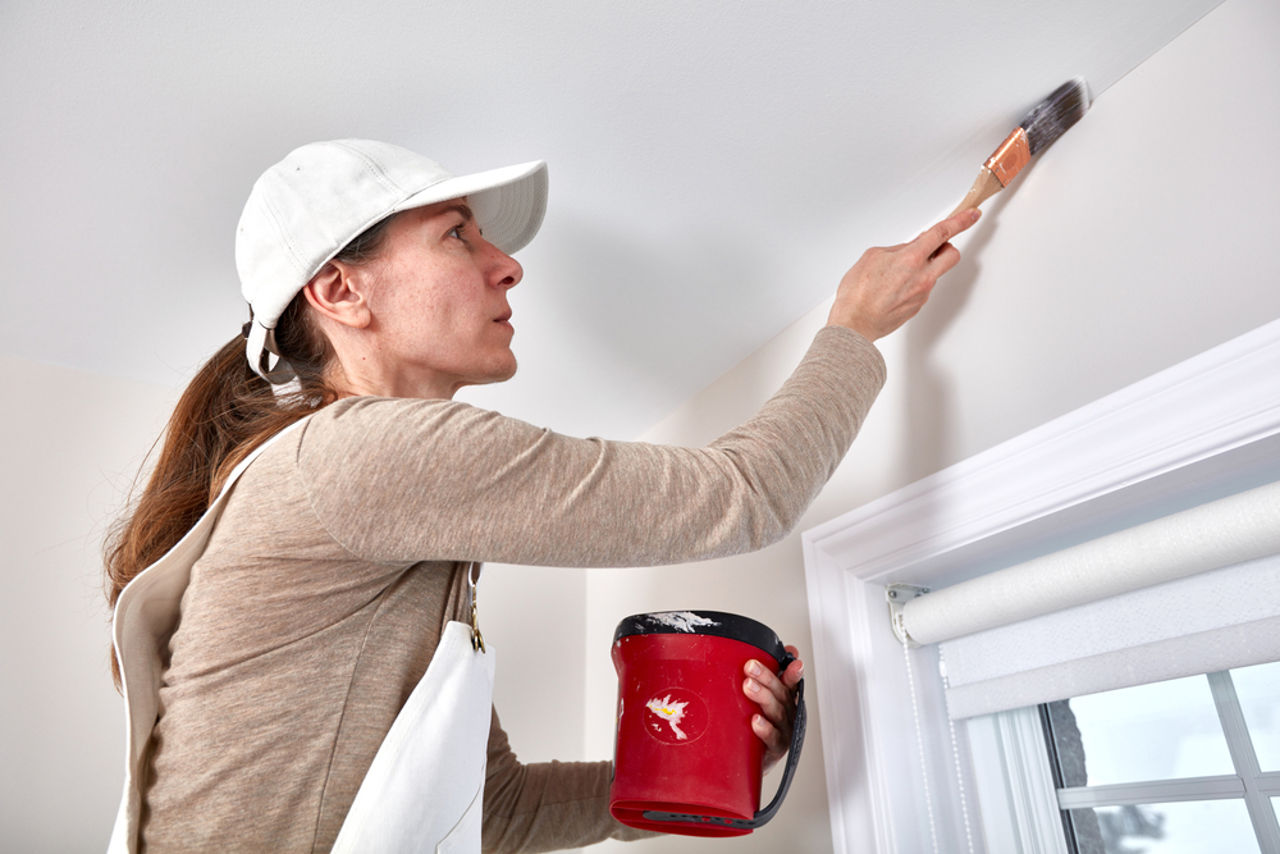
Above all, are we witnessing a transformation of the building trades sector, or—more broadly—a shift in society?
The study conducted by the CoCréatec Chair (Montpellier University Foundation), funded by the European Social Fund (2016–2018), shows that women are now entering this sector with new ambitions, bringing a breath of fresh air that is driving improvements in overall performance.
Although our survey finds that only 60% of tradespeople view the arrival of women in their companies as somewhat or very favorable, the push toward gender diversity in certain trades is becoming a reality. The survey included women and men—business owners, employees, and stakeholders—working in the construction sector. Everyone agrees on the need to grant women genuine status as leaders and hands-on tradespeople, particularly by combating stereotypes.
This is evident from the series of verbatim transcripts below.
Overcoming the Physical Obstacle
The demanding nature of certain construction trades remains a reality, especially in structural work (activities involved in building a structure’s framework): material handling, transporting loads, and physical labor.
"I'm supposed to work until I'm 73—can you imagine having to repaint a ceiling again?"
“There’s still a lot of physical labor involved, and for me, at least, that’s a barrier to women entering this profession.”
But the activities of construction companies are not limited to these physical aspects:
"Aside from lifting very heavy weights, a woman can perform the same tasks as a man."
In the public mind, the physical demands of certain trades remain a barrier, while in others—such as carpentry—gender diversity is becoming more common in training centers.
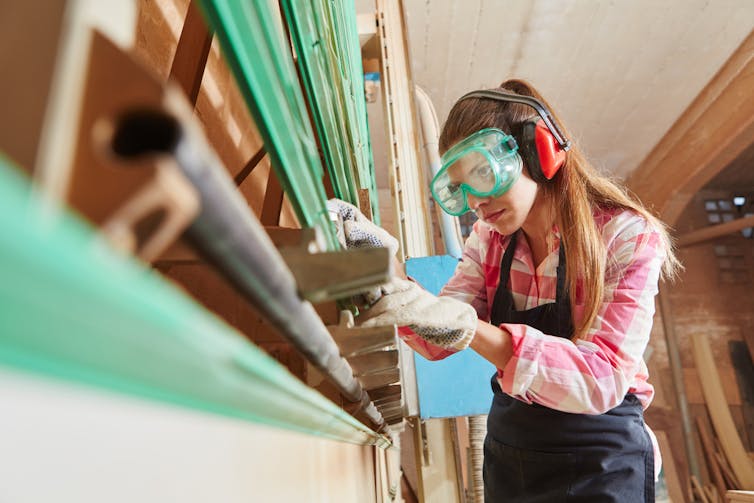
Robert Kneschke/Shutterstock
Nevertheless, this physical barrier appears to be surmountable. First, technological advancements are reducing the physical demands of the work, making it easier for women to enter the field while also lightening the workload for men. Second, the women interviewed demonstrate great ingenuity in overcoming physical barriers (hiring employees and temporary workers, collaborating with other companies, securing placements on suitable job sites, etc.). Ultimately, the physical challenge seems to exist more in people’s minds than in the reality of construction sites.
The real problem today is that “we don’t have representation across all trades.” Women are not applying for jobs in certain trades; girls are also virtually absent from certain training programs, despite the gender-equity policy initiated by the Ministry of National Education and subsequently implemented by the regional education offices. So what’s still holding us back?
The answer might be… all of us
Parents, business owners, clients, coworkers, friends, spouses, neighbors, children… the study clearly shows that societal pressure significantly dampens women’s motivation. The family circle exerts a particularly strong dissuasive influence on young people. Even when parents are artisans themselves, they discourage their daughters from entering the trade:
"From the very beginning, my father told me that being a painter wasn't a profession for women."
The challenge commonly cited by female business leaders is also present in this sector: family responsibilities. In fact, these responsibilities are highlighted far more by the partners of women working in the construction industry than by the women themselves: “We don’t know what time we have to finish… it’s a bit complicated.”
Another barrier to gender diversity in the building trades stems from a social obstacle, perpetuated by stereotypes associated with a divide between different trades.
“There needs to be gender diversity in all professions, not just in the construction industry.” (a woman’s words)
“We’re not providing our young people with the right information. In my opinion, this is intentional.” (remark by a man lamenting the underrepresentation of women among young apprentices)
There are numerous accounts describing societal barriers. The study clearly shows that the “roughness” attributed to this sector is in reality merely a reflection of a society that associates construction tradespeople with an exaggerated sense of masculinity. Take, for example, this female carpenter, to whom a client replied:
“But are you the carpenter? Then I don’t want a quote—a carpenter is a man, and I don’t want your services!”
From “artisan’s wife” to “artisan women”
Stereotypes help shape our perception of others. In a way, they organize our view of society by categorizing the population. On the other hand, they risk limiting women’s roles to primarily administrative tasks, since the collective unconscious ofthe 20th century has taught us that there are “artisans’ wives” but not “female artisans.” The “artisan’s wife” assists her husband, while the “female artisan” takes on the role of business owner.
Stereotypes become truly dangerous when they turn into prejudices—that is, when they reach a level of discrimination that equates a secondary role with incompetence in leadership. What our study shows is the prevalence of shared responsibility among both women and men for these prejudices. Some revel in their leadership roles, while others, shaped by a patriarchal upbringing, slip comfortably into the shadows of the former. More surprisingly, we found no generational divide in these behaviors.
"They're different": the traditional view
Stereotypes can be negative, stemming from practical constraints due to the physically demanding nature of certain construction activities.
"These are physically demanding jobs… it's true that for a woman, it might be a little challenging."
But the stereotypical view also includes non-discriminatory aspects, reflected in the perceptions of both men and women. When it comes to management and organization, women appear to be better:
“The difference on construction sites is the organization. For starters, they show up on time for meetings… They’re much more disciplined than the guys.” (a man’s words)
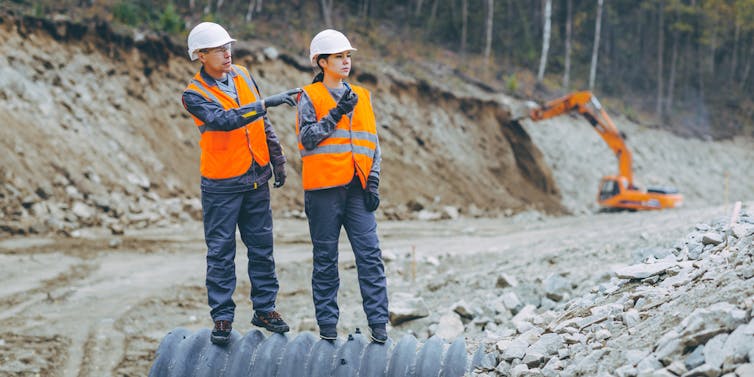
Mark Agnor/Shutterstock
Women are also valued in customer relations:
"In people's minds, having a woman do the work reassures them that the job site will be clean."
Finally, the quality of relationships with employees—as well as with business partners—is perceived as being higher among women. As a result, their role as director of operations appears to be becoming an integral part of the day-to-day operations of small craft businesses, even though it is neither formally recognized nor contractually standardized.
“What’s a woman doing on a construction site?”: hostile discrimination
The look can be downright disapproving:
"Sometimes we get the impression—we feel—that we're taking up space..."
But more often than not, the issue of professional recognition arises—and it's a difficult one.
"A woman isn't going to teach me how to do my job."
In any case, mistakes—or even simple clumsiness—are not tolerated when made by a woman on construction sites (whereas they would be accepted if made by a male tradesperson…).
"I'm not sure I would have been tested if I had been a man": excessive professional demands
When a woman arrives at a construction site, she feels as though she is being put through a trial imposed by her male colleagues. Her competence is automatically called into question:
"They're expressing doubts... They don't trust us."
Women are expected to demonstrate a higher level of mastery of their craft than male artisans; they must prove themselves. But once their competence is recognized and they have demonstrated technical mastery:
"Men are even more impressed."
Are women the future of the construction industry?
The term “entrepreneurial,” when applied to women’s motivations for entering the world of the building trades, is justified for two reasons: professionalization and capability.
A Demonstration of Technical Expertise
Women's entry into construction trades reflects a career choice (rather than a choice made by default):
“I didn’t choose this job because it was for men; I chose this job because I liked it.” (a woman’s words)
As a result, women demonstrate a high degree of rigor in the practice of their profession:
"When they say they're going to do something, they do it." (a man's words)

Gorodenkoff/Shutterstock
This (stereotypical?) perception that men have of women’s professionalism seems to drive their desire to bring more women into the technical aspects of their profession. The men interviewed acknowledged that they pay closer attention to the quality of their work when there are women on their teams. Gender diversity could thus help boost corporate performance by fostering greater professional rigor across the board.
“I like having both men and women working together: I like it because, as a result, we’re all better off together.” (words of a craftsman)
Demonstrating Capability: The Foundation of Entrepreneurial Determination
Although they are expected to demonstrate their skills, these women are confident in their abilities.
“A woman can stay true to herself, see it through to the end… there’s no reason not to.”
These motivations drive an entrepreneurial approach, leading to the decision to start a business. This explains the high proportion of one-person startups founded by women in the sample we analyzed.
The individual, organizational, social, and economic performance indicators we measured show significant improvement when there is gender diversity in the building trades. Not only does the work environment become more harmonious, but professionalism also improves both within companies and on construction sites where multiple trades are involved. This only reinforces the importance of breaking down the many stereotypes that still exist.
Marion Polge, Associate Professor with HDR status in Management Sciences, University of Montpellier; Agnès Paradas, Associate Professor (HDR) in Management Sciences, University of Avignon ; Caroline Debray, Associate Professor of Management Sciences—SME Management, University of Montpellier and Colette Fourcade, Adjunct Associate Professor, University of Montpellier
This article is republished from The Conversation under a Creative Commons license. Readthe original article.