Mayotte: A New Approach to Urban Development
On December 14, 2024, Mayotte was hit by Tropical Cyclone Chido, with a death toll that is still difficult to estimate. This natural disaster cannot be separated from vulnerabilities linked to social organization. The risk factors associated with rapid population growth and unplanned urbanization must be analyzed to better plan for reconstruction. President Macron has announced a special law and stated that he no longer wants slums. Is his approach the right one?
Anthony Goreau-Ponceaud, University of Bordeaux; Fahad Idaroussi Tsimanda, University of Montpellier and Olivier Chadoin, ENSAP Bordeaux
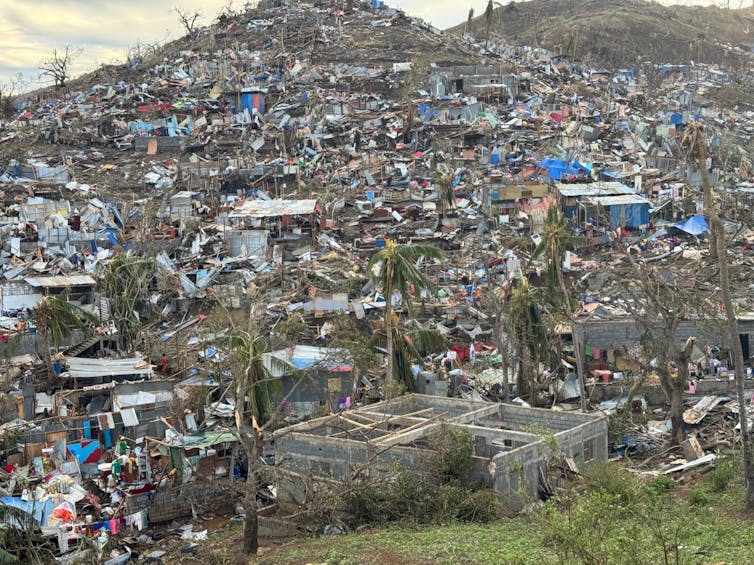
The concepts of vulnerability and risk are closely linked: they stem from the cyclone hazard and the fragility of Mayotte’s social organization. While the media often compare Cyclone Chido to Cyclone Dicel of 1934, the wind speeds and damage caused by the two are by no means comparable. Between 1934 and today, Mayotte’s landscape has changed considerably: it has become more urbanized, developed, coastal, and densely populated. In less than forty years, the island’s population has more than quintupled. Thus, the island’s geographical vulnerability in this region of the Indian Ocean is compounded by a socially constructed vulnerability: social adaptations to climatic and demographic changes have had significant effects on the landscape and natural resources (soil, plantations, urbanization, water, forests…), which, combined with the government’s limited commitment to addressing the ecological and demographic crisis, have led to a general state of vulnerability that makes it impossible to draw a clear distinction between natural and non-natural disasters.
From a rural landscape to an urbanized landscape
As recently as fifty years ago, the landscape of Mayotte was rural. Homes were primarily built of wood and/or mud, and the roofs were made of coconut leaves or raffia. The island’s few permanent structures were located in a handful of towns such as Dzaoudzi and Pamandzi. The huts built using natural materials (mud and plant fibers) and their attached outbuildings (banga) were gradually replaced by permanent structures with the creation of the Société Immobilière de Mayotte (SIM) and the SIM housing project, initially designed to address the elimination of substandard housing and the arrival of numerous civil servants. Over the past three decades, given the sharp increase in population and the rise in the standard of living, a new form of multi-story housing has emerged, built with imported materials (concrete blocks, cement, and sheet metal).
Despite this trend toward modernization, beginning in the 1990s, other types of precarious housing—often described as informal or irregular—spread across the entire island, developing primarily on the outskirts of village and urban centers. These shantytowns form the outlines of distinct neighborhoods, each with its own history and sense of time, where narrow alleys open onto public spaces. These neighborhoods are home to populations that are administratively diverse and too poor to qualify for public housing.
In 2017,INSEE estimated that these fragile structures (mostly sheet-metal houses) accounted for nearly four out of every ten homes. Foreigners are much more likely to live in them: 65% of them live in a sheet-metal house, compared to 25% of French natives of the island. During the alert, it seemed unlikely that nearly 100,000 people could be sheltered in the 71 evacuation centers. This was especially true since the vast majority of them, due to their irregular status on the island, were wary of going there. In this post-disaster assessment, one might wonder where these people have gone.
These precarious dwellings are often built on the steep slopes that characterize the island’s terrain, with nearly 56% of the island’s land area exposed to at least one high-level natural hazard. More broadly, due to intense land-use and demographic pressures—whether from agricultural development or urban expansion—areas with gentle slopes are rare, and building on slopes has become a necessity. Directly linked to shortcomings in housing policy, these high-altitude areas continually create precarious living conditions that a weather-related hazard can quickly turn into a humanitarian disaster. This issue has already been widely highlighted and studied, revealing the failings of a makeshift state, a state in disarray.
To consider the role of these housing units on the island and stabilize land tenure, we must break free from the rut of a normative, repressive, and security-focused approach (as exemplified by Wuambushu) and transform neighborhoods “from the ground up”—by making them safer, providing water and electricity infrastructure, and establishing safe pathways that stabilize the slopes.
The issue of land use planning in Mayotte will arise very soon, as residents are already beginning to rebuild their makeshift homes in the aftermath of Chido, and others will likely be forced to give up the places where they lived due to new zoning regulations established by political authorities that classify their former neighborhoods as dangerous.
In this regard, President Macron’s recent statements about enacting a special law and his assertion that the bangas must not be rebuilt are likely to clash with the current reality. Indeed, of the estimated 100,000 residents in these areas, not only were not all of them undocumented, but they must now find alternative housing immediately. It is also important to note that the hurricane season is not over and that rain and wind are common in January.
Thinking About “What Comes Next”
Vulnerability is the combination of the severity of the foreseeable consequences of climate change-related phenomena and a society’s capacity to respond to a potential crisis. It is precisely this capacity to respond that is problematic in Mayotte.
In situations of intense crisis, individuals move beyond their usual social attitudes and relationships to develop specific interactions centered on mutual aid and rescue efforts. However, this adaptation requires, on the one hand, the ability to align with the aid being provided and, on the other hand, a certain degree of homogeneity among the social groups involved. In Mayotte, a territory marked by stark inequalities and social and spatial divides, this is clearly not the case. For example, public commentary quickly focused on the presence of looters and other “dakous”—often defined as “Anjouanese criminals”—leading to calls for law enforcement reinforcements and a state of emergency. While this is not to downplay the incidents of looting, these remain very much in the minority compared to acts of solidarity and reveal biases in the interpretation of the disaster.
This is a critical issue because the perception of the event and its political interpretation determine whether this disaster is defined as a public problem. This definition will undoubtedly be the key issue in addressing the devastating effects of Chido and its “aftermath.” Indeed, while substandard housing was the first to be devastated by the cyclone, it is also where the majority of vulnerable and stigmatized migrant populations are concentrated. Consequently, it is highly likely that the management of this disaster will be influenced by perceptions of the island’s social dynamics, such as those circulating in French political circles.
Once the initial shock has passed, the search for political culprits begins. It has evidently already started, for example, with the remarks madeby Anchya Bamana and Jean-Luc Melenchon. Others will surely follow. This blame game and the reduction of the calamity to questions of guilt risk imposing a narrative designed to justify political choices for emerging from the crisis. However, if the pre-crisis dysfunctions and vulnerabilities, as well as social hierarchies and divisions, reestablish themselves, it is highly likely that they will produce the same decision-making logic and the same results. The risk here, once again, is that Mayotte will be trapped and unable to take control of its own destiny, unable to mobilize itself beyond the public assistance provided.
The crisis facing Mayotte presents an opportunity to rethink a number of issues, such as the increasing scarcity of resources, environmental degradation, and the demographic crisis. Envisioning the “aftermath” also means making Mayotte a key player in a project and a narrative—one of collective memory, experience, and attitude toward risk.
Anthony Goreau-Ponceaud, Geographer, Professor, UMR 5115 LAM, University of Bordeaux; Fahad Idaroussi Tsimanda, Geographer, University of Montpellier and Olivier Chadoin, Professor of Sociology, Pave – Emile Durkheim Center CNRS 5116, ENSAP Bordeaux
This article is republished from The Conversation under a Creative Commons license. Readthe original article.