Montpellier, a breeding ground for the agriculture of tomorrow
With their sights set on the South, 2,500 researchers in Montpellier are developing the agricultural models of tomorrow, combining the rediscovery of traditional techniques with new technologies.
Laurent Bruckler is unequivocal: “There is no longer any agronomy that does not take the environment into account.”The president of the INRA Occitanie-Montpellier center traces the evolution of a discipline that has undergone a profound transformation. “Before the 1970s, the focus was on feeding the country amid postwar reconstruction. So the focus was on fertilization, crop protection, and the artificial transformation of the environment… Then came the realization of agriculture’s impact on the environmental crisis and public health. A long period of transition led to the widespread adoption of new principles in the early 2000s, within a global framework that takes into account issues such as climate change, demographic challenges, and threats to biodiversity….”
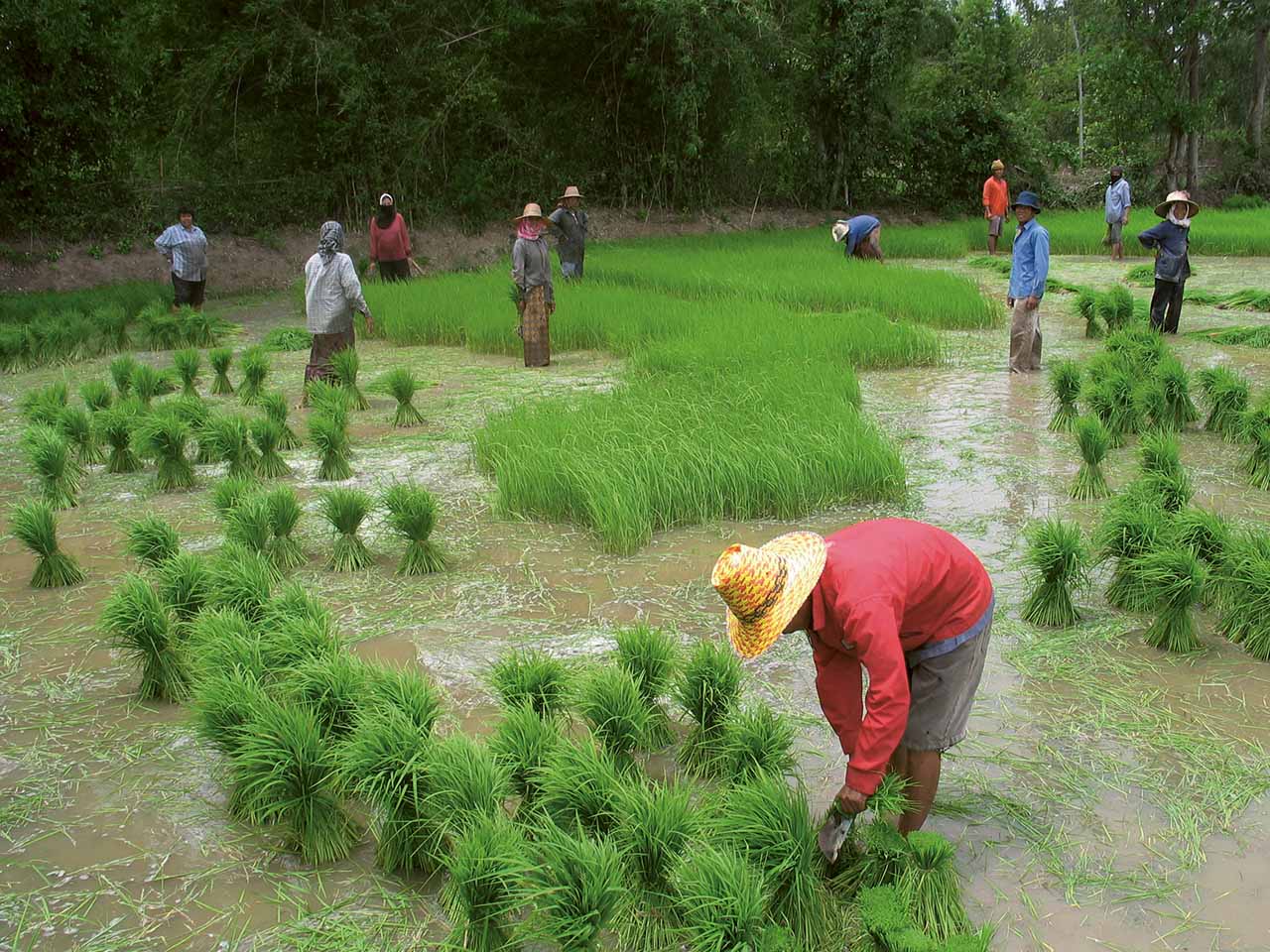
Jean-Luc Maeght © IRD
Bio-inspired agriculture
A gradual evolution that has led to the emergence of new concepts, such as the very timely one ofagroecology.“Agroecology involves using biologicalmechanisms found in nature to support agricultural production: drawing inspiration from a forest ecosystem that sustains itself through internal fertilization, using the microbial biomass already present in the soil to fix nitrogen…”explains the research director.
“The productivist approach was focused solely on the study of the individual plot,” confirms Marie-Laure Navas.“Today, on the contrary, we are led to work at the scale of a watershed, a landscape, or even a region to integrate these environmental dimensions. Agroecology reflects this. The challenges are more complex. In fact, we no longer speak of ‘agriculture’ but of ‘agricultures’ in the plural,” notes the deputy director of education and scientific policy at SupAgro Montpellier. Located north of Les Arceaux on the La Gaillarde campus, this prestigious agricultural college trains the future leaders of French agronomy. On the campus, which houses INRA facilities, vineyards and greenhouses spring up like mushrooms, forming an unexpected oasis of greenery just a stone’s throw from downtown.
Lavalette: An Agricultural Tower of Babel
The La Gaillarde site is not the only hub of agronomy in Montpellier. On the other side of the city, at the foot of the Lunaret Zoo, the Lavalette campus sees hundreds of researchers come together every day, many of whom are from countries in the Global South.
One distinctive feature that enriches the site, explains Michel Salas, regional director of CIRAD, is that“our watchword is partnership. We work with and for the Global South—not through a top-down approach, but rather in full cooperation.”For the researcher, it is essential to move beyond an archaic view of the North-South relationship.“The Global South is a vast reservoir of expertise, diverse approaches, and genetic material waiting to be explored. Innovative techniques are also being developed in the Global South. For example, no-till farming has been practiced in Brazil for over 20 years, ” notes Michel Salas.“Working for the Global South means working for the planet. What happens in the South has repercussions for the North: the level of development in Southern countries has a significant impact on the present and future of the entire planet,” summarizes the researcher. To refine its international strategy, the site can also count on the presence ofthe French National Research Institute for Sustainable Development (IRD), whose researchers, stationed across the globe, provide valuable expertise on development projects.
A veritable Tower of Babel, Lavalette thus boasts one of the world’s richest genetic collections of rice, cacao, rubber trees, sugarcane, and more. In high-security containment greenhouses, researchers also study the relationships between plants and pests—relationships that have also been disrupted by climate change.
World Capital
As further proof of Montpellier’s indispensable role in agricultural research, the Lavalette campus has been home to the headquarters of the Consultative Group on International Agricultural Research(CGIAR) since 2014. This international organization, which coordinates more than 8,000 people and 15 research centers around the world, chose Montpellier over other candidates such as Rome and New Delhi to establish its headquarters. This recognition is a fitting tribute to Montpellier’s status as the world capital of agricultural research.
I-SITE MUSE
 “ Feed, Care for, Protect“, three global challenges for the 21st century at the heart of I-SITE MUSE.
The MUSE (“Montpellier University of Excellence”) project brings together 19 institutions behind a shared goal: to establish in Montpellier a thematically focused, research-intensive university that is internationally recognized for its impact in fields related to agriculture, the environment, and health—a university that will serve as a close academic partner for all members of the consortium, one with which they will have strong ties and of which they can be proud.