Success for the Montpellier University of Excellence Project!
This is a major success for the entire scientific community in Montpellier and a wonderful recognition of its potential and its projects. Following its presentation to an international jury on February 21, the Montpellier University of Excellence (MUSE) project was awarded the Initiatives – Science – Innovation – Territories – Economy (I-SITE) designation. 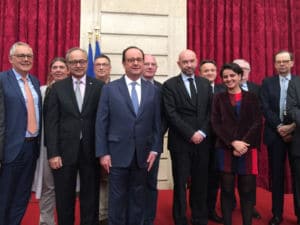
The General Commission for Investment (CGI) has decided to allocate 550 million euros to the project led by the University of Montpellier: 350 million euros for new MUSE initiatives and 200 million to ensure the long-term viability of the LABEX programs. This allocation is on par with IDEX funding.
Centered around the University of Montpellier, the project involves 10 research organizations (BRGM, CEA, CIRAD, CNRS, Ifremer, INRA, Inria, Inserm, IRD, Irstea), 4 schools (ENSAM, ENSCM, EMA, SupAgro), 3 healthcare institutions (Montpellier University Hospital, Nîmes University Hospital, Montpellier Cancer Institute), and one international organization (CIHEAM-IAMM).
More than 150 partners support MUSE and have committed to increasing their involvement in university-industry partnerships: SMEs, large corporations (including five key partners: Banque Populaire du Sud, BRL, Horiba, Invivo, and MSD), and competitiveness clusters (Derbi, Eau, Eurobiomed, Mer, Optitec, Qualiméditerranée, and Trimatec).
Horiba played a particularly decisive role, as its Chairman and CEO, Dr. Jai Hakhu, participated in the hearings before the international jury; it will continue to do so in the future, as Dr. Hakhu has also agreed to participate, alongside the four other preferred partners, in the advisory bodies that will oversee the project’s progress.
A Strengthened Scientific Ambition
This result reinforces the ambition of the MUSE project—the largest scientific project ever conceived at the Montpellier site—to address three major challenges for the 21st century: feeding, protecting, and providing healthcare.“By capitalizing on Montpellier’s strength in the life sciences, environmental sciences, and agriculture, and by providing a collective response to these three interdependent challenges, MUSE has played its cards right,”says Philippe Augé, president of the University of Montpellier. Through research, education, and innovation, MUSE will set out to break new ground in science and the economy and will contribute to food security, the sustainable management of natural resources and ecosystems, and the development of improved treatments for emerging infectious diseases, chronic diseases, and cancers.
“Muse aims to elevate Montpellier to the status of an international leader in health, environmental sciences, and agriculture”
The project involves, in conjunction with the University of Montpellier, 10 research organizations (BRGM, CEA, CIRAD, CNRS, Ifremer, INRA, Inria, Inserm, IRD, Irstea), 4 schools (ENSAM, ENSCM, EMA, SupAgro), 3 healthcare institutions (Montpellier University Hospital, Nîmes University Hospital, Montpellier Cancer Institute), and one international organization (CIHEAM-IAMM).
An Exceptional Presence in the South, Further Strengthened
With 400 researchers currently based permanently in the intertropical zone, Muse has a network and expertise that are unparalleled worldwide in the Global South, thanks in particular to the expertise of CIRAD, IRD, and CNRS. As the nation’s leading center for agro-environment and biodiversity, Montpellier is now the French leader in research on new agricultural models and environmental management. Similarly, the Montpellier site is a leading authority on the study of emerging infectious diseases and their vectors. These are two issues that primarily affect the Global South and lie at the heart of the accredited project.
Montpellier is now the French leader in research on new agricultural models and environmental management
A recognized trend toward cooperation that is set to accelerate
With its 6,000 scientists and 50,000 students, the MUSE project enjoys the active support of the Occitanie / Pyrénées–Méditerranée Region and Montpellier Méditerranée Métropole
The creation of an internationally recognized thematic research university capable of generating positive momentum across all scientific communities (not only those in agronomy, ecology, and biology, but also in chemistry, the hard sciences, engineering, and the social sciences) is indeed a strategic asset for the region’s development. In addition, more than 150 partners supported MUSE in its bid for accreditation and have committed to further investing in university-industry partnerships: SMEs, major corporations (including five key partners: Banque Populaire du Sud, BRL, Horiba, Invivo, and MSD) and competitiveness clusters (Derbi, Eau, Eurobiomed, Mer, Optitec, Qualiméditerranée, and Trimatec). Objectives: to establish world-renowned joint laboratories, send research teams to campuses, jointly develop curricula tailored to the challenges of tomorrow, and collaborate on European projects…
Obtaining the I-SITE certification will help strengthen the partnership between stakeholders in the socioeconomic sector and MUSE’s center of scientific excellence.
Muse: Funding on Par with IDEX Funding
The General Commission for Investment (CGI) has decided to allocate 550 million euros to the project led by the University of Montpellier: 350 million euros for new MUSE initiatives and 200 million to ensure the long-term sustainability of the LABEX programs. A grant on par with IDEX funding.
Since the overall grant is a non-expendable endowment, the interest generated by it—amounting to 17 million euros—will be used each year to fund the MUSE project’s initiatives (10.5 million euros) and the LABEX programs (6.5 million euros).
This funding will be supplemented by the Occitanie / Pyrénées–Méditerranée Region, which, following the recent adoption of its SRESRI (Regional Plan for Higher Education Research , and Innovation), has committed to funding certain MUSE initiatives.
17 million euros will be allocated annually to support the MUSE project (10.5 million euros) and to fund the LABEX programs (6.5 million euros).