Storing Carbon in the Soil: What Agriculture Can Do
It’s right there, beneath our feet. In our daily lives, we hardly ever notice it, and yet it is nothing less than the largest carbon storehouse in terrestrial ecosystems. This distinction does not belong to forests or the atmosphere, but rather to the soil. There are approximately 2,400 billion metric tons of carbon in the top two meters of soil—three times more than what is found in the atmosphere.
Rémi Cardinael, CIRAD ; Armwell Shumba, University of Zimbabwe and Vira Leng, University of Montpellier
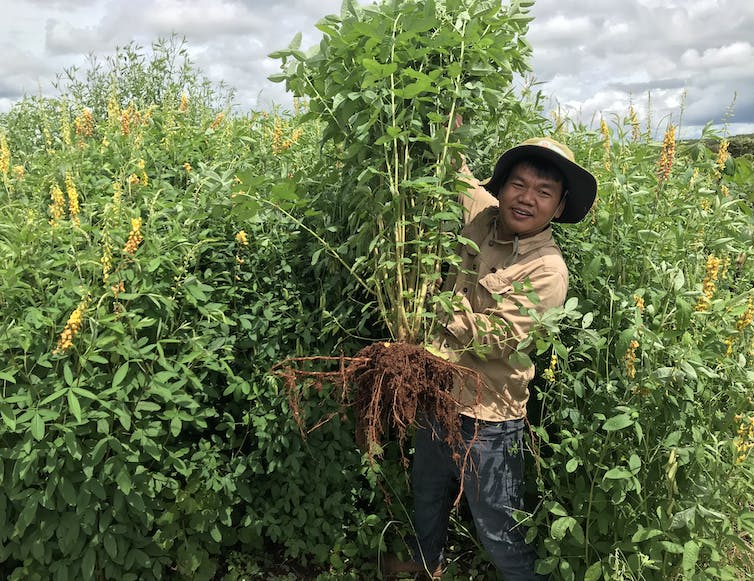
In an era of climate change and the absolute necessity of reducing greenhouse gas emissions, this impressive ability of soils to store carbon gives us pause for thought. While soils alone cannot, of course, drastically reduce the concentrations of greenhouse gases in the atmosphere that are responsible for global warming, they can nevertheless play a substantial role—not only by preserving significant underground carbon stocks but also by restoring degraded land, particularly through certain agricultural practices that allow more carbon to be sequestered underground. Here’s how.
How Carbon Enters the Soil
It all begins with photosynthesis: during this process, plants fix atmospheric carbon dioxide (CO2) within chloroplasts, small cellular organelles rich in chlorophyll. TheCO2 combines with water molecules (H₂O) using solar energy, thereby producing carbohydrates (carbon-rich molecules) and oxygen (O₂). Some of the carbon captured by the plant enters the soil directly through the plant’s roots, both through root exudation and the renewal of fine roots.
Carbon can also enter the soil when a plant’s dead leaves fall, or when crop residues are left in the field. Once they fall, these carbon-rich dead leaves cover the ground, decompose, are ingested by bacteria, fungi, or earthworms, and eventually turn into soil organic matter. Animals can also accelerate this process of carbon transfer into the soil; for example, fungus-growing termites carry plant residues into their termite mounds, where a symbiotic relationship with fungi allows them to make the residues more readily assimilable by the fungi.
Some regions and ecosystems have very large soil carbon stocks. This is the case, for example, in boreal regions, where enormous stocks are stored in the permafrost but are now threatened by global warming. In tropical regions, the high productivity of ecosystems—particularly forests—as well as very deep soils also account for the large stocks observed.
The main challenge for all these carbon-rich ecosystems—such as forests, wetlands, mangroves, and permanent grasslands—is maintaining these carbon stocks rather than increasing them, since this carbon is considered unrecoverable on a human timescale. This requires halting deforestation and the conversion of ecosystems into cropland. On average, 25 percent of soil carbon is lost when forests or wetlands are converted to cropland—and sometimes even more. On agricultural land, certain practices can sequester more carbon in the soil. Widespread adoption of these practices is one of the goals of the “4 per 1,000” initiative, launched at COP21.
Which agricultural practices increase soil carbon stocks?
There are many practices that can increase carbon stocks in agricultural soils, such as agroforestry, cover crops, and organic amendments. Among the solutions often highlighted, three come up regularly. The first is no-till farming or reduced tillage. This technique involves planting crops without first tilling or plowing the entire field. This practice helps reduce soil erosion, slow the decomposition of organic matter by limiting oxygenation of the soil, and preserve soil biodiversity (particularly earthworms).
The second practice promoted is that of permanent soil cover, either with mulch made from crop residues left in the field or with living cover crops planted between different crops. This soil cover protects the soil from erosion—particularly water erosion—helps sequester carbon, and benefits soil fauna (bacteria, fungi, earthworms, etc.).
The third technique promoted is crop diversification, either through crop rotation or intercropping. This diversification helps limit the spread of pests and plant diseases, while also increasing the productivity of cultivated plots, particularly through the residual effects of previous crops. For example, including a legume (peas, beans, peanuts, field beans, alfalfa, etc.) in the rotation will fix nitrogen from the air and make it available in the soil for the next crop, thereby promoting its growth. Higher crop productivity leads to more carbon being sequestered on the plot, and thus more carbon in the soil, particularly through the crop roots.
These three practices correspond to the three pillars of what is known as “conservation agriculture.” These practices become truly effective at increasing soil carbon when used in combination. When practiced alone, they sometimes have little or no impact. This is particularly true of no-till farming alone, which can have a positive effect on soil carbon in some contexts but not in others. It took the scientific community some time to realize this because research initially focused primarily on the top few centimeters of soil, which, under no-till conditions, did indeed have higher carbon content.
However, this was sometimes accompanied by a reduction in soil carbon in the deeper layers compared to tilled systems, where soil carbon is homogenized over a depth of 20 or 30 cm. No-till farming therefore, in some cases, primarily affects the redistribution of carbon within the soil profile, without necessarily leading to a net increase in overall carbon stocks—which is essential when addressing climate change mitigation. A recent synthesis of studies conducted in sub-Saharan Africa suggests that only the combination of the three pillars of conservation agriculture can significantly increase soil carbon stocks, as reducing tillage alone is ineffective.
[More than 85,000 readers rely on The Conversation’s newsletters to better understand the world’s major issues. Subscribe today]
What were the results in Zimbabwe and Cambodia?
To fully understand the benefits of these three practices when combined, it is crucial to conduct long-term experiments. On average, it takes 5 to 10 years for a significant change in soil carbon stocks to be detected.
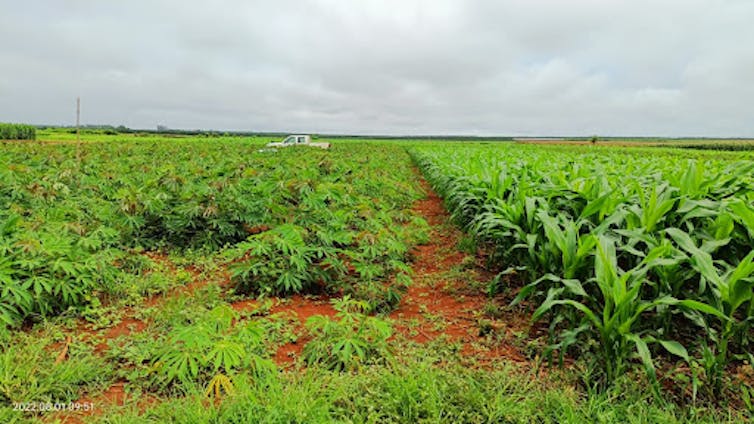
In Cambodia, CIRAD and the Cambodian Ministry of Agriculture began experiments fourteen years ago on cassava-based systems; cassava is a crop that covers nearly 700,000 hectares in the country and is primarily grown for export to produce animal feed.
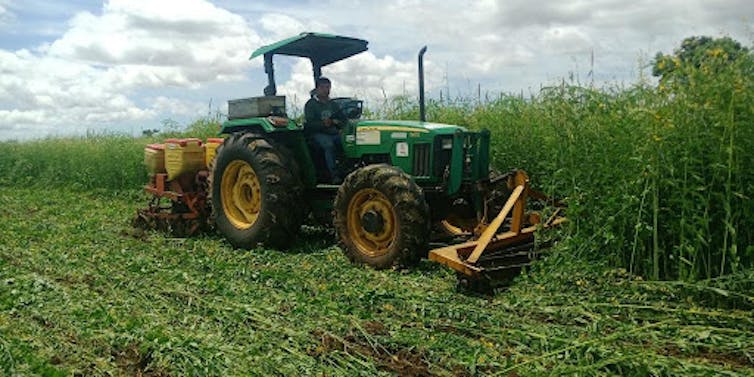
By combining no-till farming and direct seeding, permanent soil cover with cover crops, and crop rotation with corn, we observed a significant increase in soil carbon, with carbon accumulation rates of approximately 0.7 to 0.8 metric tons of carbon per hectare per year down to a depth of 40 cm. The region’s hot and humid climate allows for permanent soil cover with highly productive cover crops, including legumes (crotalaria, cowpea) and grasses (millet), grown between cassava and maize crops, on which maize is then planted.
In this way, carbon is sequestered year-round through photosynthesis, and a very deep root system develops, increasing carbon stocks beyond the topsoil layers. This additional carbon sequestration in the soil will continue until a new equilibrium is reached within the system. This experiment is designed to be sustained over the long term to estimate how many decades such a system can sequester carbon. Once equilibrium is reached, the challenge will be to preserve these carbon stocks by maintaining sound soil management practices. Proper soil management requires a long-term approach rather than a piecemeal one.
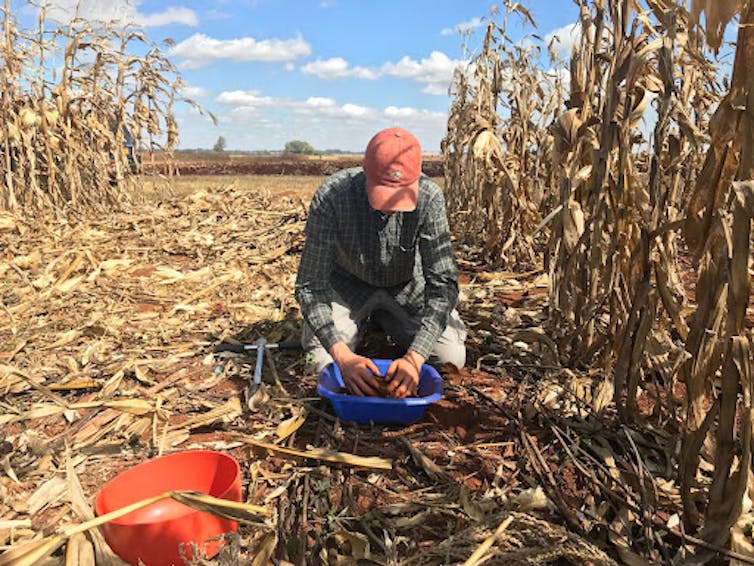
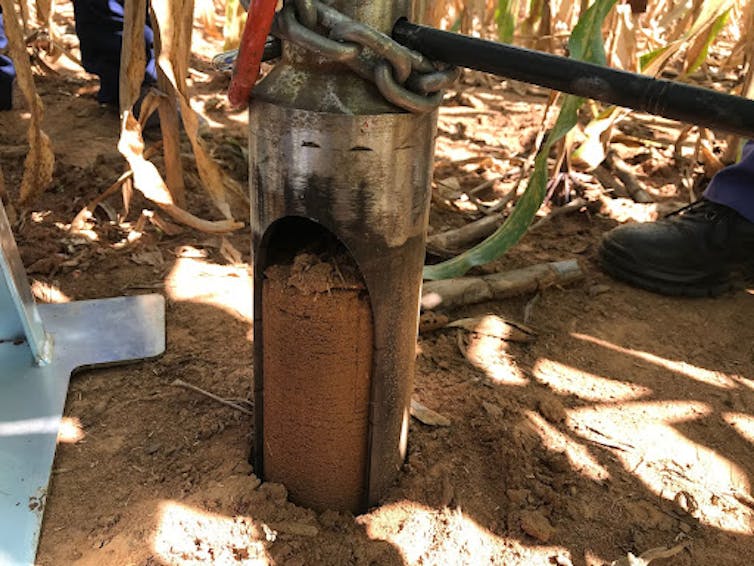
In Zimbabwe, in a completely different context—with a seven-month dry season and a five-month rainy season—we also wanted to assess the long-term effectiveness of these combined practices. To do so, we are using a trial set up by our colleagues at the International Maize and Wheat Improvement Center ten years ago in a low-input system where maize is the primary crop. We were able to measure soil carbon stocks under various practices, both individually and in combination: fields with tillage, fields without tillage, with or without maize crop residue (mulch), and with or without rotation with cowpea, a legume.
Once again, the results show that no-till farming alone doesn’t accomplish much; in fact, it even leads to a slight loss of soil carbon compared to conventional tillage. This is explained on this website by the greater soil compaction that occurs when the soil is not tilled, which makes it difficult for roots to develop. Furthermore, rain does not penetrate as well and runs off the surface, causing water stress in the corn. Ultimately, corn grows much less well in these systems, so there is less carbon input into the soil via the roots, resulting in a loss of soil carbon.
In contrast, no-till fields mulched with corn crop residues from the previous season and incorporating crop rotation do increase carbon stocks, although the effect is limited to the surface layer. Nevertheless, a net increase in carbon stock is observed, as no carbon loss at depth was detected.
What are the obstacles to the development of these practices?
While these results are promising, these practices are not always easy to implement. In Zimbabwe, for example, a major constraint has emerged. Agricultural systems there are low-input mixed crop-livestock systems (with little chemical fertilizer and little or no mechanization). At harvest time, only the corn ears are harvested by hand, and the corn stalks are left standing in the field. These stalks serve as feed for livestock during the dry season, when cows graze directly in the fields after having roamed the forests and communal lands during the wet season.
There is therefore competition over the use of corn stover—whether to feed livestock or to cover the soil. Some farmers erect fences to prevent livestock from eating the stover during the dry season, which comes at a cost. Others harvest the stalks and store them off the ground, out of reach of the animals, and bring the mulch out as the rainy season approaches. This requires a lot of organization, as well as extra time and energy. In both cases, an alternative feed source must also be found for the livestock.
On these lands, as on others, the value of these practices for farmers does not lie in carbon sequestration in the soil or its impact on climate change mitigation. These techniques are primarily valued for their positive impact on soil fertility and the resulting crop productivity, by reducing the risk of erosion, improving nutrient availability, and enabling adaptation to climate change through, for example, better water conservation. These benefits are crucial and often a top priority for farmers in the Global South, who are among those most affected by climate change.
This article is part of a project involving The Conversation France and AFP Audio. It received financial support from the European Journalism Center as part of the “Solutions Journalism Accelerator” program, which is supported by the Bill & Melinda Gates Foundation. AFP and The Conversation France maintained their editorial independence at every stage of the project.
Rémi Cardinael, Agricultural Researcher, CIRAD; Armwell Shumba, Agronomy Researcher, University of Zimbabwe and Vira Leng, Ph.D. student, University of Montpellier
This article is republished from The Conversation under a Creative Commons license. Readthe original article.