Scientific first: We have successfully recorded the heart activity of a fin whale in the wild
What happens inside a whale’s heart when it dives without breathing? In August 2025, during a mission in the Mediterranean Sea, we were able to record, for the first time, the heart activity of a fin whale, one of the largest animals on the planet (20 meters long, 70 metric tons). This was made possible by a new device capable of recording an electrocardiogram (ECG), which was attached to its back using suction cups.
Aurélie Célérier, University of Montpellier; National Center for Scientific Research (CNRS); Angelo Torrente, University of Montpellier; National Center for Scientific Research (CNRS) and Bertrand Bouchard, University of Montpellier; National Center for Scientific Research (CNRS)
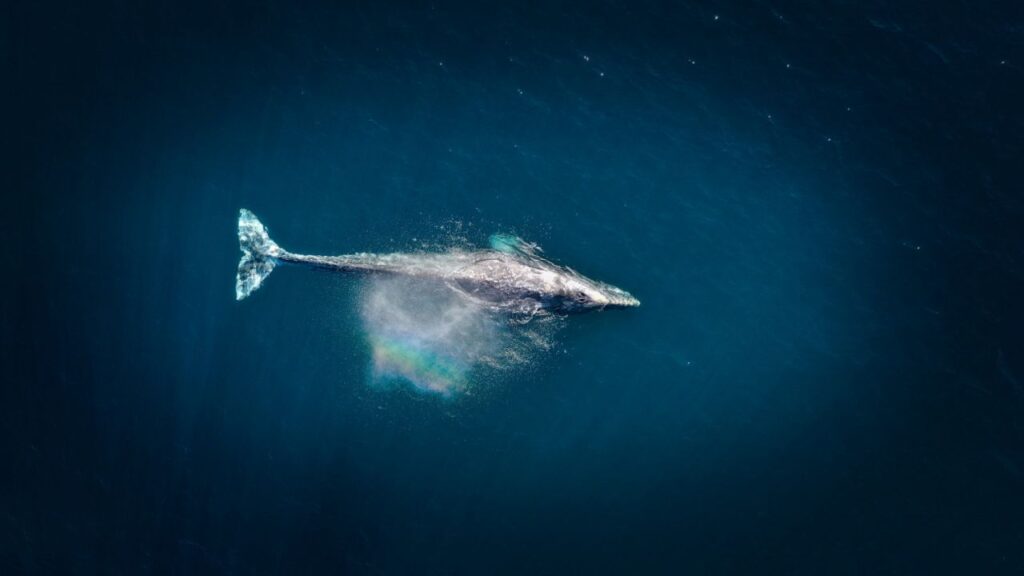
Initial analyses of this five-hour ECG reveal that this giant of the seas’ heart rate can slow to as low as 5 beats per minute (bpm) at depth and peak at 25 bpm during surface breathing phases. These extreme variations allow them to conserve oxygen during dives, making them among the champions of breath-holding (up to twenty minutes). This breakthrough opens up immense possibilities for studying cetacean physiology and helping to protect them from human-induced disturbances.
It took a great deal of tenacity, ingenuity, and hard work to achieve this major methodological breakthrough! And, as is often the case in science, these discoveries came about through unconventional paths. Initially, our research focused on the study of chemical communication in cetaceans.
Indeed, while it is generally accepted that these marine mammals are primarily acoustic creatures, using sound to perceive their world, their use of other senses remains largely a mystery. We are therefore investigating whether dolphins and whales perceive and use smells and tastes (in the air or in the water) to find food or interact with their conspecifics. https://www.youtube.com/embed/arpvNvtKzNQ?wmode=transparent&start=1 When the tagged fin whale encounters one of its own kind.
To explore this fundamental question, our team primarily collects behavioral and acoustic data that help describe how these animals react to olfactory or gustatory stimuli. Do they change their path? Do they move closer to the odor source? Do they dive underneath it? Do they make specific sounds? Sometimes these responses are so subtle and understated that they escape our observation. Thus, odors or tastes could very well be perceived without the animal exhibiting any obvious, measurable behavior…
That is why, for several years now, we have been dreaming of a device that would allow us to also study their physiological responses—particularly their cardiac activity—to supplement our measurements. But how can we capture the electrical signal emitted by the heart of a whale capable of diving as deep as 500 meters below the surface?
One meeting, and the project comes to life
The solution will take shape through a collaboration with Angelo Torrente (co-author of the article), a CNRS researcher and specialist in cardiac activity at the Institute of Functional Genomics (IGF) in Montpellier. For years, he has been studying how the heart functions in various laboratory animals, from zebrafish to mice.
It was during a scientific conference in April 2021 that he learned about our work and our desire to add heart rate data to our dataset. Events then unfolded rapidly: he wrote to us, but his email got lost in the spam folder; however, he was persistent, reached out again, and finally we met! Bursting with enthusiasm and ideas, we decided to pool our expertise to achieve a common goal: recording the heartbeats of cetaceans.
Easier said than done! In total, it took nearly four years of meticulous methodological refinement to achieve our goals… We conducted our initial trials on dolphins, orcas, and belugas housed in various zoos, which had been trained to remain still during medical procedures.
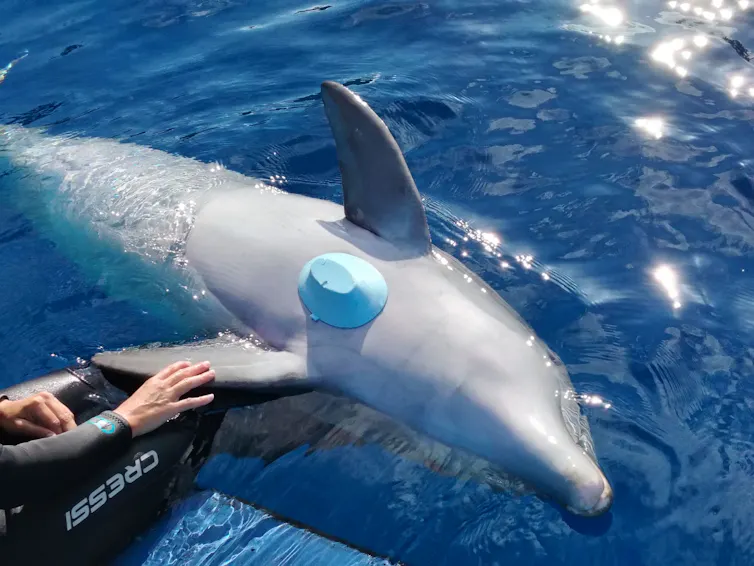
We try, we fail, we experiment… Each new attempt pushes us to be more inventive, and Angelo patiently develops new and original skills: silicone sculptor and electrode welder. After two years of hard work, a non-invasive electrocardiogram (ECG) recording device is finally functional and reliable. It allows for the recording, with near-medical precision, of cetacean heart activity under controlled conditions in zoos, and verifies that this activity varies depending on the context. For example, it slows down during periods of apnea or when they receive a food reward.
This is a significant step forward, but the decisive step remains: adapting this system to the far greater and more unpredictable challenges of working at sea with large wild cetaceans in their natural habitat. Measuring changes in heart rate could provide a better understanding of how these iconic species—most of which are endangered—perceive their environment, which is increasingly disrupted by human activities.
The Difficult Transition to the Natural Environment
We then decided to integrate our heart rate sensor into a multisensor tag already in use for studying large cetaceans, which is capable of simultaneously recording 3D movements, depth, sound, and video. Several expeditions were then planned, in collaboration with various knowledgeable and enthusiastic scientific partners, in Madagascar and Maui to study humpback whales during their breeding season. During these expeditions, we encountered new challenges: unfavorable weather conditions, elusive animals that were hard to spot, and unexpected technical problems.
Added to this is the difficulty of retrieving our precious ECG sensors after they come loose, with the risk of losing them before we can even access the recorded data… In fact, this mishap occurred twice due to the extreme pressure at great depths. For nearly a year, the recordings we obtained revealed no usable ECG signals. Our morale was sometimes put to the test… but we persisted!
And so, in August 2025, we boarded the Blue Panda, the World Wildlife Fund (WWF) vessel, for a mission off the coast of the Var dedicated to the Mediterranean fin whales. One morning, from the Zodiac and using a 6-meter pole, we managed to attach our state-of-the-art tracking tag to the back of a female whale measuring about 16 meters. Thanks to the signal it emitted at the surface, we were able to locate and retrieve our precious device—which had been floating after detaching—that same day, shortly before nightfall.
The seemingly endless data download, which Angelo monitored late into the night, finally came to an end and revealed… a five-hour ECG signal—perfectly usable! It was 4 a.m., but Angelo didn’t hesitate to wake us all up to share the joy of discovering these unprecedented images capturing the whale’s heartbeat.

In the weeks that follow, as we examine every second of this ECG, we document all the variations in this whale’s heart rate. We then cross-reference this data with the multisensor tag to link these changes to the different phases of the dive. Our analyses reveal extreme bradycardia as soon as the whale begins its descent, with the heart rate dropping from 25 to less than 5 beats per minute between the surface and a depth of 40 meters. Conversely, tachycardia (an increased heart rate, up to 25 beats per minute) is observed during locomotor exertion, as well as during interactions with other whales or exposure to noise sources, including our own zodiac.
We then realize that measuring the cardiac activity of large cetaceans could allow us to go far beyond simply describing the mechanisms of adaptation to diving. This method offers a way to more directly quantify how these animals respond to their environment, particularly to the stress caused by maritime traffic and underwater noise. It thus complements behavioral observations—which can sometimes be difficult to interpret—by providing direct insight into the animal’s physiology and energy expenditure. Ultimately, monitoring the heart function of these master free-divers could become a valuable tool for more objectively identifying stressful situations. We hope this will help guide cetacean conservation measures at a time when the ocean is increasingly turning into a dangerous and deafening highway.
These scientific advances would not have been possible without the invaluable scientific collaboration and logistical support provided by Denis Ody of the WWF, Lars Bedjer of the Marine Mammal Research Program at the University of Hawaiʻi, Simon Benhamou and Marie-Pierre Dubois of CEFE-CNRS, Isabelle Charrier and Olivier Adam of the Paris-Saclay Institute of Neuroscience, and Yvan Duhamel of the Pro3D Center at the University of Montpellier. We would also like to thank all the teams at the Oceanogràfic (Valencia, Spain) and Loro Parque (Tenerife, Spain) parks and foundations, as well as the CETAMADA association, for their hospitality and technical support.
Aurélie Célérier, Lecturer and Researcher in Behavioral Biology at CEFE, University of Montpellier; National Center for Scientific Research (CNRS); Angelo Torrente, CNRS Research Fellow in Cardiac Physiology at the IGF, University of Montpellier; National Center for Scientific Research (CNRS) and Bertrand Bouchard, Veterinarian and Researcher in Cetacean Physiology and Ecology, University of Montpellier; National Center for Scientific Research (CNRS)
This article is republished from The Conversation under a Creative Commons license. Readthe original article.