Elementary School: Nearly one in two students is enrolled in a “mixed-age” class
When we talk about classrooms where children of different ages learn together, we usually think right away of the one-room classrooms in small rural schools. This association of ideas has been reinforced in the collective imagination by the success, in 2002, of Nicolas Philibert’s film, *Être et avoir*, which followed the daily lives of students in Saint-Etienne-sur-Usson, in Auvergne.
Sylvie Jouan, University of Montpellier
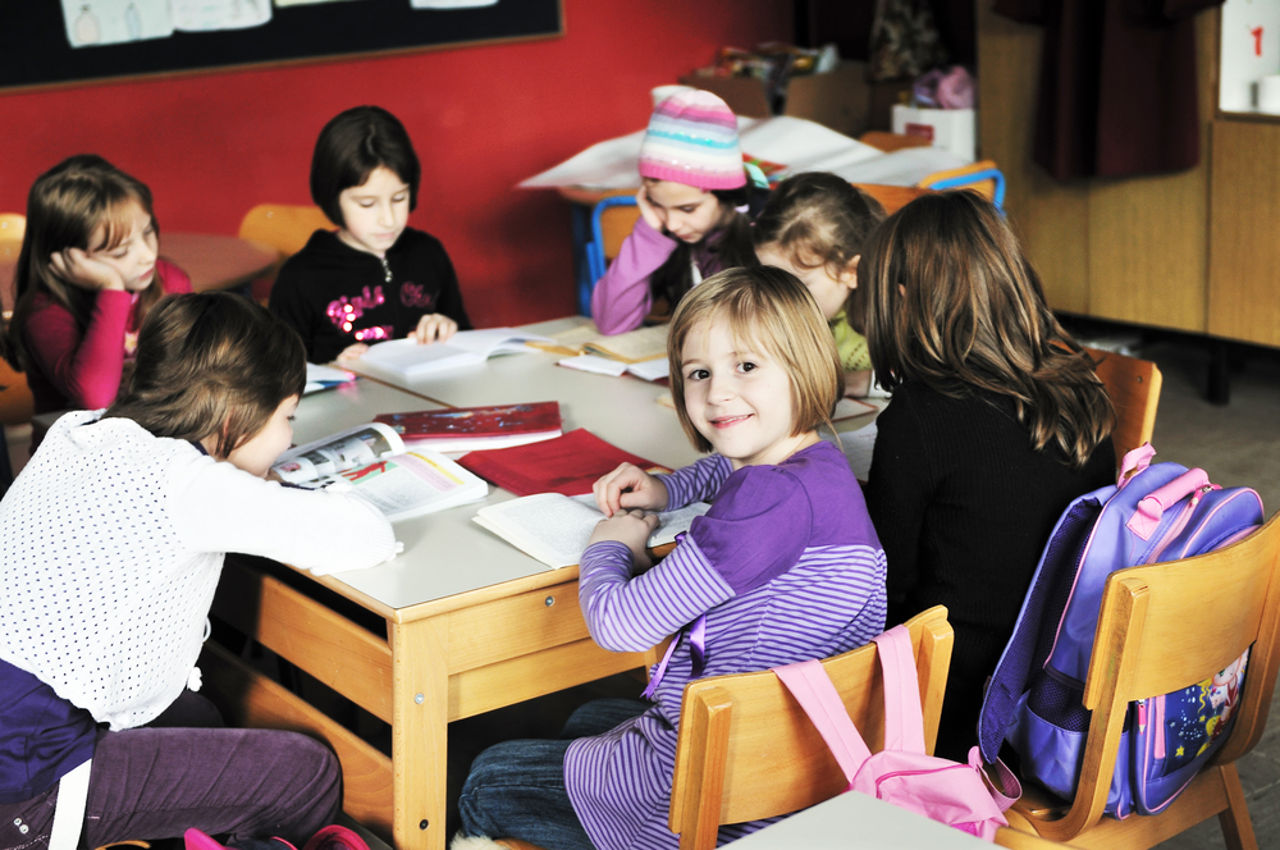
But “multi-age classes” or “multi-level classes” actually encompass a wide variety of situations. The spectrum ranges from single classes that follow children from preschool through fifth grade to classes comprising only two grade levels—or combined-grade classes. These configurations reflect vastly different contexts and operational models, and the relative importance of each has shifted over time.
An Underestimated Reality
The single-classroom school, which was the norm in rural France throughout the19th century and persisted into the first half of the20th century until the rural exodus, can now be considered an endangered species: according to figures from the French Ministry of Education, by 2018 there were only 667 single-classroom schools remaining out of nearly 15,000 public elementary schools—less than 4.5 percent. And this is despite strong local support, since a village that loses its school knows it is on the path to depopulation.
At the same time, mixed-grade classes—or classes with students of different grade levels—have continued to grow in urban areas, so it is no longer accurate to associate mixed-age classes exclusively with rural settings. The figures provided by the ministry’s statistical services serve as a reminder of this often-overlooked reality: in metropolitan France, nearly one in two children is now enrolled in a class combining multiple grade levels (48.6% at the start of the 2015 school year), in both rural and urban areas, precisely because of the presence of mixed-grade classes in urban settings.
While it is true that more rural students are enrolled in multi-age classes, this type of grouping is now a reality throughout the entire country—nearly 40 percent of urban students are enrolled in multi-age classes.
The problem is that such an overlooked reality goes hand in hand with a lack of pedagogical reflection on the potential benefits of this type of grouping, which is most often viewed merely as a means of adjusting to fluctuating student enrollment and the number of teaching positions at a school.
Cooperation Among Students
However, French studies on multigrade classrooms in rural areas reveal a real benefit in terms of academic achievement, especially when there are a large number of grade levels.
This finding runs completely counter to the decisions of a ministry that, since the 1960s, has consistently consolidated small rural classes to form more homogeneous groups. The goal has been to emulate the single-grade urban classroom model. Yet even today, this objective continues to overshadow the highly interesting findings regarding the teaching practices developed in multi-age classrooms.
This is true when it comes to the use of time: students in mixed-ability classes are thus less likely to find themselves waiting around. Since the teacher cannot be with every ability level at the same time, these classes serve as settings where new mechanisms for peer support and independence are developed, so that they can be viewed, overall, as laboratories for educational innovation.
Some teachers in urban areas have recognized this and have established—primarily in working-class neighborhoods—three-level “cycle” classes, where the mix of ages increases opportunities for cooperation among students, particularly through peer tutoring.
School Levels
Conversely, mixed-grade classes—which are most often mandated to even out class sizes within a school—are met with considerable resistance, both from teachers, who see them as an added workload, and from parents, who fear for their children’s academic success.
And the only French study on mixed-ability classes does nothing to allay these fears, since it shows no positive impact on student achievement—except when teachers chose this arrangement and decided how to group students while taking this factor into account.
Thus, because mixed-age classes are virtually unconsidered in the French education system, the two-level configuration—imposed by default when it is not possible to maintain a single grade level in a class—is favored over classes with at least three grade levels, even though research would suggest we do the opposite.
A three-level class makes it possible to cover an entire cycle. Yet these so-called learning cycles—which have structured students’ education since the 1989 Framework Act —still struggle to gain true acceptance, even though they meet the requirement, so often touted today, of taking into account differences in students’ learning paces.
Innovation Lab
However, a highly heterogeneous multilevel classroom can be seen as a way to break definitively with the simultaneous teaching method—a method inherited from the schools of Jean-Baptiste de La Salle dating back tothe 17th century, which consists of having everyone do the same thing at the same time.
This is the method we all experienced as students inthe 20th century at every stage of our schooling, and even without being experts in education, we can see that it fails to take into account the diversity of students: the fastest learners get bored, while those who struggle are unable to progress at their own pace.
Furthermore, to say that a multi-age classroom serves as a laboratory for pedagogical innovation is to assume that reflection on how this type of classroom functions—and in particular on the tools it uses to foster student autonomy and differentiation—serves as a catalyst for rethinking classroom organization in a way that meets the goals of the inclusive and supportive school we are striving to create for the 21st century.e century.
Sylvie Jouan, Professor of Philosophy, instructor in pedagogy and the education system, University of Montpellier
This article is republished from The Conversation under a Creative Commons license. Readthe original article.