Protect the ocean, feed the people
How can we balance the imperative need to protect coral reefs without penalizing the many communities that depend on marine resources for their livelihoods? The so-called “partial” protection of certain reefs, combined with sound fisheries management, could be a promising compromise, according to a study conducted by researchers from theUM, the IRD, the CNRS, and the University of New Caledonia and published in Science on April 17.
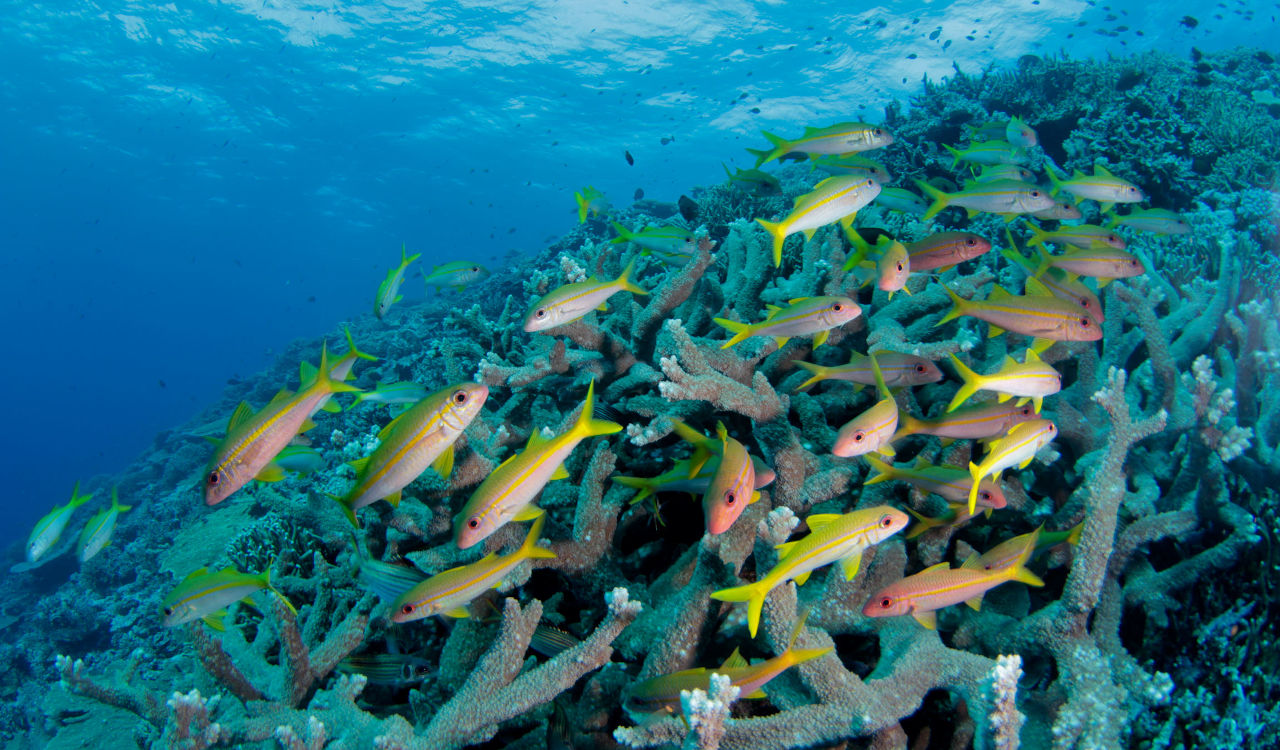
Since the 1980s, approximately 2,000 marine protected areas (MPAs) have been established to protect coral reefs from the pressure caused by human activities, particularly overfishing. These areas offer varying levels of protection, ranging from so-called “no-take” or comprehensive MPAs, which prohibit all harvesting, to “partial” MPAs where fishing activities are merely restricted. Although they currently cover only 6% of the world’s coral reefs, the UN plans to increase the number of these MPAs fivefold by 2030. This is essential, given that they are home to 6,000 species of fish and account for 70% of known marine biodiversity.
Status Report on Coral Reefs
Researchers from an international consortium comprising laboratories in the United States, Canada, Australia, the United Kingdom, and France therefore focused on this sustainable development goal. Among them were specialists from the CNRS,the IRD,the University of New Caledonia, and the University of Montpellier, along with the Marbec laboratory (marine biodiversity, exploitation, and conservation). What was the goal of this study? To assess the current state of coral reefs and simulate their protection in order to determine where to establish these MPAs so that they are both effective in protecting biodiversity and compatible with the survival of the many human populations for whom the sea is a source of food and income.
The researchers studied fish populations living on 1,800 coral reefs (including 106 in MPA) in the Caribbean Sea, the Indian Ocean, and the Pacific Ocean, located at varying distances from the coast. Three conditions essential for maintaining biodiversity and providing benefits to humans were identified: maintaining a significant biomass of commercial species such as grouper; sustaining herbivory pressure—that is, the presence of species such as parrotfish, which, by eating the algae that grow on corals, promote their growth; Finally, the presence of species that perform different ecological functions (functional diversity) and thus contribute to the resilience and robustness of coral reef ecosystems.
Effective MPAs Far from Human Settlements
First observation: Only 5% of the reefs observed met the criteria for all three reference conditions.“These are located more than 1,000 kilometers from the coast,”explains David Mouillot, a researcher at the Marbec laboratory. “They are still in good condition and represent the last refuges for many marine species, particularly large predators such as sharks, swordfish, and tuna”(see the article “Humans Too Close,” LUM magazine No. 8). According to Laurent Vigliola, a researcher at the IRD and co-author of the study,“It is imperative that we designate these very rare isolated reefs as protected areas. This is the case with the Coral Sea Natural Park, which has designated all the isolated reefs off the coast of New Caledonia as integral MPA.”
The second conclusion of this study is that marine protected areas are ineffective on reefs that have been subjected to excessive human pressure due to their proximity to human activity.“These reefs are in very poor condition, and the creation of marine protected areas provides only marginal benefits,” notes David Mouilllot. “When human pressure is too high in the surrounding area, even a complete marine sanctuary is not enough. We therefore need to scale back our objectives in these areas.”
A Possible Compromise
On a more positive note, half of the sites studied—which are currently located outside MPAs—could see significant improvement if placed under protection.“These are the reefs located 5 or 6 hours by boat from the coast. They are affected by human activity, but their degradation is reversible. It is in these areas that we really need to fight,”says David Mouillot. While full protection would obviously be desirable, the need to take societal issues into account—particularly food security in many economically struggling countries—points toward partial protection, which, combined with sound fisheries management, could pave the way for a true balance between humans and marine biodiversity.