Proxima b, a potentially habitable rocky exoplanet
Proxima Centauri, the star closest to the Sun, has a planet. Named Proxima b, this rocky exoplanet—which is comparable in size to Earth and has a surface temperature consistent with the presence of liquid water—may well be habitable… This major discovery was published on August 25, 2016, in *Nature* by an international team of researchers, including Julien Morin of the Montpellier Universe and Particle Laboratory (CNRS/University of Montpellier).
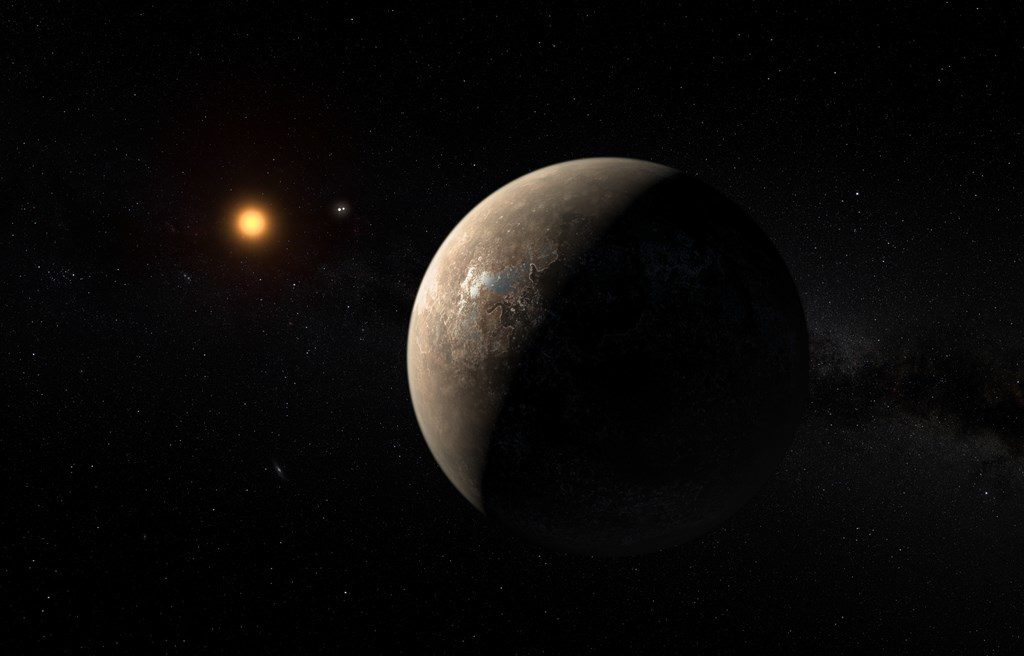
It is the closest exoplanet ever discovered: Proxima b orbits Proxima Centauri, the star closest to the Sun, at “only” 4.2 light-years away. This discovery marks a major turning point in research: Proxima b could very well be capable of supporting life…: The exoplanet is, in fact, most likely rocky, like our own planet, and it lies 7 million kilometers from Proxima Centauri—20 times closer than Earth is to the Sun. Too close? No, because Proxima Centauri, a simple red dwarf, is much less bright than the Sun. Proxima b is therefore well within the habitable zone, and its temperature could allow for the presence of liquid water on its surface.
Proxima b—a smaller twin of Earth? More like a distant cousin, if the research conducted by scientists is to be believed. Two teams, composed mainly of French researchers, have indeed shown that, although it may potentially harbor life, Proxima b cannot be considered a twin of Earth. The history of Proxima b and its star has been radically different from that of Earth and the Sun. The formation of Proxima b, its exposure to radiation from Proxima Centauri, and the tidal forces it experiences—which affect its internal structure and rotation—have no equivalent in the history of our planet.
Detections of rocky planets orbiting active dwarf stars are expected to increase in the coming years with the commissioning of dedicated instruments such as SPIRou. This international near-infrared spectropolarimeter, developed by France, will begin operations in 2017 at the Canada-France-Hawaii Telescope (CFHT) located at the summit of Mauna Kea volcano in Hawaii. The dawn of a new era in space exploration.
Illustration: This artist’s conception shows the planet Proxima b orbiting the red dwarf Proxima Centauri, the star closest to the Solar System. The Alpha Centauri AB binary star system is shown in the upper right corner of the image, between the planet and Proxima Centauri. Proxima b has a mass slightly greater than that of Earth and orbits Proxima Centauri within the star’s habitable zone, meaning its surface temperature is compatible with the presence of liquid water.
References: “A terrestrial planet candidate in a temperate orbit around Proxima Centauri,” by G. Anglada-Escudé et al., August 25, 2016, *Nature*.