[LUM#18] When the Sea Rises
It’s an undeniable fact: sea levels are rising. In some places, this is visible to the naked eye—where the beach is losing ground meter by meter and homes with ocean views sometimes find themselves with water lapping at their doorsteps. How does this phenomenon occur, and how can we better manage it? Beach physicist Frédéric Bouchette and economist Hélène Rey-Valette explain.
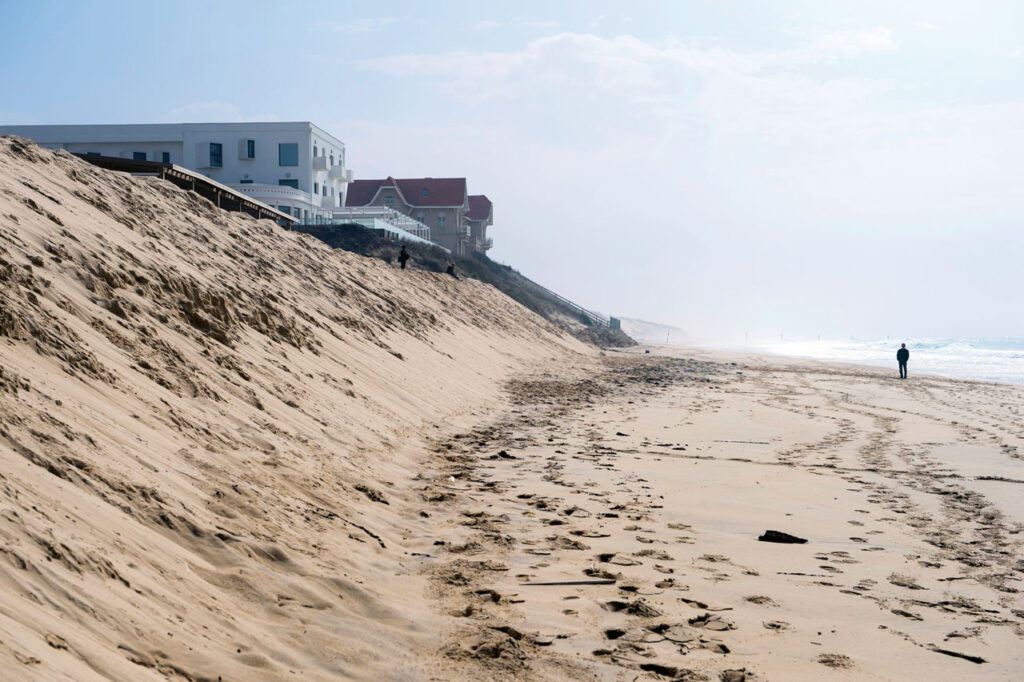
Six million people currently live in coastal municipalities. According to projections by Cerema, the Center for Studies and Expertise on Risks, the Environment, Mobility, and Land Use Planning, that number will rise to 9 million by 2040. More and more people, but less and less space: between 1950 and 2010, 27.7 km² of beaches were lost in metropolitan France. The causes: erosion and rising sea levels, linked in particular to global warming. “A rise of 3.2 millimeters per year over the past 20 years,” explains Frédéric Bouchette, a researcher atthe
Géosciences Montpellier* laboratory and a member of Gladys, the collaborative network dedicated to academic research on coastal dynamics. “This rise in sea level leads
, in principle, to a retreat of the shoreline, what we call the coastline,” explains the re
researcher.
Coastal Resilience
However, this shift in the coastline is not a systematic phenomenon. “The coastline exhibits a certain degree of hydro-sedimentary resilience—that is, the ability of beaches to adapt and/or rebuild themselves in such a way that the land is not necessarily doomed to be inundated by seawater,” explains Frédéric Bouchette. Except that… “Except that for this coastal hydro-sedimentary resilience to work, there needs to be enough sand—and today that is no longer the case.” The main culprits are coastal developments—seawalls, ports, and groins—which block the natural movement of sand, and, to a much lesser extent, dams that
trap it in rivers. “But also massive, unregulated sediment extraction—
—which involves tons of sand being taken from the sea for use in construction, transportation, and road infrastructure.” Not to mention urbanization and infrastructure built too close to the shoreline, which prevent
beaches from naturally retreating.
As a result, the coastline is no longer able to adapt to rising sea
, and over the past 30 years, the water has encroached an average of 100 meters
inland. “These are abnormally high figures compared to what has been
observed in the past, ” explains Frédéric Bouchette. And what about the future? “There is a
great deal of uncertainty regarding the evolution of the coastline; in fact, it is one of the most complex issues in coastal research, ” explains the specialist, who emphasizes the importance of geophysics in developing predictive tools. “We make uncertainty projections using methods similar to those used in finance. The complexity of the dynamics inherent in the wave-sediment relationship makes changes difficult to predict; but the models we’re developing allow us either to identify trends or to understand certain specific changes, such as the formation of sand spits. This information is essential for decision-makers in the sector, ” insists Frédéric Bouchette.
Spatial Reorganization
Raising awareness among coastal managers to anticipate the consequences of climate change is precisely one aspect of Hélène Rey-Valette’s research. “Implementing policies to adapt to sea-level rise involves assessing the differences in damage with and without adaptation, ” explains the researcher at the Montpellier Center for Environmental Economics (CEE-M)**. Together with economist Cécile Hérivaux of the BRGM(Bureau de recherches géologiques et minières), she assessed the damages and benefits across the Occitanie region by the year 2100
for a 1-meter rise in sea level. Without adaptation? 77,000 residents, 34,000 homes, and 4,600 businesses would be affected. 11,500 hectares of farmland and 570 hectares of beaches and dunes would be lost. Additionally, four aquifers could be affected by salinization, impacting 7.5 million cubic meters of drinking water per year. So what can be done to prevent this from happening? “Until now, we’ve talked about retreating, pulling back, and relocating, but the idea today is to move toward spatial reorganization, ” explains the economist, who sees this as a true paradigm shift involving learning to live with risk. “Yet our surveys show that coastal residents do not fully grasp the extent of the problem, particularly due to what is known as the ‘optimism bias,’ which causes those who enjoy the benefits of living near the beach to downplay the risk. We need to study these perceptions to inform elected officials and help them better understand the population’
.”
Opportunity
One million people currently live along the coast—a population directly
affected by the spatial restructuring that will involve relocating certain neighborhoods but, above all, rethinking the region’s layout while taking into account all the challenges and consequences of climate change. “For example, issues such as land development, soil sealing, sustainable transportation, energy challenges, and heat islands, ” adds Hélène Rey-Valette. But relocate to where? “We’ll need to collaborate with the inland municipalities, which will face a population influx and will have to, in particular, resize the city, its schools, and its infrastructure. Those who have to move will also lose their neighborhoods and their friends—it’s a complex situation, ” acknowledges Hélène Rey-Valette. This is where the researcher steps in to propose solutions that make these policies economically and socially feasible. But also to find the right pace: “In terms of acceptability, we recommend a gradual transition, but the IPCC re
s tell us clearly that we don’t have time; we must therefore help elected officials implement appropriate policies that are as progressive as possible.”
For the economist, a major transformation lies ahead: “We’re going to have to rethink the city as a whole and adopt more reasonable and coordinated approaches. From this perspective, climate change can also be seen as an opportunity to rethink our lifestyles, but we must not miss the boat.”
Interview with Hélène Rey-Valette focusing on the adaptation of coastal areas to the risk of erosion and coastal flooding, which is exacerbated by climate change:
*GM (UM, CNRS, University of the Antilles)
**CEE-M (UM, CNRS, INRAE, Institut Agro)
Check out theUM podcasts, now available on your favorite platform (Spotify, Deezer, Apple Podcasts, Amazon Music, etc.).