When Generative AI Can Predict Fish Communities
A new study published on October 22 in *Current Biology* and led by Noémie Coulon, a researcher at the Marbec Joint Research Unit, in collaboration with scientists from Lirmm, proposes using a species distribution model inspired by language models to predict reef fish communities. Trained on nearly 27,000 surveys, the model generates several plausible communities under the same environmental conditions, rather than a single average response. In about one-third of the surveys, these communities fall into distinct configurations, combining, for example, species associated with corals or macroalgae. This approach offers a new way to study the organization of marine communities and the diversity of possible configurations within a single environment.
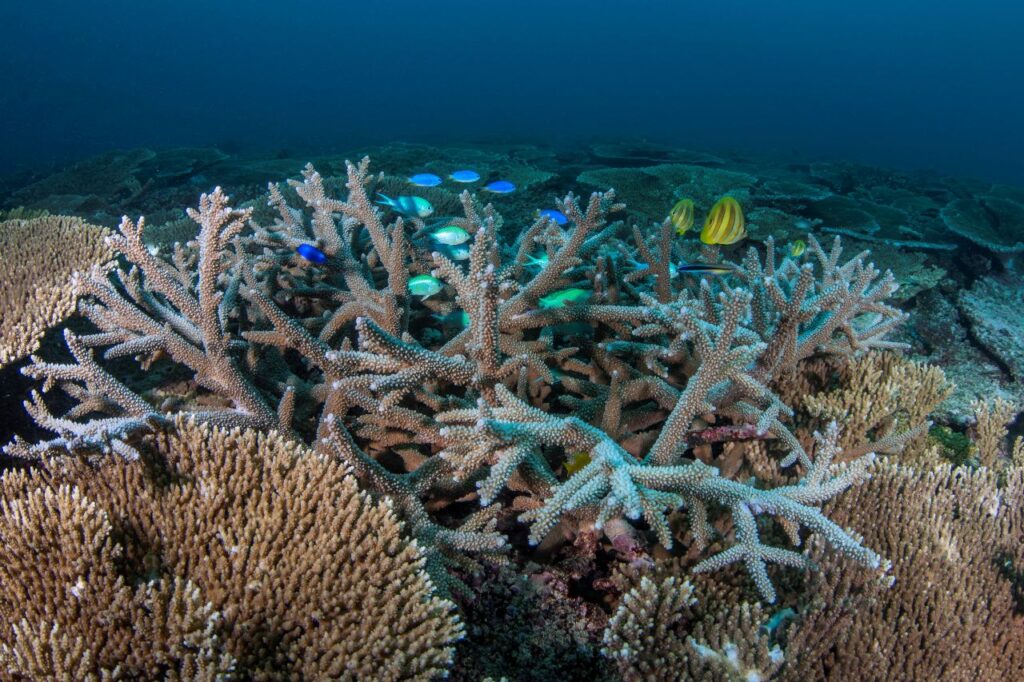
© Rick Stuart-Smith, Reef Life Survey
A New Way to Predict Fish Communities
Historically, ecological models have predicted the distribution of each species separately: for example, they estimate whether a given fish is likely to be found in a reef. This study, however, proposes using a language model to reconstruct an entire community.
The principle is similar to writing a sentence: based on the environmental context, the model gradually “writes” a fish community, taking into account the species already generated and their biomass. In this way, it learns how species are statistically associated with one another.
Most importantly, it does not simply provide a single answer or an average community. Just as a language model can suggest several plausible sequences for a given sentence, it allows us to explore different community compositions under the same environmental conditions.
Trained on nearly 27,000 reef surveys, this tool also improves the prediction of fish communities compared to the methods evaluated in the study.
Exploring the various possible communities within a single environment
For each survey, the research team generated 500 fish communities based on the same environmental context. Analysis of these different simulations shows that, in about one-third of the surveys studied, the generated communities are divided into several distinct groups, each characterized by its own unique combination of species and biomass.
These groups are not merely lists of different species; they are also structured around recurring species associations. Certain species are particularly associated with a given configuration, while others may be present in multiple configurations.
This framework provides a statistical signature consistent with the existence of several plausible communities. The model alone does not prove that these different communities actually exist or transition in this way in nature. However, it does provide a novel framework for examining this hypothesis based on ecological data.
Why is it important to consider multiple configurations?
These configurations are not merely minor variations: they may correspond to ecologically distinct communities.
For example, one of the reef communities on Lord Howe Island is associated with macroalgae and seagrass beds, while another is home to more species that depend on stony corals.
This difference is not merely taxonomic: it can also alter conservation challenges. In this example, the proportion of biomass accounted for by threatened species varies significantly between the two scenarios, reaching as high as 10% in the first, compared with 3.6% in the second.
Distinguishing between these configurations thus allows for a better representation of community diversity and paves the way for the study of their associated ecological functions.
A language-model approach to species distribution reveals alternative stable states