What Kind of School for a World in Overdrive?
In a world that is rapidly becoming more urbanized, where children are spending less and less time outdoors, the benefits of children’s connection to nature are now the subject of numerous research studies and are increasingly well documented.
Sylvain Wagnon, University of Montpellier
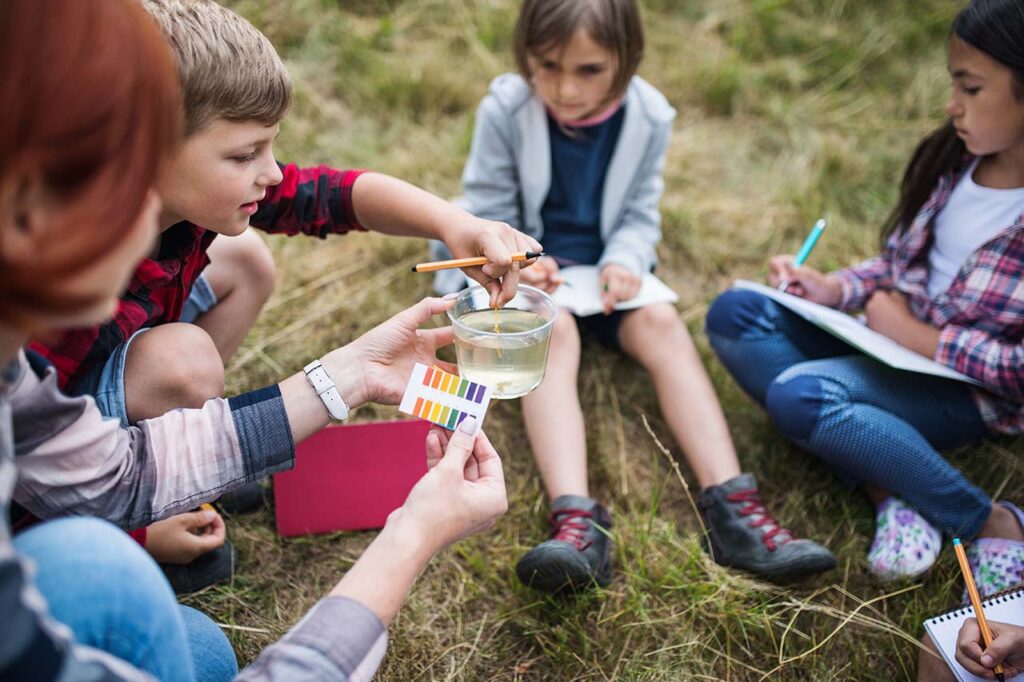
Outdoor activities there appear to be beneficial not only to children’s health but also to their overall well-being. Playing and spending time in nature—observing, running, singing, listening, and smelling—also foster a different relationship with oneself and the environment.
Nature Experiences and Child Development
Even before considering the benefits of exposure to nature for the development of future citizens in the context of global warming, time spent outdoors promotes children’s physical and mental health. For example, a causal link has been established between time spent outdoors and the prevention of myopia.
In 2008, Professor of Orthoptics Kathryn Rose assessed the average time spent outdoors by a group of Australian children (two hours on average) and then by a group of Singaporean children (only thirty minutes on average), in order to correlate these levels of exposure to natural sunlight with myopia, which was twice as prevalent among young Singaporeans.
In recent years, scientific research has also allowed us to establish a link between reduced access to natural areas and the risk of allergies and a predisposition toobesity.
Eight Proven Benefits of Nature on Learning
Research, particularly that conducted by Ming Kuo, a professor of environmental science at the University of Illinois, also highlights the benefits of being close to nature for academic success and for shaping future citizens who are responsible and committed to preserving our planet.
In a meta-analysis published in 2019, Ming Kuo and his colleagues reviewed various studies on the potentially positive roles of nature in child development.
They identified eight benefits: exposure to nature leads to improved attention, self-discipline, and interest; better physical fitness; reduced stress; and a calmer environment that fosters both greater cooperation and autonomy. The study emphasizes that these benefits were observed even when exposure to nature was limited.
[More than 85,000 readers rely on The Conversation’s newsletters to better understand the world’s major issues. Subscribe today]
For example, research published in 2016 shows that students randomly assigned to classrooms with a view of greenery perform better on concentration tests and experience lower heart rates and reduced stress levels.
Outdoor Schooling: A Long-Standing Tradition
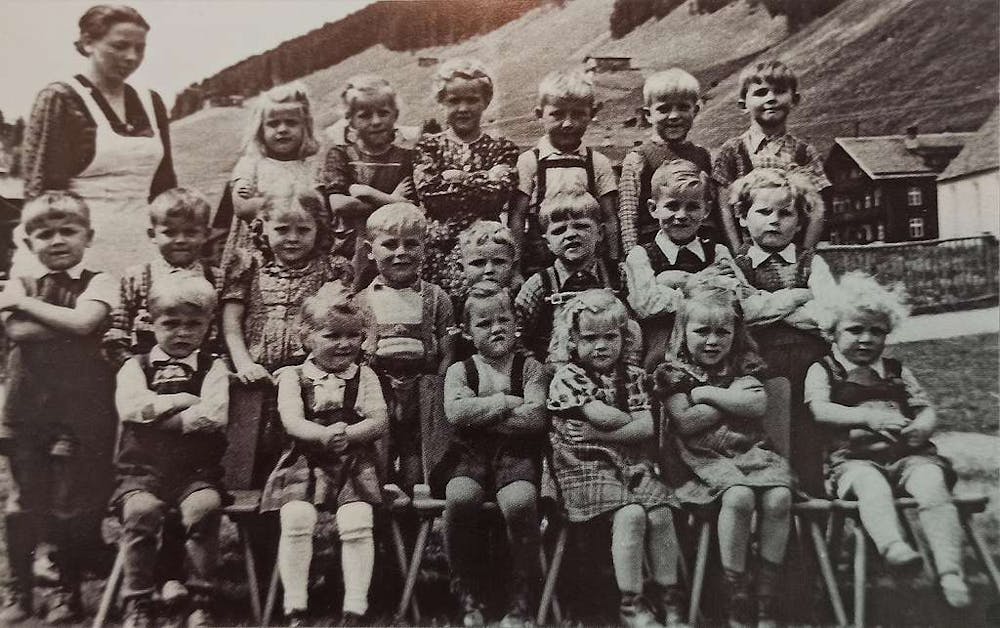
As early as the emergence of industrial and urban society in the19th century, educational reformers—particularly those associated with the “nouvelle éducation” movement—had already highlighted the need to connect with nature.
In the early20th century, the Belgian educator Ovide Decroly also made this point using a striking phrase:
"It's really cool when it rains."
During the same period, the “field trip, ” proposed by Élise and Célestin Freinet, was an educational activity that involved taking students outside the classroom to explore nature, observe, collect data, and conduct hands-on experiments, thereby integrating learning through concrete interactions with the environment. For example, during a “class-walk,” students can study the different types of trees in a park, observe local wildlife, and document their discoveries through drawings or descriptions.
A Global Trend
The benefits of an education that is more in tune with nature and more aware of climate issues have also been attracting the attention of leaders for several decades.
As early as 1975, UNESCO’s Belgrade Charter stated that a new type of education was needed in order to:
“To develop a global population that is aware of and concerned about the environment and related issues—a population with the knowledge, skills, mindset, motivation, and sense of commitment to work individually and collectively to solve current problems and prevent new ones from arising.”
Nearly fifty years later, in September 2022, the UN Summit on Transforming Education reaffirmed the crucial role of education in the era of climate disruption, proposing the establishment of a “partnership for green education.”
Seeking both to reform the educational framework (with “green schools that operate sustainably”) as part of its mission, and to incorporate “green curricula that include climate education” into classrooms through adequate teacher training, the stated goal of this partnership is to double the number of countries that include climate education in their school curricula at the pre-primary, primary, and secondary levels.
A wide range of implementations
For now, however, the situation varies greatly from country to country. UNESCO has found that more than half of the world’s school curricula make no mention of climate change, and that only 19% address biodiversity.
In recent years, however, policy decisions aligned with UNESCO’s objectives have been observed. In 2019, Italy became the first country in the world to incorporate climate change into the core curriculum of its education system, with a specific 33-hour course.
Starting in 2020, Cambodia followed suit by incorporating climate change and its study into the high school curriculum and by developing a network of pilot schools engaged in projects focused on climate-resilient agriculture.
In 2021, the Argentine Congress, for its part, passed a law requiring that environmental education be included at every stage of the school curriculum.
But such changes are not always lasting. For example, while India has long been a pioneer—with its Supreme Court’s 2004 decision to make environmental studies a required subject at all levels of the curriculum—the country has recently backtracked by removing the chapters on global warming from that subject.
PISA Assessments
Since 2006, PISA (the Program for International Student Assessment) has been assessing children’s environmental knowledge around the world. Report after report, the data collected confirm the disparities highlighted by UNESCO… and point to others as well.
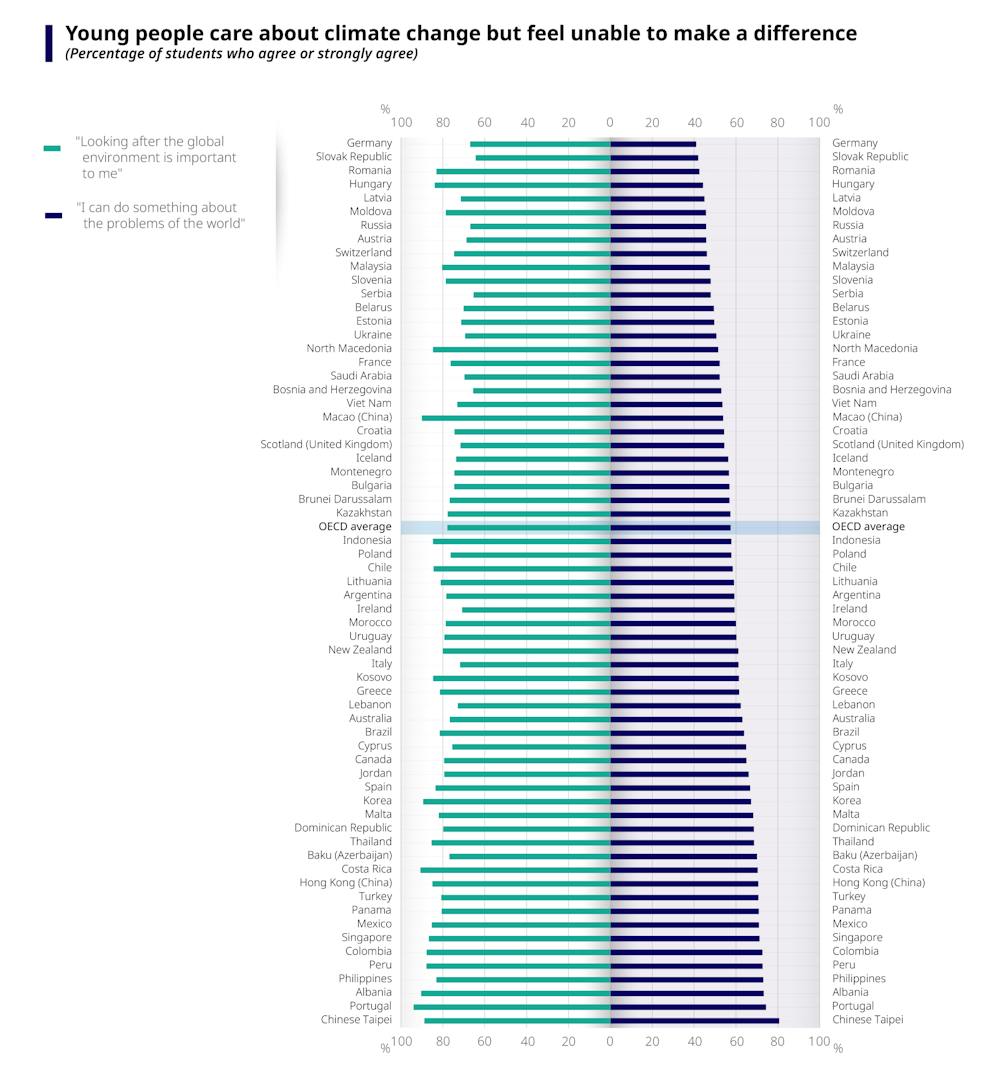
Data collected in 2018 show that while 79% of children in the 38 OECD countries say they are familiar with the topic of global warming, this figure rises to 90% in Hong Kong and drops to 40% in Saudi Arabia.
That same year, PISA also asked students whether they felt they could “do something to solve these global problems.” Fifty-seven percent answered yes. Surprisingly, the report continues, this figure does not correlate with the knowledge acquired: in the two highest-performing OECD countries—South Korea and Singapore—only 20% and 24% of the students surveyed believe they can have an impact on climate change.
The Dimensions of Age and Gender
Within a single country, awareness of global warming and the desire to take action to combat this global problem can also vary significantly depending on age and gender.
In Australia, for example, a team of researchers from the University of Sydney surveyed 1,000 urban students aged 8 to 14 and found that while one in two children said they felt “strongly connected to nature”—and were therefore inclined to engage in activities to protect biodiversity—that figure dropped to one in five once they reached adolescence.
Another difference noted by the researchers: girls show more empathy toward wildlife and, on average, have formed closer emotional bonds with plants than boys.
Eco-representatives in French middle and high schools
In France, Article 5 of the “Climate and Resilience” Act of August 2021 enshrines the fundamental role of education for sustainable development for all, from elementary school through high school. This ambition is also present at the European level: since 2022, a new competency framework, GreenComp, has been implemented to offer a new approach that “encompasses and transcends the mere preservation of the environment by reexamining the place of human beings and the meaning to be given to the development of our societies.”
During Emmanuel Macron’s first five-year term, French middle and high schools will have seen an “eco-delegate” assigned to every classroom, tasked with raising awareness about climate issues among their classmates. With the new 2019 curricula, the terms “global warming” and “climate change” have also been incorporated into high school science and Earth and Life Sciences curricula.
At the time, several voices from the research community—including that of Valérie Masson-Delmotte, a climatologist and chair of IPCC Working Group I—had deemed this development to lack ambition.
Since then, several initiatives have been launched to strengthen the tools and resources needed to adapt education to the challenges posed by climate change.
In March 2023, the report by the General Inspectorate of National Education—titled “How Can Education and Research Systems Be Both Transformed and Transformative in the Face of Climate Change?”—listed nine recommendations, emphasizing in particular the training of teachers “on the impacts of human activities on the environment as well as an understanding of the international context,” the implementation of “measures to assess the environmental impact of schools,” the “strengthening of science education” in elementary school, and the implementation of “educational projects focused on environmental themes” with a “dedicated interdisciplinary time slot.”
In the same vein, on June 23, 2023, the Ministry of National Education outlined 20 measures designed to help students better understand the challenges of the ecological transition as part of their education.
Which subjects are involved in environmental education?
On a global scale, there is growing debate over which academic disciplines should be included in environmental education. Often limited to science classes, some argue that the study of climate challenges should also be incorporated into other subjects.
Amanda Power, a historian at the University of Oxford, proposes—as she emphasized in an article published in The Conversation UK in 2020—that history curricula be updated to educate students about the origins of the climate crisis:
“One of the main problems with the public’s understanding of the current situation is that most of the information and interpretations come from the sciences. Scientists can explain what is happening and make projections for the future. Understanding why human societies have made the choices that have led us to where we are today is not part of their discipline. Yet the contemporary climate and environmental crises are the result of human activity.”
Equally strongly, Bellarmine Nneji, a Nigerian professor of philosophy of education, advocates for incorporating environmental ethics into students’ curricula to prepare them for climate challenges from an early age. In an article published in 2022 on The Conversation Afrique, he emphasized:
“Children are curious and ask a lot of questions about the world around them. This is where introducing philosophy in elementary and secondary schools could be beneficial. It would help develop children’s reasoning skills and prepare them to participate in debates and policy-making.”
According to him, teaching environmental ethics would enable younger generations to understand their rights, foremost among which is the fundamental right to inherit “a healthy and sustainable environment.”
This article is part of a project involving The Conversation France and AFP Audio. It received financial support from the European Journalism Center as part of the “Solutions Journalism Accelerator” program, which is supported by the Bill & Melinda Gates Foundation. AFP and The Conversation France maintained their editorial independence at every stage of the project.
Sylvain Wagnon, Full Professor of Education, School of Education, University of Montpellier
This article is republished from The Conversation under a Creative Commons license. Readthe original article.