Pension Reform: What Impact Will It Have on Volunteer Work?
The pension reform will have consequences for future retirees and public finances, but—and this is often overlooked—it will likely also affect nonprofit organizations.
Andréa Gourmelen, University of Montpellier and Ziad Malas, University of Toulouse III – Paul Sabatier

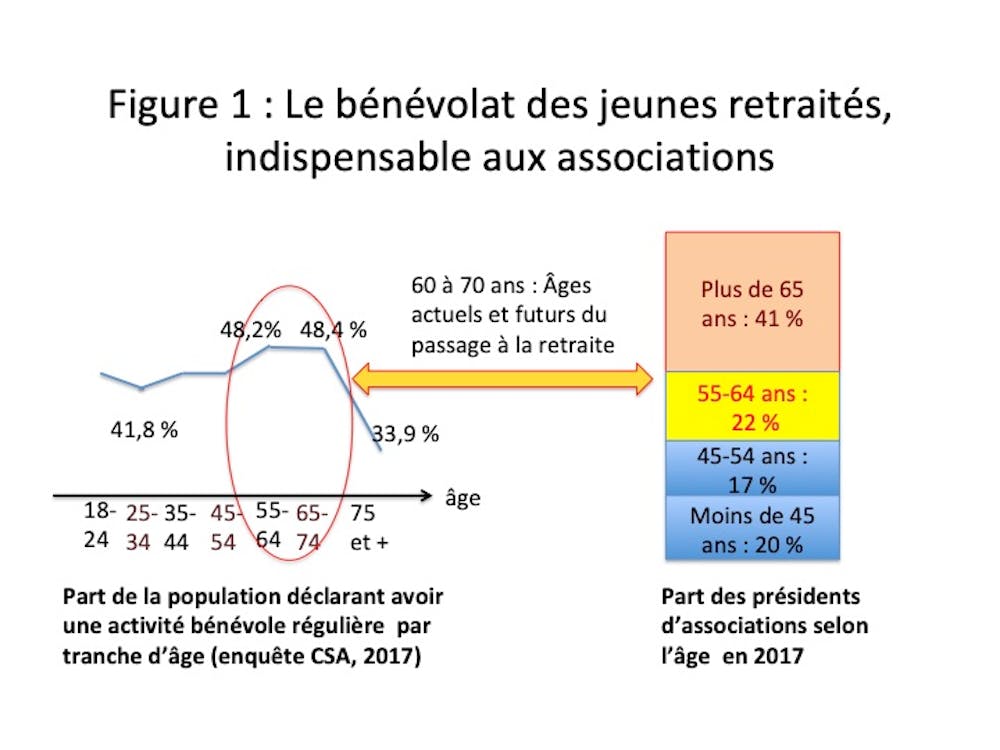
Young retirees are, in fact, a group whose available time and health status make them significantly more likely than average to engage in volunteer work.
This is reflected in a high percentage of volunteers among those aged 55–74—48.3 percent—as well as in longer hours spent volunteering (58 percent of those over 65 who are involved in an organization devote more than five hours a week to it) and in their key roles in leading these organizations, as shown in Figure 1 (based on the work of Viviane Tchernonog and Lionel Prouteau).
Andrea Gourmelen/Ziad Malas, Author provided
While many details of the future law have yet to be finalized, its main principles and part of the implementation schedule are already known: it will be introduced in the chamber starting Monday, February 17, and a final vote will take place before the end of the parliamentary session by summer 2020.
Is the French nonprofit sector drying up?
Some of these principles may contribute to a decline in the pool of volunteers for nonprofit organizations. Beyond the discussions about the “pivot age,” the future law grants employees greater freedom in choosing their retirement age and encourages them to remain in the workforce longer. If retirement begins later, logically, this should result in less time available for volunteer work.
From a statistical standpoint, this line of reasoning is open to debate due to the increase in life expectancy and the less pronounced increase in healthy life expectancy.
But the logic of shifting life stages comes up against the inertia of perceptions and emotions associated with age and the time we have left to live. Thus, taking into account what researchers call “ultimate time pressure” (UTP)—that is, the pressure we feel as time passes—also becomes a matter of the time we have left. This is, in fact, one of the keys to understanding retirees’ volunteer engagement.
Future retirees under the universal pension system are 45 years old at most today, and are probably not yet thinking about what they’ll do in retirement… But what about between now and then? The economic and social situation will also have changed the values and priorities of future generations of retirees.
Nevertheless, it is possible to envision potential scenarios that will begin to affect volunteerism within the next 10 years, based on the profiles of current retired volunteers that we examined in a previous article published in 2014. These profiles are characterized in particular by their ultimate time pressure and their generativity —that is, their degree of concern for future generations.
Will volunteers who care about future generations work longer?
These profiles account for approximately 38% of retired volunteers, who appear to be deeply affected by negative emotions related to the end of life and the time they have left to live. They fear the approaching end of life and the process of aging. Volunteering is thus a way for them to counter the passage of time and to make themselves indispensable in order to gain a certain degree of recognition.
Thus, they first seek to build a reputation during their lifetime, in order to transform that reputation into a popularity that will endure beyond their death. Leadership roles and positions that involve being in the public eye seem to particularly resonate with their motivations.
With the current reform, their careers may be extended. As a result, to align with their ambitions, they may prioritize professional opportunities over volunteering as a “second career.” The new financial incentives will reinforce this choice. Furthermore, getting involved in an organization later in life would leave them less time to dedicate to it and move up the organizational hierarchy, which could lead to frustration among these individuals and create a gap in the organizational hierarchy.
We can therefore expect them to place greater emphasis on their careers (working as long as possible) in order to gain recognition more quickly, since retirement may be seen as a sign of aging that causes them anxiety.
Volunteers at Fault: Is the Number Declining?
These retirees volunteer out of a sense of moral duty and demonstrate true selflessness. Feeling guilty for having had a good life or for having been privileged, their generativity leads them to get involved in society for as long as they can. The self fades away in favor of others and the community.
Volunteering thus becomes a way for them to give back to society what it has given them. Isn’t there a risk that this profile—which accounts for about 13% of current retired volunteers—will disappear among future generations of retirees? Will this selflessness—linked to the need to give back to society what it has given us—remain as strong if working longer and the fear of a lower standard of living lead us to believe that society takes more from us than it gives?
Generational guilt may thus give way to individual guilt (the feeling of having fared better than others in one’s generation), at least for the 1975–1985 generation, which corresponds to the transition period between pension systems.
Indeed, this generation may feel neglected and, as a result, at a disadvantage compared to the baby boomer generation (which remains a significant demographic, accounting for nearly 24% of the French population). The reform could thus widen the generational divide and reinforce the perception that “boomers” are privileged, as is the case with the “OK boomer” phenomenon on social media.
This could lead to difficulties in the very areas where this profile is most suitable: charitable organizations or volunteer-based social service roles such as providing a listening ear to people in need, assisting with reintegration, or distributing food.
Hedonists and Emotionalists: Toward New Time Trade-offs?
These “hedonistic and emotionally driven” profiles alone account for about half of all retired volunteers. They include retirees who have freely chosen volunteering as a fun activity, one that allows them to discover new opportunities while building relationships with others. While they are not necessarily concerned about the future of subsequent generations, they nevertheless enjoy interacting with a variety of people through their volunteer work. Indeed, for them, it’s about making the most of the time they have left to live. They feel little anxiety about the fact that their time is limited.
At first glance, pension reform seems to have fewer consequences for these individuals, given how strong the enjoyment associated with volunteering appears to be. However, retiring later in life may lead to a greater sense of pressure regarding the time remaining to live once one stops working. This could lead to an increase in negative feelings about the time remaining (stress, bitterness) and, consequently, more difficult decisions regarding how to allocate that remaining time. A shift toward spending more time with family or on leisure activities at the expense of volunteer work might be a possibility.
Pxhere, CC BY
From “young retirees” to “active seniors”
While the reform will allow those who have worked in demanding jobs (physically demanding, high-risk, or shift work) to retire earlier—and although the definition of “demanding work” is still under review—it is important to keep in mind that these jobs generally require only a short period of education.
However, retirees involved in nonprofit organizations generally have a high level of education (compared to the average level of education for their generation). As a result, future retirees who might be interested in volunteering are likely to be increasingly older (since they have spent many years in school, they may not identify with the concept of physically demanding work) and may ultimately come to believe that they are too old to volunteer.
Should organizations therefore target individuals who are eligible for early retirement? Not necessarily, because their past working conditions may affect their perception of how long they have left to live in good health and lead them to think, “I’m too tired, too worn out to work—and therefore… to volunteer.”
Therefore, rather than targeting “young retirees”—who may perceive themselves as “too old” or “not healthy enough” depending on their previous occupation—organizations might be better off focusing on active seniors. This would help them anticipate their objections.
The Need for a Thoughtful Commitment
For several years now, France Bénévolat has emphasized that successful volunteering stems from a thoughtful commitment. And what better way to ensure that commitment is thoughtful than to prepare for it before retirement? In addition, we know that among the working population, those over 50 are the most likely to volunteer, largely because they no longer have young children to care for.
We could also add that between the age of 50 and retirement, financial pressures are less intense. Therefore, provided that anxiety about pension amounts is alleviated, this population will be receptive to volunteer work—a commitment that will continue into retirement and will be accompanied by another key resource for nonprofit organizations: the donations.
Andréa Gourmelen, Associate Professor of Management Science (Marketing), University of Montpellier and Ziad Malas, Associate Professor of Management Sciences, University of Toulouse III – Paul Sabatier
This article is republished from The Conversation under a Creative Commons license. Readthe original article.