Science-Society Relations: “It’s our role to plant the seeds”
Listen to science stories about the work of researchers at the University of Montpellier, take part in a science-themed geocaching game, or go on a geolocation-based walking tour… All of this will soon be possible thanks to the “Science with and for Society” label awarded to theUM for its “ UM VIA des sciences” project, which received 680,000 euros in funding from the Ministry of Higher Education and the “ Research.”
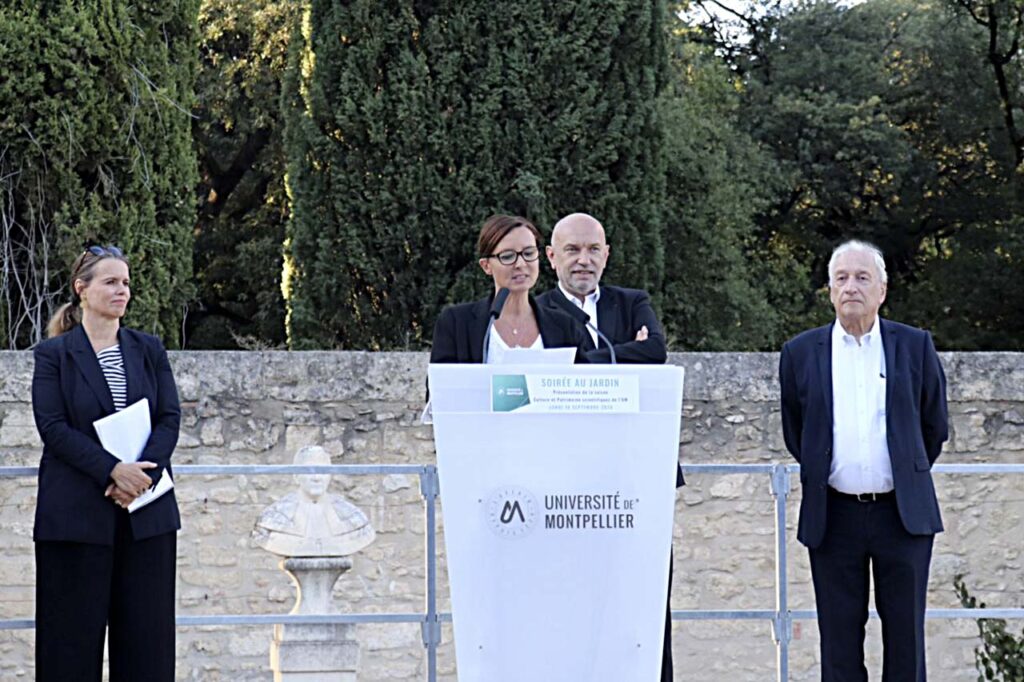
Isabelle Parrot received some very good news at the end of June. The vice president for science-society relations learned that the University of Montpellier had just been awarded the “Science with and for Society” (SAPS) designation.“This designation recognizes and rewards all the work our university has already done to promote scientific culture at the regional level,” said Philippe Augé, president of theUM.
An Innovative Partnership
The 2021 Research Programming Act is the first to aim to make the relationship between science and society a fully-fledged dimension of scientific activity.“While the term ‘popularization’ has given way to a less pejorative and more inclusive term—the dissemination of scientific, technical, and industrial culture—this concept is now included, along with collaborative research, under the term ‘science with and for society ,’” explains Isabelle Parrot. To distinguish strategic projects from those at universities, the ministry then established the SAPS label.
Although the “UM ” fell just short of the podium in its first two bids, the third time was the charm with the “UM VIA des sciences” project. Its strength lies in an innovative partnership with the Montpellier metropolitan area, the result of“extensive discussions with the management of the media library network and the scientific culture department, as well as the department responsible for environmental education—and thus with the zoo and the eco-library,” the vice president enthuses.
Via Domitia
With funding of 680,000 euros over three years, this designation will enable the “UM ” to strengthen existing initiatives and ensure the long-term viability of new ones.“The name ‘ UM VIA des sciences’ refers to the famous Via Domitia, which crosses the region and was the source of numerous cultural, scientific, and technical exchanges that shaped the future of knowledge and culture.” TheUM ’s project aims to carry forward the same ambition of developing scientific culture in the region and is structured around three pillars: visibility, momentum, and inclusivity and boldness.
To ensure the visibility of the sciences,“a map of key personnel involved in the science-society relationship will be created, in coordination with the research skills map that will be established by the Structural Programs Directorate. This will be accompanied by an annual seminar that will serve as an opportunity to highlight that we offer training in science communication,” explains the vice president, who also proposed the creation of a SAPS UM award designed to recognize the involvement of research staff in the dissemination of knowledge.
The project also aims to create a schedule of scientific, technical, and industrial outreach activities aligned with the metropolitan area’s participatory agenda to enhance “the impact and visibility of these initiatives.”
Drive and Inclusivity
The second goal of the VIA des sciences “ UM ” project isto “strengthen established and emerging initiatives in scientific, technical, and industrial culture, as well as participatory science, aimed at young children, such as LitterNature, Nounours, Univerlacité or the “Cordées de la Réussite” .” With a threefold goal: to combat skepticism toward science, to inform public debate, and to reinforce the idea that science is a common good that contributes to social cohesion.
“We want to move toward greater inclusivity in the dissemination of knowledge by reaching new audiences,” emphasizes Isabelle Parrot. Who? Residents of working-class neighborhoods who don’t actively seek out science, or areas geographically remote from major cities, such as Lozère, France’s least populous department.“By launching traveling science outreach programs, the university is bringing science to them.”
Moving toward greater inclusivity also means improving access to theUM ’s flagship events—for example, by providing sign language interpretation for most of the Science Bars, compared to just two today, or for films at the Sud de Sciences festival.
Boldness
The third pillar of the “ UM ” project—VIA des sciences—which will account for the largest share of this new budget, is boldness.“In a metropolis where 50 percent of the population is under 34, it is our role as a university to sow the seeds and dare to experiment with innovative approaches,” emphasizes Isabelle Parrot.
The first bold project: translating researchers’ work into stories.“In a post-COVID era where researchers are held accountable, we propose that research tell stories.” Once upon a time, there was research on…“feeding, caring for, and protecting—we chose to base our science stories on the three pillars that define our research identity.”
Scavenger Hunt
For older children, “ UM ” VIA des sciences is launching a geocaching project designed for teens and families and inspired by the famous game Cluedo.“Except that instead of Colonel Mustard, we’ll have renowned scientists who will be found not in the office or the library but in the botanical garden or on the Alexander Grothendieck Plaza, for example.” A life-size scavenger hunt that can be offered by the Tourist Office or even used by schools.
The third and final of these ambitious projects is the creation of a geolocation-based walking tour, aimed primarily at students and young adults, featuring science quizzes created by students for students, under the guidance of their Professors.
Radiation
“All of these projects, developed in collaboration with our partners in the metropolitan area, are intended to be implemented and sustained beyond the ‘Science with and for Society’ designation,”explains Isabelle Parrot, who looks not only further into the future but also further afield, hoping that these projects will extend beyond the region and be adopted nationally, or even internationally.