Risks of Conflict Between Fishing and Carbon Sequestration in the Ocean
An international team led by researchers from the University of Montpellier, the CNRS, and the University of California has mapped areas of potential conflict between two major ways in which the ocean benefits human societies: fishing and carbon sequestration. With just a few months to go before the opening of the3rd United Nations Ocean Conference, to be held in Nice in June 2025, their research—published in the journal *One Earth*— offers innovative approaches to adapting fishing practices.
Fishing and Carbon Sequestration in the Ocean: A Long-Neglected Link
On land, the impact of agriculture on forests as carbon sinks is now well understood. In contrast, the link between fishing and carbon sequestration by the oceans remains less well understood. Through their carcasses and the carbon-rich feces they produce—which sink into the abyss—fish play a direct role in carbon sequestration in the deep ocean. Ocean sediments, for their part, store vast quantities of carbon accumulated over time—a form of carbon known as “blue carbon.” The problem is that fishing—by removing large quantities of fish and damaging the seafloor through techniques such as bottom trawling (a method that involves dragging a trawl net in direct contact with the seabed)—drastically limits the oceans’ ability to sequester this “blue carbon.”
While the conflict between blue carbon and the socioeconomic benefits of fishing (jobs, food security, etc.) has been highlighted for several years, the size and location of these potentially conflicting areas were unknown until now. This new study reveals that these areas cover 15% of the ocean, spread across international waters and coastal regions.
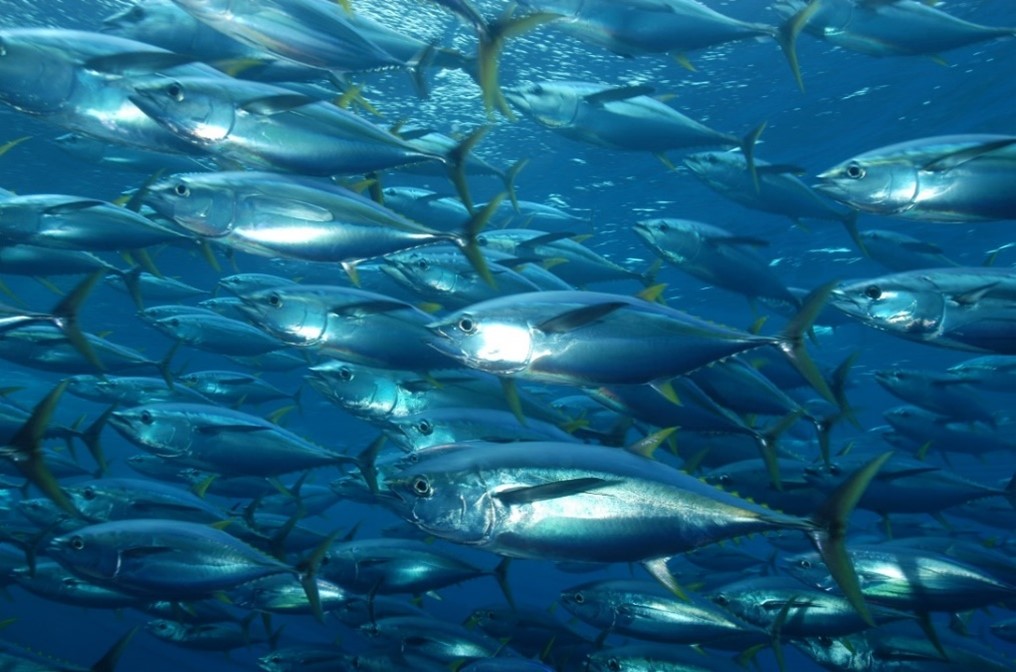
Fish play a crucial role in the ocean’s carbon cycle, contributing directly to carbon sequestration in the deep ocean through the regular production of carbon-rich fecal pellets and carcasses that sink into the abyss, thereby trapping the carbon they contain for several centuries. © IRD – Ifremer
International waters: a major conflict zone
International waters—which are not under the direct authority of any state and where high-seas fishing takes place—account for nearly 50% of the conflict zones identified in this study. “However, other studies have shown that deep-sea fishing is recognized as contributing very little to global food security because it is primarily conducted by developed countries that do not face food insecurity,” the study’s authors explain. “Our study therefore provides an additional argument for applying the precautionary principle—that is, limiting high-seas fishing until its impacts on carbon sequestration are assessed,” they conclude.
Benthic Trawling and Carbon Sequestration: A Coastal Conflict
While protecting the high seas will have little impact on global socioeconomic goals such as food security, the situation is quite different when it comes to bottom trawling in coastal waters. In fact, although the areas where carbon sequestration in sediment and bottom trawling conflict cover only 3.8% of the ocean, more than 56% of bottom trawl catches occur there. “This shows that significant conflicts can arise if these areas are protected from trawl fishing. These conflicts are all the more significant when the identified areas involve countries facing food insecurity,” the researchers explain.
Solutions are available
The study shows, however, that solutions do exist. “Let’s take a simple example. The Argentine coast is identified as a conflict area because it is of critical importance for carbon sequestration in the sediment, but also for trawl fishing. However, certain species can also be caught using gear that does not come into contact with the sediment. This is the case, for example, with Argentine hake, which is typically caught using bottom trawls that come into contact with the sediment, but can also be caught with pelagic trawls or by line fishing. “Thus, changing fishing methods would make it possible to maintain the jobs and socioeconomic benefits derived from Argentine hake fishing, while preserving the carbon stock in the sediment,” the study’s authors explain.
Practical Information
- Publication date: March 26, 2025
- Read the full article