[LUM#3] Under Safer Skies
Even more reliable airplanes: that’s what researchers promise at EuroMov. These motion specialists are tackling a pilot’s arch-enemy: spatial disorientation.
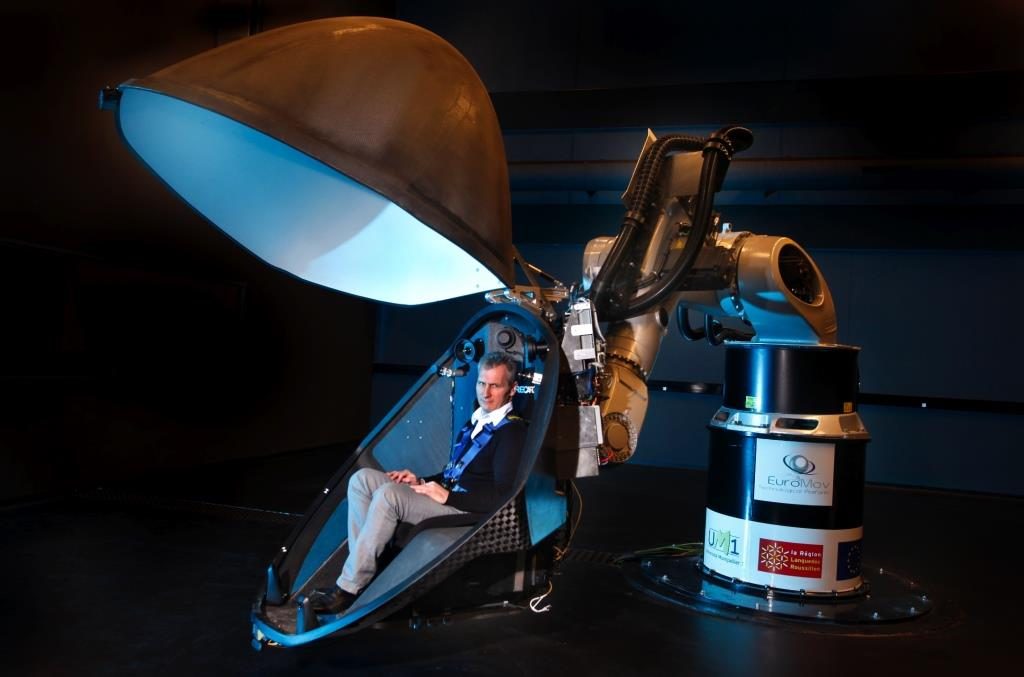
of a robotic arm and a cockpit. © Patrick Aventurier
Can you tell up from down? Can you tell the difference between going up and going down? Yes, of course! It’s easy when you have both feet on the ground. But it’s harder when you’re at the controls of an airplane or a helicopter…“The senses we rely on to maintain our balance and distinguish up from down are no longer reliable when we’re in motion without an external reference point,” explains Benoît Bardy.
This sensory confusion can cause the pilot to have a distorted perception of his position and movement relative to the Earth. He then suffers from “spatial disorientation.” This phenomenon is still poorly understood and has serious consequences: 15 to 20 percent of airplane accidents are believed to be attributable to it.
Upside Down
To study this phenomenon, Airbus and Onera, the French aerospace research center, turned to researchers at EuroMov, the European center for research on motion, and its specialists in spatial orientation.
“We have a simulator—the only one of its kind in France—called iMose, which allows us to put airplane and helicopter pilots in simulated situations to analyze their reactions,” explains the director of Euromov.“They wear a virtual reality headset to replicate real flight conditions as faithfully as possible,” adds Jérémie Landrieu. And they’reequipped with sensors to measure their stress levels, brain activity, and even their eye movements.
Safer Flights
The goal of this project, known as CoSenses, is to improve flight safety.“A better understanding of spatial disorientation will enable us to develop solutions to mitigate the risks and reduce the number of accidents,” emphasizes Benoît Bardy.
And there are many potential solutions being discussed: improving the training programs used in flight schools, modifying cockpit ergonomics, and optimizing human-machine interfaces.“This is an important issue because, in the event of spatial disorientation, there can be a discrepancy between the sensations experienced by the pilot and the information provided by the flight instruments,” explains Jérémie Landrieu.
“The three-year CoSenses project will develop a prototype for a new human-machine interface,” explains Benoît Bardy. This is good news for the approximately three billion passengers who fly each year. Air travel is already the safest mode of transportation, ahead of rail… and far ahead of road travel, which is responsible for 1.24 million deaths each year, according to the World Health Organization.
See also:
Check out theUM podcasts, now available on your favorite platform (Spotify, Deezer, Apple Podcasts, Amazon Music, etc.).