Spirus Gay, the anarchist acrobat who turned his life and his body into a political statement
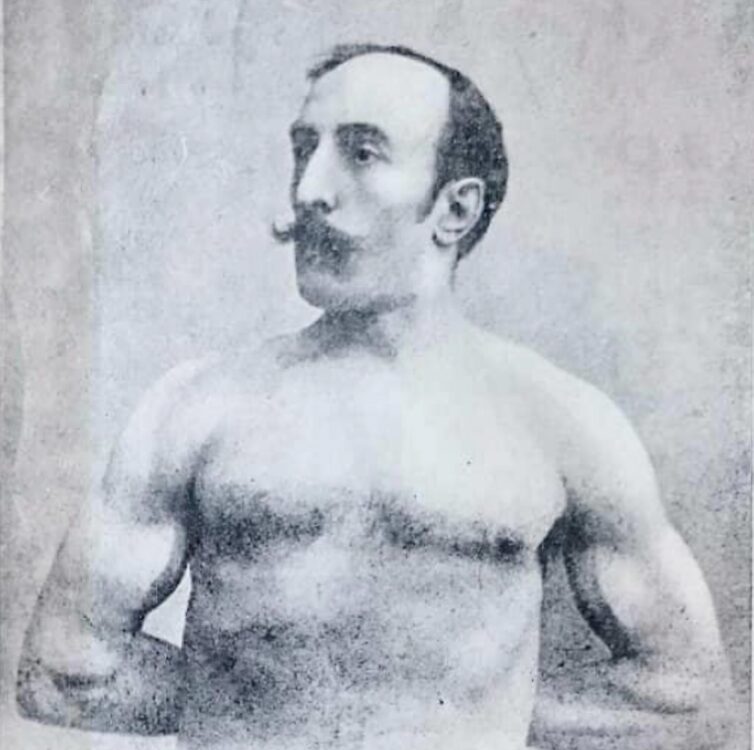
Spirus Gay (1865–1938), a circus performer and anarchist activist, embodies a rare figure of the early20thcentury: one of total commitment, blending art, the body, ethics, and politics. Defying rigid categories, his life reflected a joyful, coherent radicalism, where acrobatics went hand in hand with education, naturism with unionism, and polemics with solidarity.
Sylvain Wagnon, University of Montpellier
How can we define Spirus Gay? Acrobat, juggler, tightrope walker, anarchist, union activist, free thinker, pamphleteer, naturist, Freemason, but also educator… Joseph Jean Auguste Gay, known as Spirus Gay (1865–1938), defies any attempt at classification. His multifaceted life embodies a rare example of total commitment, in which body, mind, art, and political thought intertwine to challenge and subvert established norms.
It is through this coherent interplay between physical action, intellectual engagement, and radical activism that a truly unique path begins to take shape.
In our compartmentalized and fragmented society, would there still be a place for someone like Spirus Gay today?
Why write about Spirus Gay?
For a historian, writing about such a figure is a challenge. At first glance, there is little evidence. He left behind no major works or famous manifestos. He did not edit an influential newspaper or found a theoretical school of thought. And yet, he is there, implicitly, in the margins and interstices of the history of French anarchism. As an activist, he took part in the struggles, battles, experiments, and utopian visions of the latenineteenthand earlytwentieth centuries.
His journey embodies a way of living anarchism: in the body, in action, and in the harmony between personal life and individual and collective commitment. Because it illustrates that rare coherence between the ideas one defends and the life one leads. Because it forces us to rethink categories: artist or activist? Intellectual or manual laborer? Thinker or educator?
Much like biographical work on women’s history, the challenge is to move beyond conventional genre conventions, to resist the temptation to oversimplify, to present a linear narrative, or to do a disservice to a life so rich and multifaceted. Conversely, the goal is not to construct a legend, but to understand—through primary sources and historical rigor—what this unique life can tell us today. To piece together a puzzle from scattered archives and forgotten journals, from aphorisms and articles by Spirus Gay, from tenuous traces (more than 600 mentions in the press of the time, and some fifteen signed texts, nonetheless). To write without glossing over the contradictions, the gray areas, and the silences.
An accomplished artist
A leading figure in late19th-centuryParisian music hall, Spirus Gay embodied the versatile artist: a tightrope walker, power juggler, illusionist, ventriloquist, and magician, he performed on Parisian stages, from the Folies-Belleville to the Folies Bergère. Caught between the fringes of society and mainstream culture, behind the glamour of the posters and titles such as “king of tightrope walkers” or “world champion” of bodybuilding, lies a far harsher reality.
Like many variety performers, Spirus Gay lives in a state of constant uncertainty, dependent on his performance fees, vulnerable to injuries, on-stage accidents, and life’s hardships. On several occasions, the activist and artistic community has had to organize fundraisers to support him, repair his damaged equipment, or help him cope with illness.
This precarious situation does not prevent him from fighting on many fronts for the recognition of “performing artists.” Spirus Gay is passionately committed to defending artists’ rights, viewing them as an integral part of the working-class experience.
As early as 1893, he served on the union council of the Union of Dramatic Artists, and in 1898, he became secretary of the Artistic Union of the Stage, Orchestra, and Circus. This role allowed him to organize collective actions that combined concerts with militant solidarity. As a spokesperson, he defended opera artists and advocated for direct action against employer abuses.

A self-taught writer, Spirus Gay also publishes in the newspaper the Workers’ Party, the official organ of the Revolutionary Socialist Party, about ten articles outlining his vision of society and the world. These writings, mostly aphorisms —a unique literary genre —reflect on his own education and upbringing. The apparent astonishment at this union of body and mind stems, even today, from deeply entrenched prejudices that draw a line between the entertainer and deep, sustained political commitment, as well as a hierarchy between intellectual and manual labor.
Holistic Education as a Revolutionary Project
Spirus Gay is also an educator, a direct heir to the educational principles championed by the libertarian educator Paul Robin beginning in 1869. For Robin, holistic education rests on a simple yet profoundly subversive principle: rejecting the separation between the intellect, the body, and the emotions. Developing “the head, the hand, and the heart” in a harmonious way would free the individual from the alienation produced by schools deemed authoritarian, by factories, by the Church, or by the state.
Spirus Gay applied this principle both in his personal life and in his educational practices. The gym he founded in Paris in 1903, the Végétarium, became a space for educational experimentation and training in freedom, where physical culture, vegetarianism, “mind-body” education, and a healthy lifestyle came together as tools for emancipation. For him, acrobatics became a political act, and movement a philosophy of resistance. Education, viewed as a continuous, lifelong process, was as much about the development of the mind as it was about that of the body. As a libertarian naturist and activist, he helped found the first naturist community in Brières-les-Scellés, in what is now the Essonne department, and campaigned against the ravages of alcohol.
A Thinker on Political Altruism
A free thinker, anticlerical, atheist, and Freemason, Spirus Gay also embodied a humanist intellectual commitment, fueled by the ideals of freedom of conscience and individual and collective emancipation. “I believe in divine equality in a society without religion or masters, ” he wrote in 1894.
His writings outline an ethical, committed, and radical philosophy. In them, he advocates for a society based on equality, justice, the rejection of authority, and a relentless struggle against capitalist selfishness.
For him, altruism is not a moral stance, but a political weapon: a way to defuse the violence of a world based on exploitation and competition. This idea is reflected in the conceptof “effective altruism,” as defined by the philosopher Peter Singer.
The Subversive Power of a Life
Spirus Gay cannot be summed up. He defies classification and rejects labels. And that’s just as well, because we should be wary of pantheons: they freeze in time what they celebrate.
His life’s journey is ultimately a proposal: that of a radicalism that is both embodied and consistent. His life offers constant resistance to compartmentalization, hierarchies, and identity-based categorizations. It brings together aesthetic expression, intellectual rigor, and social commitment.
Spirus Gay takes an in-depth look at the ways we live out our ideas: how can we avoid separating our convictions from our daily lives, our politics from the way we live, eat, and breathe? His journey is an invitation to think, to fight, and to live.
Sylvain Wagnon, Full Professor of Education, School of Education, University of Montpellier
This article is republished from The Conversation under a Creative Commons license. Readthe original article.