[LUM#21] Tracking Down Viruses: A Painstaking Task
When we think of the inhabitants of tropical forests, we think of jaguars, leopards, and all kinds of monkeys. Or birds and reptiles, such as toucans and chameleons. But there are also tiny, tiny inhabitants living there by the millions. These are viruses—a growing source of concern for human health—which virologists Eric Leroy and Philippe Roumagnac are studying closely with the help of ants.
COVID-19, Ebola, HIV. But also hepatitis, measles, and mumps. These infectious diseases have one thing in common: they all originate in animals, as do three-quarters of the epidemics that affect humans. “These are what we call zoonoses. The viruses responsible for these diseases are originally hosted by animals and have been transmitted to humans, ” explains Eric Leroy, a virologist at the Infectious Diseases and Vectors: Ecology, Genetics, Evolution, and Control (Mivegec) laboratory1.
While these viruses may originate from farm animals, they most often come from wild animals, which live primarily in tropical forests. “On the one hand, because these are the areas with the greatest biodiversity, and on the other hand, because certain sociocultural practices increase contact with wildlife, which facilitates transmission to humans, ” explains Eric Leroy.
A Public Health Issue
Studying these viruses hidden in the forests has therefore become a public health issue. “We need to be able to conduct early surveillance at the animal reservoir level before the viruses jump to humans, ” explains the virologist. But how can we learn more about the tiny inhabitants of these vast, impenetrable forests?
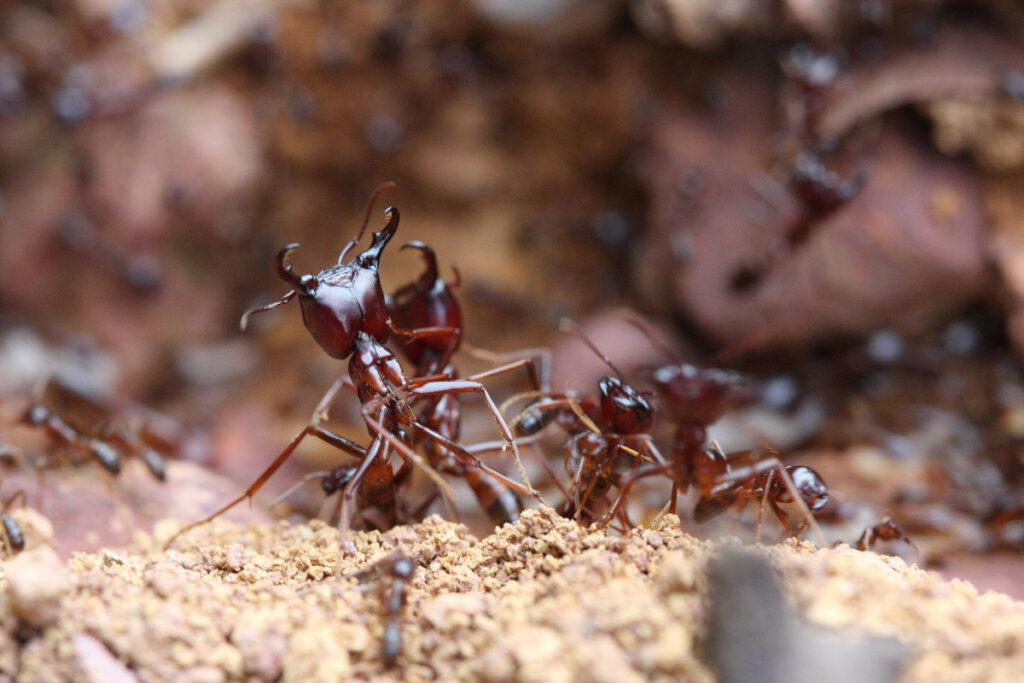
Eric Leroy, who knows tropical forests well having lived and worked for many years in Gabon and the Congo, and his colleague Philippe Roumagnac, a virologist at the Montpellier Institute of Plant Health (Phim), came up with an idea. Since it’s impossible to capture, collect, and analyze all the animals and plants that inhabit the forests to study their viruses, why not let others take care of this valuable sampling? These others make up an entire army of tiny insects unlike any others: army ants, or magnan ants.
These carnivores prey on anything that falls into their jaws: from arthropods and other invertebrates to small animals such as birds, reptiles, or small mammals. “They’re known for the spectacular raids they carry out in columns of millions of individuals stretching for several dozen meters,” says the virologist. Not picky eaters, these nomads will also consume the carcasses of large animals when the opportunity arises, hence their nickname, “Africa’s garbage cans.”
“We therefore hypothesized that these magnan ants might absorb and accumulate viruses carried by the hosts they consume, whether plants, invertebrates, or vertebrates. ” By analyzing genetic material from the ants, the researchers hope to identify the viruses with which they have come into contact and thereby gain a better understanding of what they call the virosphere of tropical forests.
Pilot Study
To test this hypothesis, Eric Leroy and his colleagues conducted a pilot study. They collected 209 ants from about 30 colonies in northeastern Gabon and analyzed each of these insects using a viral metagenomics approach. “We extract all the genetic material—DNA and RNA—present in a sample—in this case, the ant—to analyze the portion corresponding to the total viral genome, which includes not only the ant’s own genome but also genetic material from the animals or plants it has consumed, ” explains Eric Leroy.
The researchers detected an exceptional number of genomic sequences, 46,000 of which were similar to sequences from viruses, bacteria, plants, invertebrates, and vertebrates. “A veritable Aladdin’s cave, ” enthuses Eric Leroy. A cave that also holds a few surprises : “Only half of these sequences corresponded to recognized viral genera, which means that in the forest ecosystems inhabited by ants, there are likely a great many viruses that are still unknown.”
Sentinel Ants
While researchers will conduct larger-scale studies, these preliminary results already demonstrate that the idea is sound. “Not only would this method provide a better understanding of the virosphere and help map the presence of viruses in a given area, but we could also consider establishing a system to monitor these zoonotic viruses before they are transmitted to humans,” explains the researcher, who envisions, for example, collecting army ants monthly at specific locations to identify the viruses present there.
“If problematic viruses reach a critical threshold, measures could be put in place,” Eric Leroy speculates. These six-legged sentinels would thus help with early virus surveillance, making it possible to predict, anticipate, and prevent the emergence of diseases and epidemics “of which we are still too often mere spectators, stunned and powerless, ” the researcher concludes.
Check out theUM podcasts, now available on your favorite platform (Spotify, Deezer, Apple Podcasts, Amazon Music, etc.).
- Mivegec (CNRS, UM, IRD)
↩︎