[LUM#14] A Grain of Salt in the Eternity of the Pharaohs
Salt for preservation? Not always… And that is precisely the problem facing the pharaohs Osorkon II and Psusennes I, whose legacy is now under threat. Their tombs, located in Tanis in the Nile Delta, are suffering damage due to the presence of salt water in their masonry. Where does this water come from? It’s a mystery that Séverin Pistre, a researcher at Hydrosciences Montpellier*, has set out to investigate.
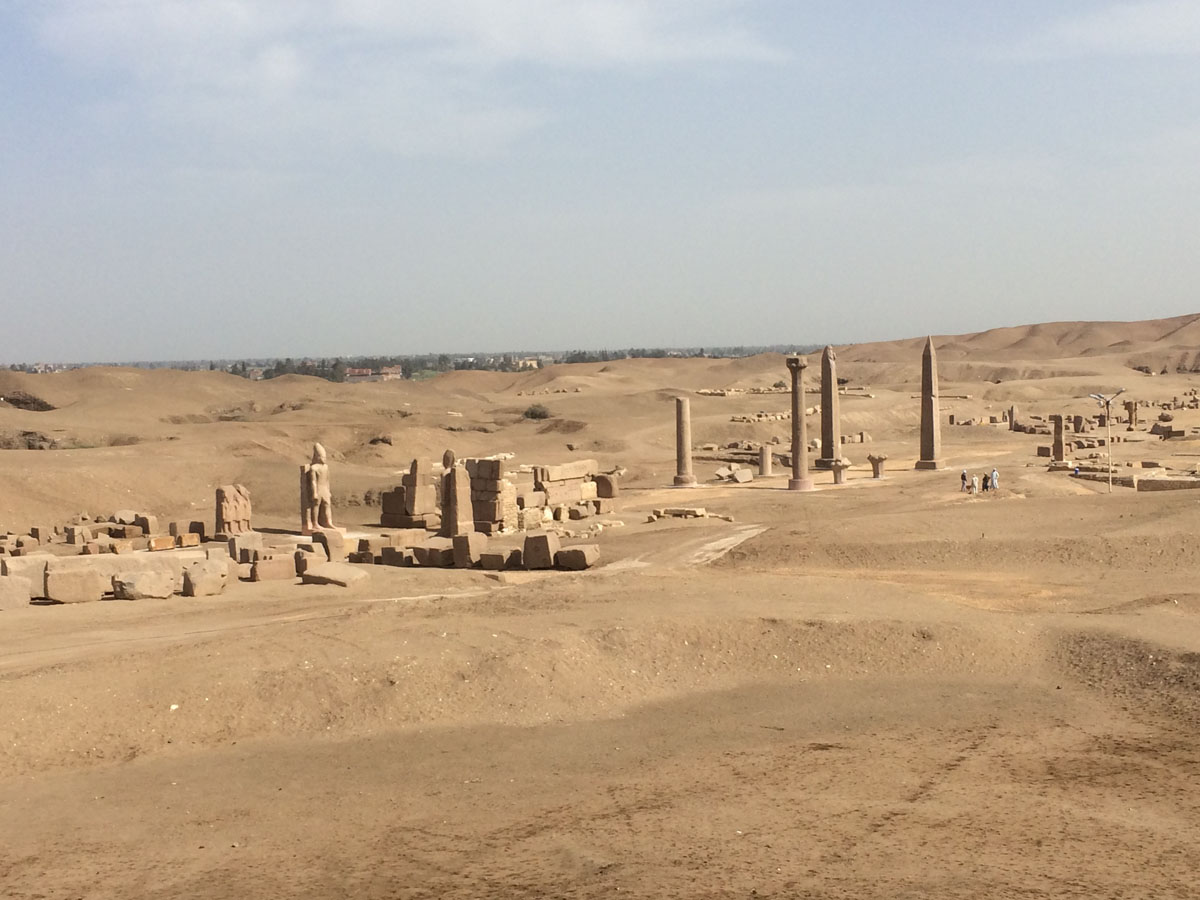
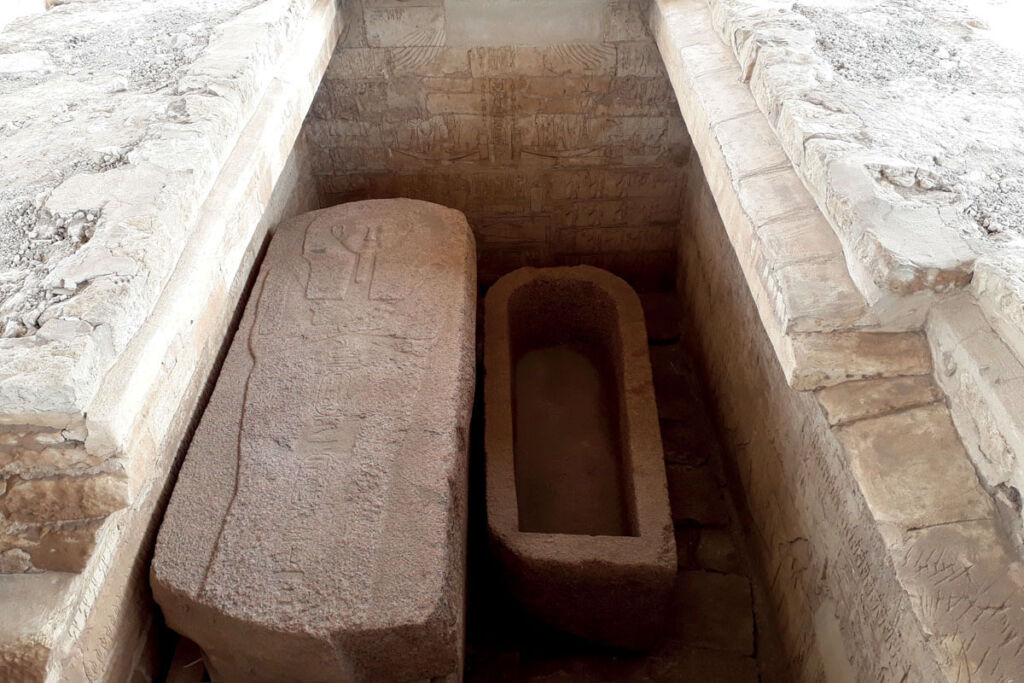
“Obelisks, enormous blocks of granite, and colossal stone figures barely raising their heads above the sand that stretches as far as the eye can see.” Welcome to the royal necropolis of Tanis, located in the heart of the Nile Delta, the eternal resting place of Pharaohs Osorkon II and Psousennes I. These 3,000-year-old tombs are threatened by saltwater seepage, which is causing the engravings and paintings that adorn them to deteriorate, as well as eroding the blocks and mortar joints that hold them together. This is a tragedy for history, and the solution is far from obvious.
In the middle of the desert and nearly 25 km from the sea, the origin of this brackish water raises questions. To solve this mystery, Séverin Pistre, a researcher at the Hydrosciences Montpellier laboratory, set off for Egypt, with many questions and a few hypotheses in mind. “It all started with a curator at the Louvre Museum who, faced with this conservation challenge, thought it was necessary to study the water at this specific site—that is, both surface runoff from rain and the possibility of a groundwater table beneath the tombs,” he explains.
The Testimony of the Sand
To test these hypotheses, the hydrogeologist started from scratch—or nearly so—with just a few handfuls of sand collected from the site. Deeper down, there was yellow sand corresponding to the ancient dune. “We call it ‘ghezira.’ It’s a type of sand typical of these sites that is highly permeable to water and in which the water table could be found.” Closer to the surface, there is brown sand “that is highly impermeable, allowing rainwater to flow over it and runoff to reach the water table, thereby raising its level,” explains Séverin Pistre.
To verify the presence of this underground aquifer, the researcher went a step further. At exactly 27 meters deep, using piezometers—small devices equipped with electrodes that can detect the presence of water underground and measure its level. This work was made easier by the existence of old boreholes on the site, dating back to an operation conducted by Egyptian authorities about fifteen years earlier.“ Thanks to several measurement points, we were able to confirm the presence of the aquifer less than one meter below the tombs. From there, we were also able to study the direction of water flow , for example.”
Proof Through Electricity
Although the culprit seemed obvious, the salinity of the groundwater still needed to be verified. All it would take was a simple lab analysis, and that would be that. Except that in the land of the pharaohs, no sample of any kind is allowed to leave the country. So it was on site, equipped with a conductivity meter, that Séverin Pistre continued his investigation. “This device measures the electrical conductivity of water. The saltier the water, the better the current flows—it’s a very reliable method. And in this case, I found water that was extremely salty, sometimes very close to seawater.” This result was confirmed by analyses conducted in a laboratory in Cairo.
At this point, there’s no doubt about it: it is indeed this salty groundwater that, through capillary action, seeps up into the tombs and causes them to deteriorate. But how can this phenomenon be prevented? According to the researcher, there are several ways to address this problem. The first involves “dismantling the tombs in order to slide a sheet of lead beneath the water table before rebuilding them. “It’s effective but very burdensome, both literally and figuratively,” the researcher points out. The second option is to lower the water table, “in other words, to bring it down to a depth where the salts can no longer reach the tombs through capillary action. This requires a nearly continuous pumping system.”
The Essence of Mystery
While the mystery of the water has now been solved, that of the salt remains a complete enigma; for how can we explain its presence in this arid, desert-like area? “When groundwater tables are close to the sea—as in Mauguio, for example—we observe a phenomenon known as a ‘salt wedge.’ In other words, seawater—which is denser than freshwater—gradually seeps beneath the aquifer, but here we’re too far from the sea for that to happen, ” explains Séverin Pistre.
Other hypotheses are being considered, such as the possibility that these saltwater deposits have been present for a long time—perhaps trapped there millennia ago—or that the phenomenon is related to evaporation. “Together with our colleagues at the Géosciences Montpellier laboratory, we are conducting geochemical analyses of the isotopes contained in these saltwater deposits to try to determine their origin. We still have more digging to do, ” the researcher concludes. Proof that even in the 21st century, the mysteries of the pharaohs have certainly lost none of their allure.
Check out theUM podcasts, now available on your favorite platform (Spotify, Deezer, Apple Podcasts, Amazon Music, etc.).
*Hydrosciences Montpellier (UM , CNRS, and IRD)