New Insights into the Origins of Amazonian Biodiversity
Based on a 13-million-year-old fossil site discovered in the Peruvian Amazon that contains seven species of fossil crocodiles, a team from ISEM (University of Montpellier, IRD, CNRS), in partnership with Géosciences-Environnement Toulouse, Paul Sabatier University /CNRS/IRD) and the Natural History Museum of Lima (Peru), has shed light on the origin of the Amazon’s exuberant biodiversity.
These findings have just been published in the journal *Proceedings of the Royal Society B*.
An Unexpected Discovery
Since 2002, this international team has been conducting surveys in northeastern Peru and excavating fossil-bearing layers dating from the Miocene epoch.
“Only fossils allow us to better understand how the Amazonian ecosystem emerged and to characterize how it functioned in the past. And these fossils—especially those of vertebrates—are extremely rare! Needless to say, under such appalling field conditions, discovering a deposit like this is a true feat,” explains Pierre-Olivier Antoine, professor of paleontology at the University of Montpellier and co-author of the article.
“Every time a window like this opens onto the past, it provides entirely new data on these ancient ecosystems. And what we find there is rarely what we expected to discover,” says John Flynn, co-author of the article and curator of fossil mammals at the American Museum of Natural History in New York .
Hyperdiversity Linked to Unexpected Diets
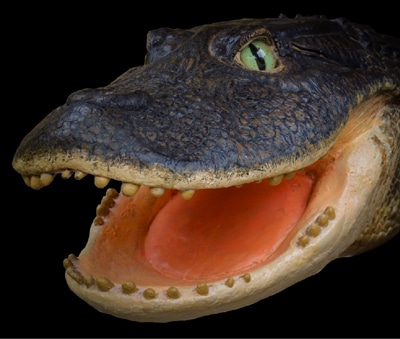
The abundance of crocodile species discovered at the site is likely due to their consumption of a food source that is unusual for modern crocodiles: shellfish (such as clams, mussels, and whelks). In fact, of the seven crocodile species described in the article, three—all of which are entirely new to science—likely fed on shellfish. The strangest is Gnatusuchus pebasensis, a small duck-billed caiman with bulbous teeth, which likely used its open mouth to stir up the muddy bottom of water bodies and crunch on clams and other shellfish…
“When we analyzed the skull and jaws of Gnatusuchus and deduced that it crunched on shellfish using lateral head movements similar to those of platypuses, we immediately realized that this was an exceptional animal,” recalls the article’s lead author, Rodolfo Salas-Gismondi, director of the Department of Paleontology at the Natural History Museum of Lima and a Ph.D. candidate at the Institute of Evolutionary Sciences in Montpellier (University of Montpellier / IRD / CNRS).
Along with the shell-eating caimans, the researchers also discovered the first fossil representative of the modern Amazonian caiman, which has a longer, narrower snout adapted to more typical prey.
Study partners:
- Patrice Baby of the Institute of Research s for Development (Géosciences-Environnement Toulouse, Paul Sabatier University /CNRS/IRD)
- Julia Tejada-Lara of the Natural History Museum in Lima, Peru, and the University of Florida in Gainesville
- Frank Wesselingh of the Naturalis Biodiversity Center in Leiden (Netherlands)
This study was funded by NASA, the Field Museum (Chicago), the American Museum of Natural History (Frick Fund, New York), the ECLIPSE II Program, the National Center for Scientific Research , and the Institute for Development and Research .
Researchers' contact information:
- Rodolfo Salas-Gismondi
- Pierre-Olivier Antoine – 04 67 14 32 51