Is a cowpat worth a horse dropping? Not all dung beetles have the same taste preferences
The purpose of livestock farming is to produce resources that humans can use: milk (and, by extension, dairy products), wool, meat, and so on. However, we are not the only ones who indirectly benefit from livestock grazing on pastures. Dung beetles—coprophagous beetles—thrive on their manure.
But when it comes to dung beetles, is a cowpat as good as a horse dropping? Are they connoisseurs, with species-specific taste preferences? This question was at the heart of our recent study.
But answering that question is more complicated than it seems: dung beetles’ preferences may not depend solely on their species in the strict sense, but also on the types of feces to which they were exposed during their development, particularly during the larval stage.
Cloé Joly, French National Center for Scientific Research (CNRS); University of Montpellier; University of Rouen Normandy
THE ESSENTIALS
- Dung beetles are a large family of beetles that feed on and lay their eggs in animal dung, including that of large farm animals (cows, horses, etc.).
- Until now, it was thought that, in southern France, dung beetles of the species *Onthophagus vacca* preferred cow dung. A new study contradicts these findings: the beetles preferred horse manure in that region. Several hypotheses are being considered to explain these differences.
- Understanding the ecology of dung beetles is important because they provide valuable ecosystem services in pastures, where they act as both scavengers and seed dispersers.
Dung beetles: true gourmets
The term “dung beetles” refers to several hundred different species, all of which belong to the beetle superfamily (Scarabaeoidea). What they all have in common is that, at least at some point in their lives, they feed on feces.
There are more than 150 species in the Mediterranean region alone, 900 species in Europe, and more than 6,000 worldwide.
Generally, dung beetles can be divided into three major groups, based on how they use dung:
- endocoprids, whose larvae are found either directly in the feces or at the interface with the soil;
- paracoprids, which form pellets of feces, buried beneath them, into which the female lays an egg;
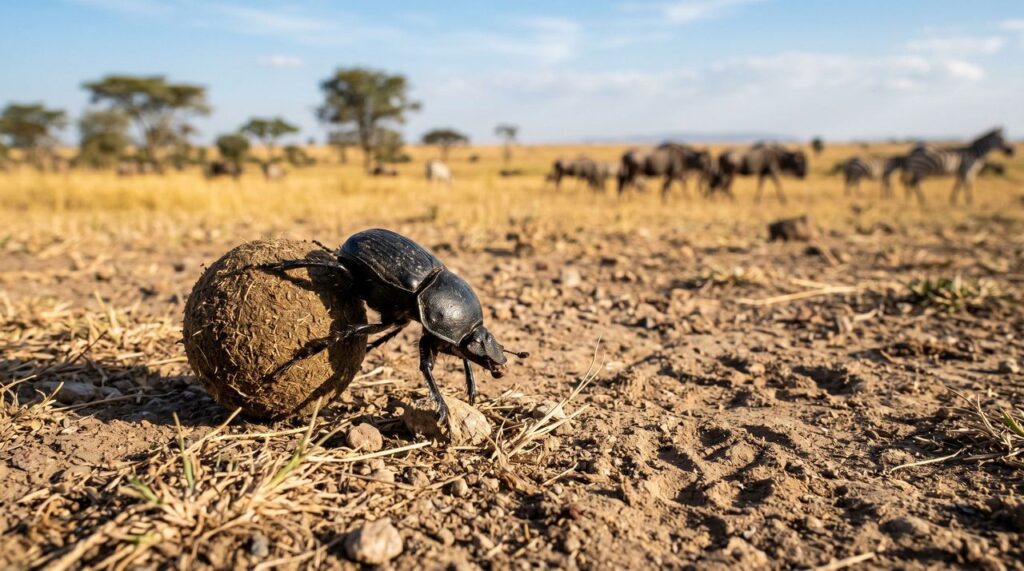
- and the telecoprids, which form pellets of feces by rolling them on the ground, into which the female lays an egg that will be buried a short distance away.

Choosing the right dung is therefore a major challenge for dung beetle parents, since the survival of their offspring depends on it. They use their sense of smell to navigate their environment until they find a suitable food source.
Not all feces are created equal
However, for dung beetles, not all dung is created equal. And for good reason: it does not emit the same odorous compounds, nor does it have the same nutritional composition or physical characteristics (particle size, moisture content, dung size, etc.). These differences depend, among other things, on the diet of the animal that produced the dung and its metabolism.
Some species of dung beetles may therefore exhibit food preferences. For example, a study conducted by Laurent Dormont and his team, published in 2004, showed that cattle manure is more attractive in the Mediterranean environment, both in the field and in the laboratory.
My team and I traveled to the south of France, where the dung beetle population is the most diverse, and we tested their dietary preferences. To do this, we worked at the Sigean African Reserve, located between Narbonne (Aude) and Perpignan (Pyrénées-Orientales), a zoo known for its enclosures where several species of large herbivores live together.
We set up dung beetle traps, using dung from zebras, cattle, antelopes, or ostriches as bait. We then waited 24 hours to count the number of dung beetle species present in the traps and the number of individuals captured.

Our results showed that dung beetles in the Sigean African Reserve are less attracted to ostrich droppings and prefer zebra droppings to those of antelopes or cattle.
One species in particular, called Onthophagus vacca (from the Latin vacca, meaning “cow”)—so named precisely because it is known to have a particular fondness for cow dung—showed a strong preference for zebra droppings under our experimental conditions.
Our results therefore contradict previous studies. Why?
"Try a little of everything to love everything"
In insects, the “chemical inheritance” hypothesis posits that when larvae are exposed to a certain food resource during their development, the adults they eventually become will prefer to lay their own eggs in the same type of resource. The idea is that since the adult was able to develop on a particular food source, this guarantees that it will also be suitable for its offspring.

In our case, the Sigean African Reserve has been in operation for fifty years—approximately 50 generations of dung beetles. One hypothesis explaining whyO. vacca has been observed to prefer equine droppings is that the species’ reproductive success is higher in zebra droppings compared to those of other herbivores, within the specific context of this zoo. Over time, this feeding behavior would therefore have been selected for. In contrast, Laurent Dormont’s study used dung beetles from cattle pens, whose feeding preferences may already have been shaped by selection.
According to this hypothesis, dung beetles' food preferences depend primarily on the availability of various resources.
Two closely related species of dung beetles with different preferences
But there could be another explanation for these conflicting results.
In Europe, there is a species of dung beetle that closely resembles O. vacca and is called Onthophagus medius. They are so similar in appearance that it was only after studying their DNA that the scientific community realized they were two distinct species.
Thanks to these studies conducted in the 2010s, we know thatO. vacca is found more often in warm regions than O. medius, and tends to occur at lower elevations.
However, these two species, though visually similar, may not share the same preferences, which would explain why our results differ from those described previously, a few years before the two species were officially distinguished. In fact, what was mistaken for O. vacca a few years earlier in cow dung may well have beenO. medius.
Dietary Preferences and Ecosystem Services
Let’s take a step back: why should we care about the dietary preferences of dung beetles? The topic might seem a bit silly, and yet… By feeding on dung and burying much of it, dung beetles perform a monumental task in our pastures, where they provide considerable ecosystem services.
In fact, they help keep pastures clean, leaving clear grazing areas for herbivores to graze on. Along with the droppings, dung beetles also bury a whole host of seeds—previously swallowed by herbivores—and thus help disperse plants.
They also accelerate the decomposition of organic matter, enriching the soil and, consequently, the vegetation, whose growth is also accelerated by this natural fertilizer. Finally, when dung beetles are present, the survival rate of parasites of large herbivores—whose eggs are found in the host’s droppings—decreases, thereby reducing the risk of infestation.
In short, dung beetles provide a wide range of benefits to our pastures. For this reason, it is crucial to better understand their ecology so that we can adjust our livestock management practices as needed to better protect them.
The author extends her heartfelt thanks to Pierre Jay-Robert, Freddie-Jeanne Richard, and Alix Ortega, the co-authors of the scientific article that led to this sharing of knowledge with the general public.
Cloé Joly, Postdoctoral Fellow, National Center for Scientific Research (CNRS); University of Montpellier; University of Rouen Normandy
This article is republished from The Conversation under a Creative Commons license. Readthe original article.