Paul-Émile Paradan: The Perseverance of a Gold Prospector
Mathematics researcher at theAlexander GrothendieckInstitutein Montpellier of the’University of Montpellier, Paul-Émile Paradan has been awarded the “ Alexandre-Joannidès ” awarded bytheAcademymy of Sciences. It recognizes years of solitary research at the interface of Atiyah–Singer index theory, representation theory, and symplectic geometry.
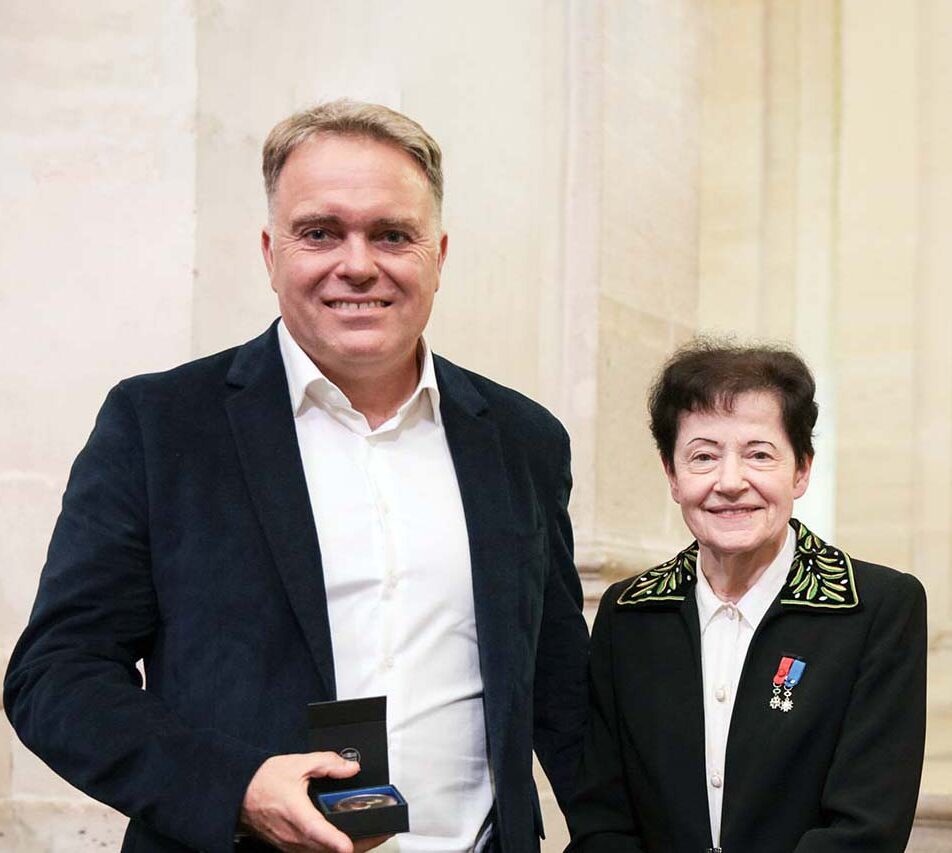
Meeting a mathematician is always preceded by a certain amount of apprehension. How does one approach subjects that are as complex as they are abstract, explained in inaccessible mathematical language? But Paul-Émile Paradan seems determined not to intimidate. The mathematics professor at the University of Montpellier begins by explaining that, for him, choosing math in high school was more a choice made by a lazy student than by a gifted one: “When I was young, I was more interested in sports than inschool subjects. Only math appealed to me, because once you understand it, there’s nothing left to learn—you just have to play around with it.”
In his senior year of high school, he discovered in an Onisep brochure that being a mathematician was a real profession. Although his math teacher at the time advised him against pursuing this path, he has now been honored for his career with the “Alexandre-Joannidès” Prize, awarded by the Academy of Sciences in October 2024. But Alexander Grothendieck, a researcher at the Montpellier Institute, does not dwell on honors. And the presentation of his work—titled “Work at the Interface of Atiyah-Singer Index Theory, Representation Theory, and Symplectic Geometry”—remains elusive. Even Academician Etienne Ghys, tasked with presenting the medal beneath the dome of the Institut de France, sidestepped the subject, sketching out in broad strokes “a geometry that allows for a better understanding of mechanics” and joking, “I’ll explain all of this to you at the cocktail reception.”
Strike it rich
The story of his career, however, offers insight into how the mathematical sciences function: a scientific community working on the innovative ideas of its most eminent members. For example, Alexandre Grothendieck, after whom the Montpellier laboratory is named, was an international leader in algebraic geometry in the 1960s and received the Fields Medal in 1966. He left behind a colossal legacy that has inspired generations of mathematicians. Another remarkable example isEdward Witten, a physicist and mathematician who won the Fields Medal in 1990 and had a profound impact on contemporary mathematics by applying his knowledge of physics.
During his doctoral research, Paul-Émile Paradan tackled a non-Abelian localization formula conjectured by Edward Witten in 1992. He devoted his dissertation and postdoctoral work, between 1993 and 1998, to proving this localization formula. “That was my big break, because my results didn’t go unnoticed in the mathematical community. Especially since some people thought the formula was unprovable , ” he notes. “Mathematicians have to be very persistent, a bit like gold prospectors. You find a vein—an interesting problem whose solution seems feasible—and you dig for years.”In the 1990s, Witten’s idea was used to resolve a conjecture put forward by G. Guillemin and S. Steinberg in 1982, titled “quantification commutes with reduction” and denoted [Q,R]=0.
The Researcher's Solitude
Although E. Meinrenken provided a complete proof of this conjecture in 1998, Paul-Émile Paradan shifted the focus of his research toward geometric quantification and began exploring a proof of [Q,R]=0 in a more general setting (“Witten non-abelian localization for equivariant K-theory, and the $[Q,R]=0$ theorem,” 2019 , American Mathematical Society). The goal was to develop a formal geometric quantification and apply it to the theory of Lie group representations and the Kirillov orbit method (“Horn Problem for Quasi-Hermitian Lie Groups,” 2022, Cambridge University Press).“It took me about fifteen years to complete this project. At one point, I thought I wouldn’t make it, but I persevered because it would have been even harder to move on.” In recent years, Paul-Emile Paradan has focused on convexity problems associated with projections of adjoint orbits.
Mathematics allows for research free from external constraints, but the life of a “ Professor ” is not without its limitations. Research must be balanced with numerous administrative and academic responsibilities, which Paul-Émile Paradan has taken on, thereby breaking away from the solitude of the researcher. For Paul-Émile Paradan is indeed one of those mathematicians who, for the most part, work alone.“For a long time, I was the only one working on the mathematical tools I was developing.”Not entirely alone, however, for that would be to overlook his thesis advisor, the mathematician Michèle Vergne, who introduced him to E. Witten’s localization formula. At 80, he still values her input.“ Even today, when I have an idea, I turn to her—she always has avery insightful commentto offer ,” says the researcher, who almost makes you forget that he already has a rich and varied career behind him.
News
Nemesis: An Exceptional ERC Synergy That Is Starting to Prove Its Worth
Published on: September 3 , 2026
Two years after its official launch, the first scientific report from the Nemesis project…