Rocio Semino, a Way with Words
Rocio Semino is a researcher at the Charles Gerhardt Institute in Montpellier. Last December, she was awarded a grant of 1.35 million fromthe European Research Council ( ERC) to conduct her research on metal-organic frameworks. A profile of a chemist who masters the art of synthesis… without a test tube!
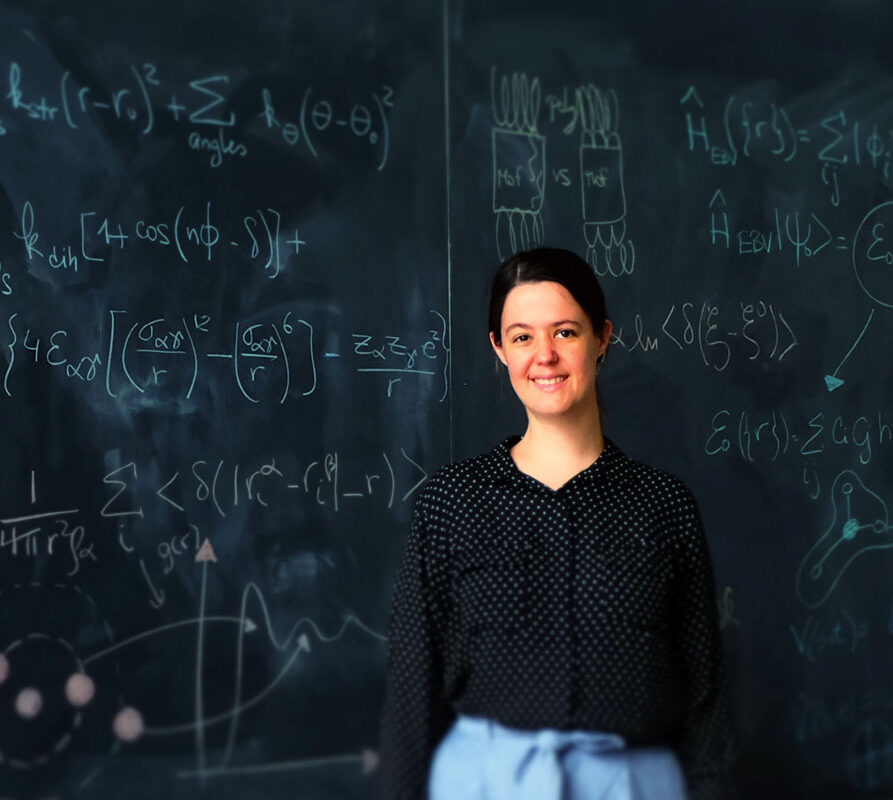
The good news is still fresh. In late December 2021, Rocio Semino learned that she had been awarded a grant from theEuropean Research Council (ERC). When the 37-year-old chemist recounts the months leading up to her selection, it becomes clear that she left nothing to chance.
Weeks of intense writing
The first step—writing her research proposal—wasn’t the hardest part. First of all, because Rocio Semino loves to write. Not just science, but literature as well. The connection between“Elucidation of the Assembly Mechanisms of Metal-Organic Networks”—the title of her ERC grant—and poetry isn’t immediately obvious, but Rocio Semino confirms that her love of writing makes her work easier. Originally from Argentina, she also highlights the advantages of her international background.“Starting with the bachelor’s degree [which takes five years in Argentina] and continuing through the Ph.D., it’s the student who writes their own research proposal. My postdoc in France was my first experience working on a research project that I hadn’t written myself.”
With her ERC proposal already“fully formed ” in her mind, she set out to write it. These were weeks of intense writing during which she worked“all the time,” and in which she expressed her gratitude for the support of her colleagues at the Institut Charles Gerhardt Montpellier, the CNRS, andthe National Institute of Chemistry, as well as for the kindness and hard work of Marjo Michon at the DIPA. For the second stage—the oral defense—Rocio Semino was less in her element. She lost count of how many times she had rehearsed her presentation in front of colleagues. The challenge was to successfully answer the questions from the twelve jury members within the allotted fifteen minutes. “You have to give as many answers as possible—so they need to be short and very precise. But they also need to be understandable to jurors who aren’t all experts in my field.”
"This project brings together everything I've learned."
Over the next five years, Rocio Semino will therefore devote herself to her research on metal-organic frameworks (MOFs). These porous materials have numerous applications in strategic sectors: CO2 capture, energy storage, drug delivery systems, and more. But while these materials hold great promise for industry, their synthesis still relies on numerous costly and time-consuming trials and errors. This is where her research project comes in. The chemist doesn’t work in a lab—she works on a computer.“By elucidating the mechanisms of assembly through computer models, we can better understand how to synthesize a MOF,” explains Semino, who has been doing modeling since her undergraduate studies.
“This project brings together everything I’ve learned,”notes the researcher: molecular dynamics, which she studied in particular during her doctoral thesis, completed in 2014; in-depth methodological studies on modeling and machine learning during her postdoc in Lausanne in 2017–2018; and MOFs during her previous postdoc in Montpellier.“I change my research topics and methodsquite a bit,” notes Rocio Semino as she recounts her career path. This is less an apology for inconsistency than an emphasis on her desire to explore. Subsequent events proved her right, as one of the ERC jury’s comments highlighted her ideal profile for covering all aspects of her project.
Inspiring Young Women Researchers
The ERC also marks a turning point in her work. The big change is that she will be leading a team of six people—doctoral students and postdocs—whom she will recruit to carry out this project. She would like the team to have equal representation of men and women, with the aim of inspiring young female researchers, just as the all-too-few female researchers she encountered during her studies inspired her.
While waiting for her program to get underway by the end of the year, Rocio Semino is writing. Not poetry, but all the documents needed to launch her research. To name just one: a request for computing time from major French and European supercomputing centers—the only facilities with the computing power required for her upcoming modeling work.
News

TERRA-MED: The “UM ” is a partner in a new European doctoral program on environmental challenges in the Mediterranean
Published on: October 13 , 2026
With a total budget of 8.1 million euros, TERRA-MED is a new doctoral program…