Scientific Culture
The promotion of scientific culture involves the transfer of knowledge, techniques, and expertise between science and society. This is one of the missions of universities, and it is a proactive effort in which the University of Montpellier and its scientific community—researchers, Professors, doctoral students, and others—are actively engaged.
Scientific culture is teeming with individuals and initiatives aimed at pushing the boundaries of knowledge. Its dissemination is focused on sharing, exchanging, experiencing, and debating ideas related to scientific questions. At the University of Montpellier, this is exemplified in particular by:
- the dissemination of scientific knowledge to as many people as possible;
- promoting scientific and technical careers among young people;
- the development of exchanges and partnerships;
- training in science communication (master's students, doctoral students).
The scientific outreach services at theUM coordinate the dialogue between science and society through a variety of events, both on the University of Montpellier’s campuses and off-campus, for an audience of citizens, college students, high school students, and elementary and middle school students. To this end, the teams collaborate with numerous partners: research organizations, CCSTI, associations, cultural centers, and public and private institutions.
Key Initiatives
Science Tells Stories
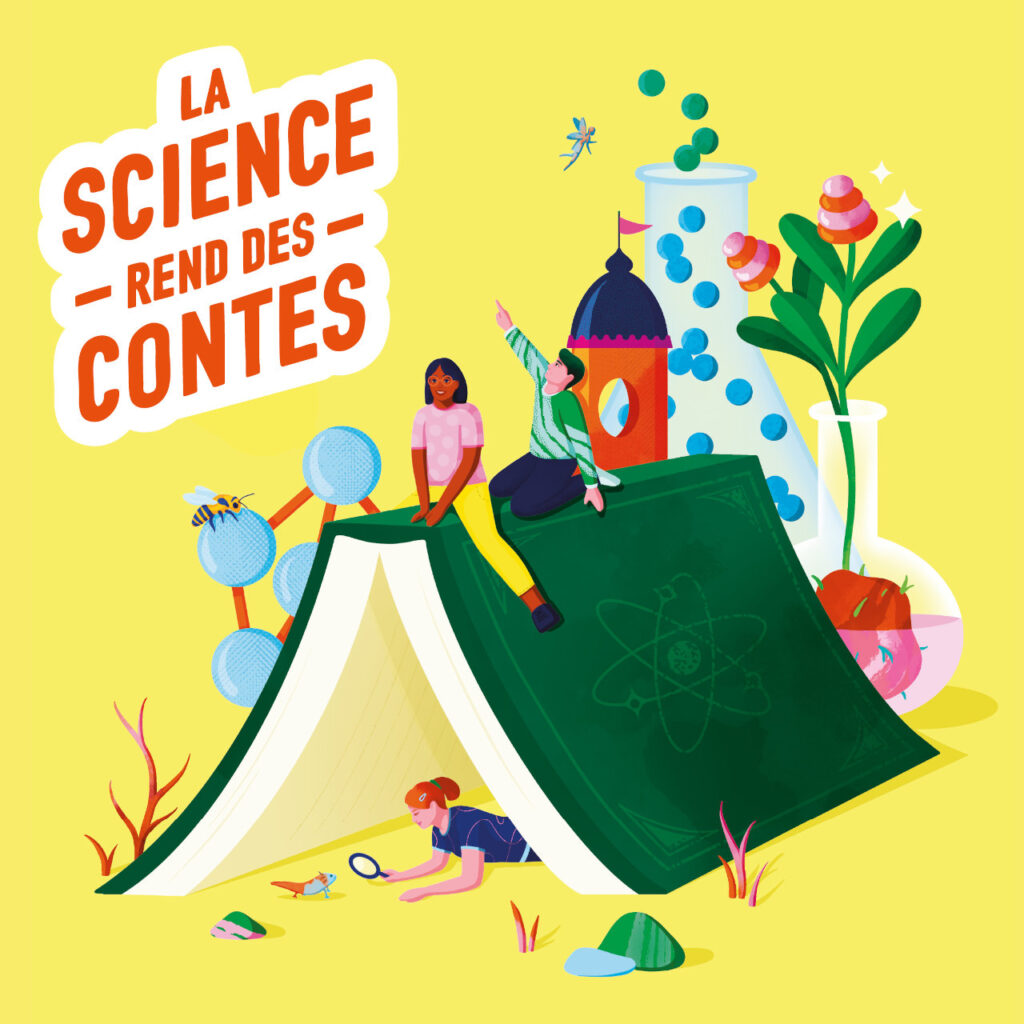
The “La science rend des contes” residency brings together three storytellers who have been working closely since September 2025 with scientists from the University of Montpellier and its partner organizations, focused on three main pillars: nourishing, healing, and protecting. The goal is to create one or more stories inspired by the research conducted in the university’s laboratories.
The public presentations will take the form of performances for children ages 6 to 11 and their parents.
The performances will also feature discussions with the scientists, and you’ll have the chance to ask them all your questions!
The Science Bar: A Thirst for Knowledge!
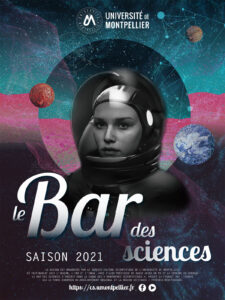
The Scientific Culture Department offers an annual series of “Bar des sciences” events on topics related to science and society. The “Bar des sciences,” organized by the University of Montpellier in partnership with INRAE, INSERM, and IRD, has for several years been hosting monthly events promoting scientific culture that foster dialogue between science and society. A far cry from formal lectures, these discussions are designed to encourage dialogue between subject experts and the general public.
Science Festival
The Science Festival is a major annual event celebrating scientific culture. Thanks to the efforts of stakeholders from faculties, research organizations, laboratories, and associations, science is showcased and brought to life through a variety of engaging, surprising, and fascinating activities.
The University of Montpellier is coordinating the event throughout the Hérault department and overseeing the Montpellier Science Village, located at the School of Education. With a focus on exploration and discovery, the Montpellier Science Village is brimming with activities for all ages: workshops, demonstrations, experiments, games, screenings, and lectures… It’s a wonderful opportunity for exciting encounters, sharing knowledge, and making discoveries to better understand the world around us and imagine the future!
Highlights from the 2020 Village des Sciences, available in digital format, can be found on the YouTube channel of theUM.
Exhibition: “NounOURS: From Cave Bears to Teddy Bears”

The next exhibition presented by the Scientific Culture Department is a continuation of “Peluchology,” an innovative educational and science outreach initiative conceived in 2010. Designed as a traveling exhibition, it consists of museum display panels, display cases featuring artifacts, and collections of books and teddy bears. It thus pays a beautiful tribute to this noble and sacred animal, the fallen god and king of stuffed animals: the bear.
Call for Proposals: Company-to-Company Relations
The I-SITE Program of Excellence includes a component that supports “Science-Society Relations” initiatives, which takes the form of a call for projects open to all institutions and organizations in the consortium. This initiative is part of a strategy to disseminate research conducted in our region and the issues it addresses, particularly to young people and students (from elementary school through high school), and aims to support innovative initiatives for sharing knowledge, fostering dialogue, and exploring methods, results, challenges, and questions related to scientific themes. With a total budget of 50 K€ spread over two rounds (fall 2022 and fall 2023), the program provides funding of up to 4 K€ per project.
In 2022, the selected projects are:
Spotlight on (In)visible Biodiversity: Biodiversity Inventoried
The project, led by Frédérique Carcaillet (Marbec), consists of three parts: the exhibition “Biodiversity Inventory,” the second installment of the exhibition “Spotlight on (In)visible Biodiversity,” an event featuring a screening of the documentary film “Discreet Sentinels: Community Conservation,” and the provision of an educational resource to accompany high school students’ visit to the exhibition. The goal of this project is to introduce high school students to the knowledge, skills, and careers related to the study of biodiversity through concrete examples drawn from the ISITE Program of Excellence community.
A Multisensory Exploration and Sharing of the Woods and Their Biodiversity
The project presented by Sandrine Bardet (LMGC) and Kevin Candelier (BioWooEB) focuses on raising awareness among young people about the biodiversity of forests, trees, and wood by asking the question: How can we highlight its value through the services it provides to humans while also preserving it? Through workshops conducted in classrooms and in the field, young students will be invited to engage their senses (observing, touching, smelling, and listening) to discover and understand the plant biodiversity around them: how trees grow, why they are different, how trees produce wood, what services forests provide, and the possible uses of wood as a material. This science program will be conducted in a classroom in Montpellier and a classroom in Kourou (French Guiana), both of which are part of Priority Education Networks, with the goal of connecting students and teachers from these two geographic areas and having them work together on a shared science project—despite their vastly different natural resources and local needs.
Launch of experimental activities focused on water treatment as part of the “Cordées de la Réussite EAU” program
This project, led by Julie Mendret (IEM), focuses on science outreach in the field of water sciences. It aims to connect middle and high school students in Lozère with researchers and students at the University of Montpellier as part of the “EAU: Encordés A l’Université” success network. Through this project, the goal is to organize hands-on activities related to water treatment and water quality and to carry out the tasks involved.
Chemistry Workshops and Outreach for High School Students (SCHOLAR)
The project, led by Jean-Yves Winum and Jean-Sébastien Filhol (IBMM), is part of an effort to strengthen the science discovery workshops launched in 2022 by the IRES Physics-Chemistry group by enabling the creation of new science outreach content for middle and high school students, including new workshop themes and related presentations. It also aims to add a research discovery component to these workshops by showcasing research conducted at the institutes of the Balard Chemistry Cluster in the fields of innovative materials, pigments, and dyes, for high-tech applications and in the healthcare sector.
Digital Career Guidance with "Seeds of Information" (ANOGI)
This project, led by Chrysta Pelissier and Jean Moutouh (IUT de Béziers), aims to promote a digitally-supported reflective approach that can be carried out by middle and high school students in Lozère as part of activities focused on their career guidance. Some of these students face social, gender-based, and sociocultural inequalities, which result in self-censorship or a lack of interest in career guidance activities. The proposed innovative approach is grounded in research from the fields of information and communication studies and language sciences. Its goal is to develop and disseminate an innovative approach to career guidance, fostering dialogue both among students and between students and their teachers.