Digital Health School of the University of Montpellier and its partners: ESNbyUM
The Digital Health School of the University of Montpellier and its partners is a project certified under the France 2030 initiative as part of the “Skills and Professions of the Future” call for proposals—the only one selected at the national level to train all professionals involved in digital health. It is a unique and innovative initiative that offers initial, vocational, and work-study training programs in the field of digital health. It takes a multidisciplinary and interdisciplinary approach to training to address the challenges of digital health, formerly known as e-health.
Digital Health, a rapidly expanding field, can be defined as the convergence of the healthcare and digital worlds, made possible by the use and development of new information and communication technologies, to support healthcare professionals in their practice and individuals throughout their care journey. It helps address significant societal challenges, such as the rise in chronic conditions and areas with a shortage of healthcare providers, and encompasses various fields such as health data, cybersecurity, AI, digital health tools, and telehealth.
Its personalized, interdisciplinary educational approach and its digital campus—designed as an immersive, collaborative learning environment accessible to everyone at all times—embody the École de Santé Numérique’s commitment to training the professionals of tomorrow who are destined to thrive in an increasingly connected world.
Objectives of ESNbyUM
Provide extensive training in digital health to future professionals in the health and medical-social sectors, and develop specific expertise for other professionals involved in digital health.
ESNbyUM will offer training in Digital Health:
- Healthcare and medical-social professionals
- Digital specialists with a background in healthcare
- Management and senior executives of health and medical-social facilities
- Lawyers with expertise in digital health
- Specialists in charge of regulatory affairs for digital medical devices
Strengthening Interdisciplinary Coherence in Digital Health
Digital Health is a complex field that involves many professionals with diverse areas of expertise and addresses topics as varied as health data, care pathways, telehealth, mobile health apps, medical decision support, and patient-assistance robotics. This diversity is at the heart of the School of Digital Health, which has taken on the challenge of training all professionals involved in Digital Health by, in particular, pooling educational resources and training programs in a single space. ESNbyUM even offers a course unit titled “Interdisciplinary Project in Digital Health,” which allows students from different master’s programs (Medicine, Sports Science, Pharmacy, Science, Business Administration, and Law) to collaboratively develop a digital medical device—from the conceptualization stage through to its construction—with each student contributing their skills to bring the project to fruition.
Offer personalized support
Digital health is a field that requires training future professionals in new interdisciplinary skills and preparing them for emerging careers to address the challenges of today and tomorrow.
To address these needs, ESNbyUM offers its students a teaching approach called “6 P Precision Pedagogy,” which is:
- Customized to provide training tailored to each learner
- Preventive Measures for Successful Training Without Failure
- Predictive, applicable to future professional practice
- Participatory, to enable learners to take an active role in their own learning
- Evidence-Based, Using a Scientific Approach
- And focused on Practices
Fostering the Digital Health Ecosystem in Occitanie
By bringing together professionals from diverse backgrounds—including educators, experts, students, and citizens interested in digital health—ESNbyUM, a renowned “off-campus” school that is an indispensable partner in all major initiatives focused on digital health, works in synergy with all its partners and stakeholders in the region, whether they are academic institutions, healthcare and medical-social facilities, businesses, or local governments.
Innovating in Education Through Its Digital Campus
To offer its students a unique learning experience, ESNbyUM has developed its digital campus, an ambitious project that serves as a true showcase for the University of Montpellier’s School of Digital Health and its partners. This digital platform consists of five areas:
- A "Training" section, in the form of a Moodle LMS, where educational resources on digital health are shared.
- A "Career Guidance" section, featuring an AI chatbot, to help everyone find the right Digital Health training program
- "News" and "Resources" sections to stay informed about developments in digital health
- An "Alumni" section to connect with former graduates
- An immersive 3D space that lets you visit the iconic landmarks of the city of Montpellier
This platform, which serves as a bridge between an original immersive universe and the very real world of education, embodies ESNbyUM’s commitment to training our students, instructors, and citizens/patients in digital health.
Governance
The Committee on Strategic and Structural Investments (COMIS), chaired by the President of the University of Montpellier, is the site’s strategic coordination body responsible for overseeing the implementation of initiatives funded in particular by France 2030, including the ESNbyUM program.
The University of Montpellier’s Directorate of Structural Programs (DPS) coordinates the activities of these projects at the operational and administrative levels.
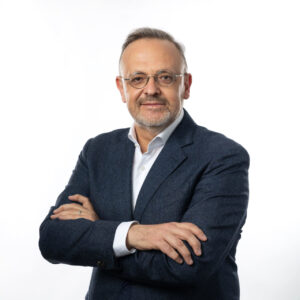
Within the ESNbyUM project, responsibility for the project was entrusted to Prof. Maurice Hayot, Associate Professor and Physician at Montpellier University Hospital, and coordination of the project to Dr. Brigitte Couette, an Inserm researcher.
ESNbyUM’s governance structure consists of several committees: a Strategic Steering Committee (COS), a Steering Committee (CoPil), and the Pedagogy and Innovation Committees (CPIs).
The COS helps define major strategic directions and allocate resources, and provides input on the action plan proposed by the Director of ESNbyUM. It is chaired by the University President and includes the Vice President for “Academic Programs and Campus Life” and the members of the consortium.
The Steering Committee proposes strategic decisions to the Project Steering Committee to achieve the project's objectives and ensures the project runs smoothly: progress, achievement of objectives, adherence to deadlines, quality, and financial costs.
The CPI’s mission is to propose a strategy for pedagogy and innovation to enable the implementation and continuous improvement of the quality of ESNbyUM’s teaching and educational programs.