“What are they used for?” The synthesis and characterization equipment in the “Polymer” and “Peptide” sections of the SynBio3 platform
This event has already taken place!
The “What Is It For?” seminars offered by the various technology and service platforms of the Chemistry Research Cluster are designed to help you discover or deepen your understanding of the technical capabilities of the analytical and characterization equipment available to you.
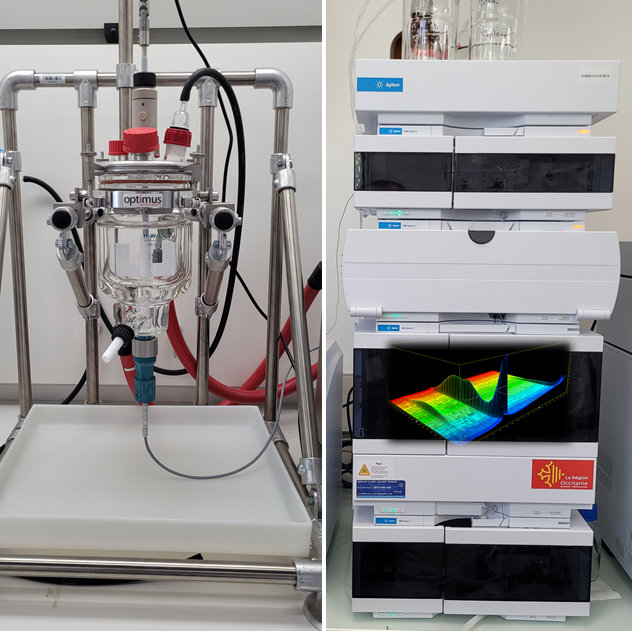
Come discover the synthesis and characterization equipment in the “Polymer” and “Peptide” sections of the SynBio3 platform.
Following a general introduction to the SynBio3 platform, the “Polymers” panel will lead a session on polymers and chromatography. The latest advances in liquid chromatography for polymer characterization will be discussed. The “Peptide” group will present its activities related to the synthesis of peptides and other classes of biomolecules, purification techniques, and the characterization and quantification of the prepared compounds.
Speakers
- Prof. Gilles SUBRA ( IBMM-SynBio3 and , “Amino Acids, Heterocycles, Peptides, and Proteins” research group)
Technical Section
- Dr. Vincent DARCOS (IBMM-SynBio3 and the “Polymers for Health and Biomaterials” team) Title: Polymers and Chromatography at SynBio3
- Dr. Pascal VERDIE (IBMM-SynBio3 and the “Amino Acids, Heterocycles, Peptides, and Proteins” team) Title: Peptides, Separation and Analytical Techniques
Examples of Science Projects
- Dr. Minh-Thuong Khong (Postdoctoral Researcher, IBMM-SynBio3 and the “Polymers for Health and Biomaterials” team) Title: 13C-Labeling of Copolymers Based on Poly(lactic Acid) and High-Sensitivity Tracking of Traces of Their Degradation Products by MALDI-TOF Mass Spectrometry.
- Dr. Elodie LOGEROT (Postdoctoral Researcher, IGF) Title: Study of the mechanisms by which two-component leucotoxins from Staphylococcus aureus induce pore formation.
- Jules SIMONIN-GARCIA (Ph.D. student, IBMM) Title: SynBio3 Peptides and Enzymology Platform: A Case Study of a Screening of Peptides Cleavable by a Protease
About the Speakers
Gilles Subra conducts his research at the IBMM in the field of peptide science. His primary research topics lie at the interface of chemistry and biology and focus in particular on solid-phase chemistry and combinatorial chemistry methodologies, as well as the design of chemical tools to improve detection and quantification by mass spectrometry in biological systems. He is also interested in the design of peptide-based materials and polymers. The main applications include the design of multi-ligand nanoparticles for cancer targeting and the functionalization of medical devices and silicone dressings. His most recent research focuses on the design of biomimetic peptide-based hydrogels used for 3D bioprinting and cell therapies.
Vincent Darcos is a CNRS/HDR research engineer in the “Polymers for Health and Biomaterials” team at IBMM. He is also the scientific director of the “Polymer” division of the SynBio3 platform. His research focuses on macromolecular engineering to develop novel polymer biomaterials for healthcare applications. At SynBio3, he is currently developing new analytical tools, particularly in chromatography, for the characterization of polymers with complex structures.
Pascal Verdie is a research engineer ( UM ) on the “Amino Acids, Heterocycles, Peptides, and Proteins” team at IBMM. He is also the operations manager for the SynBio3 platform. His research focuses on peptide engineering for the development of selective ligands. At SynBio3, he is in charge of the automated peptide synthesis systems and the platform’s operational aspects (labeling, certification, etc.).
Minh-Thuong Khong is a postdoctoral researcher with the SynBio3 platform and the “Polymers for Health and Biomaterials” team. He works with Vincent Darcos and Benjamin Nottelet. His project, funded by the Occitanie region as part of the PRRI “Biopoltrace” project, aims to develop new methods for monitoring the in vivo degradation of polymers used in the medical and pharmaceutical fields.
Jules SIMONIN-GARCIA is a second-year doctoral student working on his dissertation under the supervision of Gilles SUBRA (IBMM) and Marie Morille (ICGM). His dissertation focuses on the design of peptide-based biomaterials that are sensitive to their biological environment.
Elodie LOGEROT is a postdoctoral fellow working under the supervision of Chérine Béchara and Sébastien Granier at the IGF. Her research focuses on the study of two-component leucotoxins from Staphylococcus aureus that target G protein-coupled receptors to lyse host cells by forming octameric pores in the plasma membrane. Pore formation begins with a specific interaction between the toxins and the N-terminal region of the receptors and requires significant conformational changes in the toxins. To unravel the underlying mechanisms, she uses several structural approaches to investigate the affinity between the N-terminal peptides of the receptors and the bacterial toxins, as well as the effect of this interaction on the conformations of the toxins.
For the launch of this fourth seminar, we've planned a short and informal session for you.
See you on June 6 at 9 a.m. in the lecture hall of the Balard Research Building.
Campus access with a QR code (please email
to request a code). For any inquiries, please contact us by email.
Receive a weekly summary of theUM 's schedule
* By entering your email address, you agree to receive a weekly summary of the “UM ” calendar via email and acknowledge that you have read ourprivacy policy. You can unsubscribe at any time by using the unsubscribe linkor by contacting us via email.
News
TheUM s is strengthening its commitment to the AFM-Téléthon
Published on: July 22 , 2026
The University of Montpellier, the Montpellier University Hospital, the School of Medicine…