“Core-AI 2026” Thematic School
This event has already taken place!
Launch of the Core-AI 2026 Thematic School, a series of seminars and mini-courses funded by the COLORS Long-Term Thematic Project and dedicated to the foundations of artificial intelligence, bringing together leading international researchers.
Target audience: doctoral students , postdoctoral researchers, engineers, researchers, Professors, as well as anyone wishing to deepen their understanding of the fundamentals of AI.
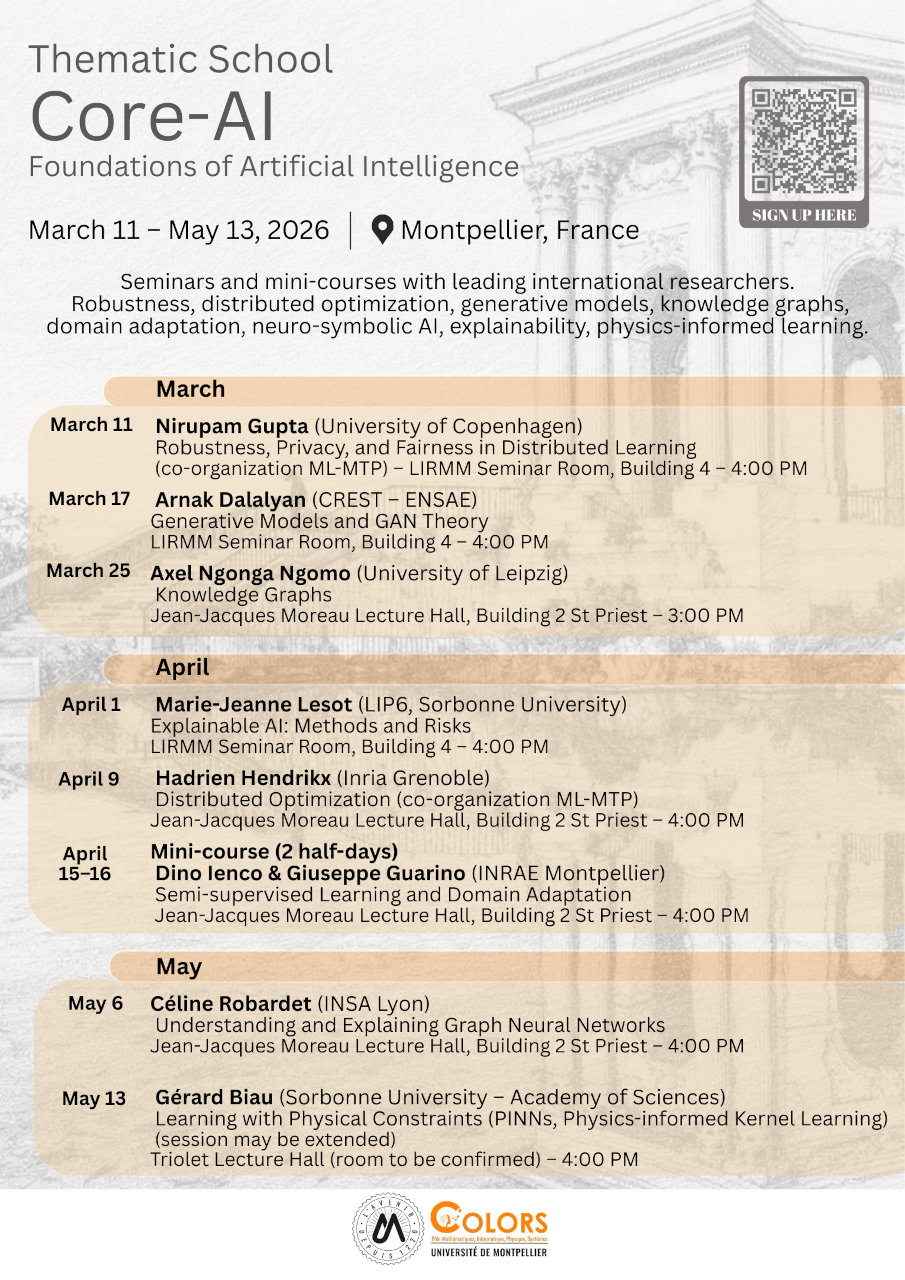
Program
March
- March 11 — Nirupam Gupta (University of Copenhagen)“
: Robustness, Privacy, and Fairness in Distributed Learning”
(co-organized by ML-MTP) – LIRMM Seminar Room, Building 4 – 4:00 p.m. - March 17 — Arnak Dalalyan (CREST – ENSAE)
Generative Models and GAN Theory – LIRMM Seminar Room, Building 4 – 4:00 p.m. - March 25 — Axel Ngonga Ngomo (University of Leipzig)
Knowledge Graphs – Jean-Jacques Moreau Lecture Hall, Building 2, St. Priest – 3:00 p.m.
April
- April 1 — Marie-Jeanne Lesot (LIP6, Sorbonne University)
Explainable AI: Methods and Risks – LIRMM Seminar Room, Building 4 – 4:00 p.m. - April 9 — Hadrien Hendrikx (Inria Grenoble)
Distributed Optimization
(co-organized by ML-MTP) – Jean-Jacques Moreau Lecture Hall, Building 2, St. Priest – 4:00 p.m. - April 15–16 — Mini-course (2 half-days)
Dino Ienco & Giuseppe Guarino (INRAE Montpellier)
Semi-supervised learning and domain adaptation – Jean-Jacques Moreau Lecture Hall, Building 2, St Priest – 4:00 p.m.
May
- May 6 — Céline Robardet (INSA Lyon)
: Understanding and Explaining Graph Neural Networks – Jean-Jacques Moreau Lecture Hall, Building 2, St. Priest – 4:00 p.m. - May 13 — Gérard Biau (Sorbonne University – French Academy of Sciences)
-Learning with Physical Constraints (PINNs, Physics-Informed Kernel Learning)
(session may be extended) – Peytavin Lecture Hall at Polytech – 4:00 p.m.
About Core-AI
Core-AI highlights the fundamental principles, theoretical methods, and methodological approaches that underpin modern artificial intelligence.
The school offers a well-rounded science curriculum covering:
- Learning Theory
- Reliability and Trust
- Distributed deep learning
- Generative Models and Kernels
- Large-Scale Data Structures (Graphs, Computer Vision, Remote Sensing)
- Explainability and Responsible AI
For more information, as well as to view the school’s other dates and events, please refer to the registration form.
Receive a weekly summary of theUM 's schedule
* By entering your email address, you agree to receive a weekly summary of the “UM ” calendar via email and acknowledge that you have read ourprivacy policy. You can unsubscribe at any time by using the unsubscribe linkor by contacting us via email.
News

The AAP TALENTS – PTL CARLA and CHIMENE from the Chemistry Division
Published on: October 6 , 2026
As part of the I-SITE Program of Excellence (PEI) at the University of Montpellier (UM) and the…