Embodied Ecologies: Residents’ Sensory Approaches to Understanding and Reducing Their Exposure to Chemicals in Everyday Urban Life
This event has already taken place!
The seminar presents the transdisciplinary project “Embodied Ecologies,” which is based on citizen science and enables people affected by chemical pollution to collect data for scientists and help set research priorities. This project aims to study cumulative toxicities by combining ethnography and sensory mapping, and to promote practices that reduce the harm caused by these chemicals.
Speaker Anita Hardon will present key insights into how people perceive, understand, and take action to reduce their exposure to hazardous chemicals in urban environments in the Philippines, France, and the Netherlands. She will also discuss the challenges of measuring exposure and propose solutions for making the results actionable.
The speaker, Dr. Anita Hardon, is a medical biologist and anthropologist who has conducted transdisciplinary studies on chemicals and pharmaceuticals, generating significant ethnographic insights.
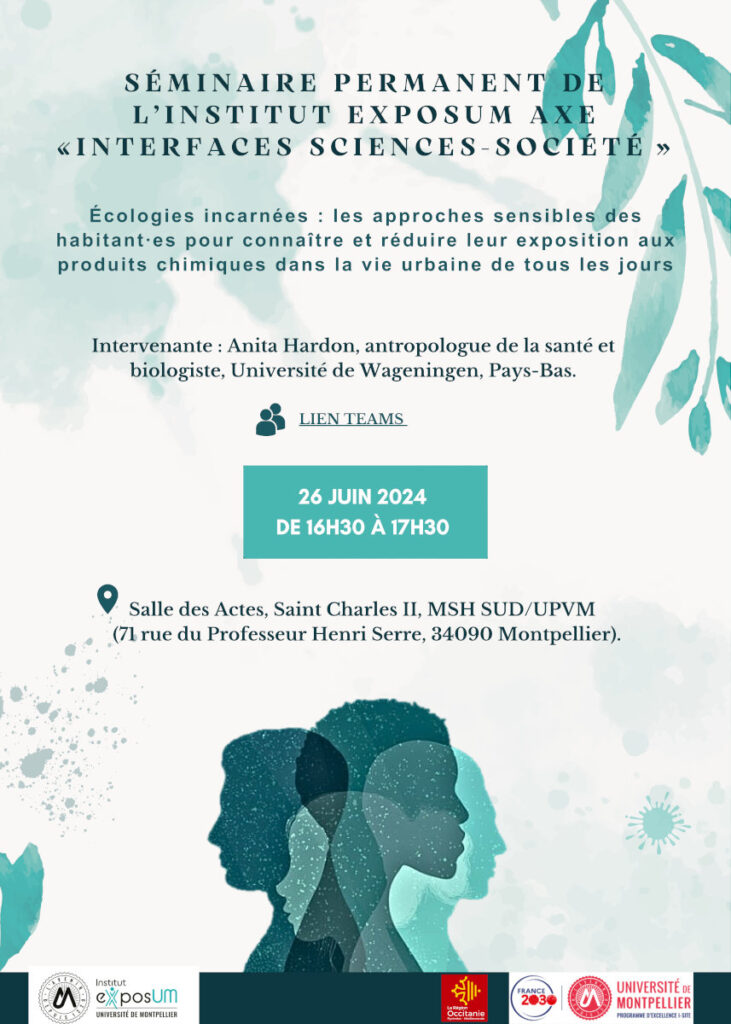
Embodied Ecologies: Residents’ Sensitive Approaches to Understanding and Reducing Their Exposure to Chemicals in Everyday Urban Life
Chemicals enter and pass through our bodies via multiple pathways: the air we breathe, the water we drink, the work we do, the soil where we live, play, and grow our food, the food we eat, the building materials in our homes, and the (personal) hygiene products we use—often without knowing what chemicals they contain. These toxic chemicals interact with one another, with organic matter in our environment, and with our body’s own endogenous molecules. They are metabolized by our organs and excreted by our bodies in the form of chemical metabolites, which end up in our waterways and affect the quality of our drinking water.
This presentation will introduce the transdisciplinary “Embodied Ecologies” project, which is based on citizen science and in which people affected by chemical pollution not only collect data for scientists but also help define research priorities. This project aims to investigate cumulative toxicities by combining ethnography and sensory mapping. It also aims to promote practices for reducing the harm to people caused by these chemicals.
Anita Hardon will share key insights into how people feel, think, and act to reduce their exposure to potentially hazardous chemicals in urban environments in the Philippines, France, and the Netherlands. She will then discuss the challenges of measuring exposure using different techniques and suggest ways to make the results usable.
Speaker: Dr. Anita Hardon was trained as a medical biologist and anthropologist and has been engaged in transdisciplinary studies on synthetic chemicals and pharmaceuticals. Her research has generated important ethnographic insights into the use of these technologies in diverse sociocultural settings and their effects on everyday life. Anita Hardon is currently chair of the Knowledge, Technology, and Innovation group at Wageningen University and Research, and Professor of Anthropology of Care and Health at the University of Amsterdam. She has published widely read articles, special issues, and books (Chemical Youth (an open-access book), 2021, Palgrave Macmillan; Social Lives of Medicines, 2002, Cambridge University Press).
Receive a weekly summary of theUM 's schedule
* By entering your email address, you agree to receive a weekly summary of the “UM ” calendar via email and acknowledge that you have read ourprivacy policy. You can unsubscribe at any time by using the unsubscribe linkor by contacting us via email.
News

A “liminal space” between humans and AI: Will the boundary be less distinct than we might think?
Published on: October 14 , 2026
There is something strangely reassuring about the way we keep talking…