Between Industrial Partnerships and Basic Research: An Example from My Work on Vitreous Silica
This event has already taken place!
By Pascal Etienne, Charles Coulomb Laboratory (L2C).
Vitrous silica is valued for its high purity, transparency, and very low thermal expansion. It is refractory, resistant to thermal shock, and resistant to many chemical agents, making it a material of choice for optics, for applications involving high temperature gradients, and for applications requiring chemical inertness. Its ultraporous form (aerogel), achieved through sol-gel synthesis and drying under supercritical conditions, gives it exceptional thermal insulation properties as well as a very low refractive index, close to that of air. However, silica has a major drawback that can limit its use: its brittle behavior and the subcritical propagation of its defects under stress, which can lead to delayed catastrophic failure.
My presentation focuses on research conducted in response to requests from industry partners interested in using silica to manufacture sensors. The idea is to showcase another—and certainly lesser-known—aspect of my expertise, which is centered not on hybrid materials but on glass.
The first section focuses on a collaboration initiated by SAFRAN Electronics & Defense. This company is a leader in the manufacture of gyroscopes incorporating silica resonators for inertial navigation. Here, the primary characteristic sought is a high quality factor resulting from low internal friction. This factor is closely dependent on the size of internal defects such as microcracks. The manufacturing process uses commercial silica that is machined and then etched to remove any surface defects. But what about internal defects? Can they propagate over time, potentially leading to a decline in the gyroscope’s performance?
The second part is the result of a collaboration with the French pharmaceutical company Medincell, which specializes in technologies for the subcutaneous administration of drugs. The rapid development of these products requires high-throughput screening using UV spectrophotometry on very small quantities. The best solution is to develop an optofluidic device based on total internal reflection to maximize the optical path length. The very low refractive index of silica aerogels makes them an excellent candidate. But how can a channel with very low propagation losses be fabricated within the aerogel? Is it possible to prevent liquid from entering its pores? Won’t its extreme fragility make it impossible to use?
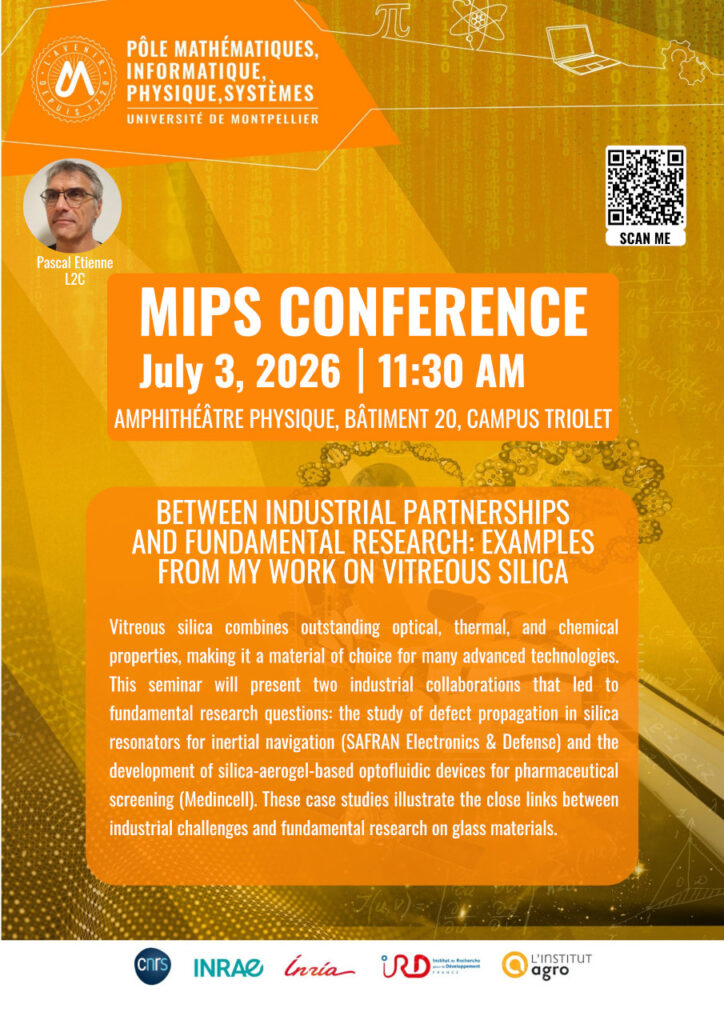
The MIPS Research s Center's conferences aim to raise awareness within the community about new topics and technological innovations.
Intended for a broad audience—students and researchers from all disciplines—these initiatives draw on the multidisciplinary expertise of the MIPS Cluster, partner clusters and organizations, as well as national and international teams.
They are held on the first Friday of every month at 11:30 a.m. and are followed by a buffet, which provides an opportunity to continue the discussions.
Receive a weekly summary of theUM 's schedule
* By entering your email address, you agree to receive a weekly summary of the “UM ” calendar via email and acknowledge that you have read ourprivacy policy. You can unsubscribe at any time by using the unsubscribe linkor by contacting us via email.
News
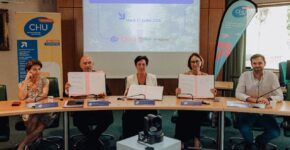
TheUM s is strengthening its commitment to the AFM-Téléthon
Published on: July 22 , 2026
The University of Montpellier, the Montpellier University Hospital, the School of Medicine…