Exhibition “Tall Grasses: An Inventory of Emergencies”
This event has already taken place!
Opening reception, meet-and-greet, and exhibition at the Science Library, Triolet Campus – Place Eugène Bataillon, Montpellier.
Opening reception and light refreshments on Monday, January 20, at 5:30 p.m.
Talk with Caroline MUHEIM and Serge MULLER, Professor in biology and ecology at the Faculty of Sciences, at 6:30 p.m. – screening room at the Science Library.
Exhibition at the Science Library, Pharmacy-PACES Library, and Nîmes Medicine Library
 “Les Hautes Herbes: An Inventory of Emergencies,” an exhibition by the “Nourrir” project
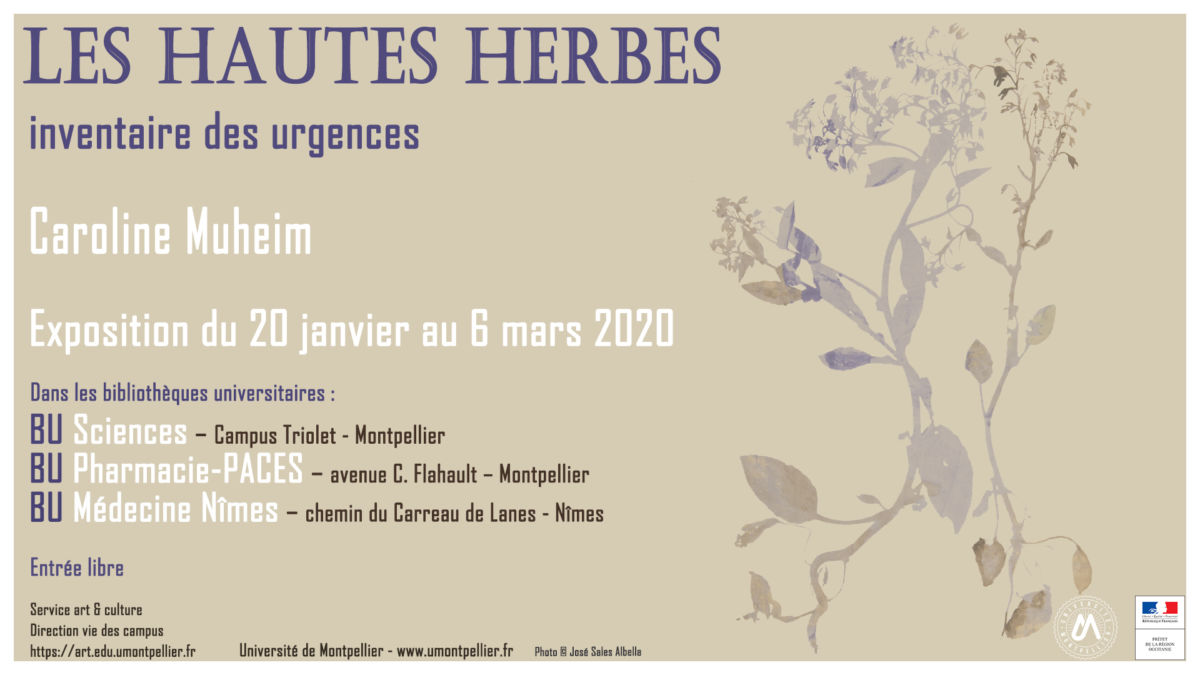
Come discover the botanical illustrations, herbarium specimens, and silkscreen prints of edible and medicinal plants that grow in the heart of the Triolet campus, created by artist Caroline MUHEIM as part of her NOURRIR project during her artist residency in 2018–2019!
The botanical illustrations, drawn in watercolor and ink, constitute a sufficiently comprehensive and accurate inventory to enable any student who so desires to feed and care for themselves—and thus potentially survive—by consuming the plants listed within the scope of their university studies.
This inventory was compiled in collaboration with researchers and students at the university studying biology and pharmacy.
The screen-printed panels are printed with inks made from extracts and juices of plants found locally: iris, oak gall, walnut husk, traveling madder, etc.
The subjects of these silkscreen prints are the large edible and medicinal plants that grow on campus: borage, laurel, plantain, fennel…
Also check out the video *Walking Through Puddles*, created over the course of an entire year using 365 photos taken with a cell phone during the artist’s daily trips to and from campus. Conceived as a stroll through the days, this video is accompanied by a text that recounts her wanderings, step by step, through light, water, the seasons, and the geometry of the gardens.
The "Hautes Herbes" exhibition is organized in partnership with the Joint Documentation Service.
Learn more about the NOURRIR project
News

A “liminal space” between humans and AI: Will the boundary be less distinct than we might think?
Published on: October 14 , 2026
There is something strangely reassuring about the way we keep talking…