The Geopolitics of Microbes
This event has already taken place!
What role do epidemics play in geopolitics? At first glance, the question seems absurd. Germs don’t engage in politics. That’s what I still believed in 2010, when the Haitian government invited me to investigate the origin of the cholera epidemic that had just struck the country. But the investigation showed that this epidemic had been caused by the introduction of Vibrio cholerae by a contingent of UN peacekeepers. Politics then quickly took precedence over science, as preserving the UN’s reputation seemed so important.
This experience made me realize that epidemics are not merely biological incidents whose management falls solely within the purview of public health. They reveal vulnerabilities, raise questions of responsibility, and give rise to conflicting narratives. As such, they are embedded in power dynamics that extend far beyond the medical sphere. Throughout history, they have played a major role in bringing about lasting changes in the geopolitical balance of power.
Even today, the attention paid to an epidemic often depends more on political considerations than on its severity as a public health issue. For example, the Ebola outbreak currently ravaging Central Africa is unfolding amid relative international indifference, while far less threatening crises, such as the hantavirus outbreak, receive global media coverage.
The geopolitics of microbes also concerns their origin. Understanding how a pathogen emerged is an essential scientific endeavor, if only to prevent its reemergence. But this research, too, becomes a political issue when strategic interests are at stake. The example of COVID-19—the exact circumstances of whose emergence remain a subject of debate—serves as a reminder that the search for the truth can become just as complex as the fight against the disease itself.
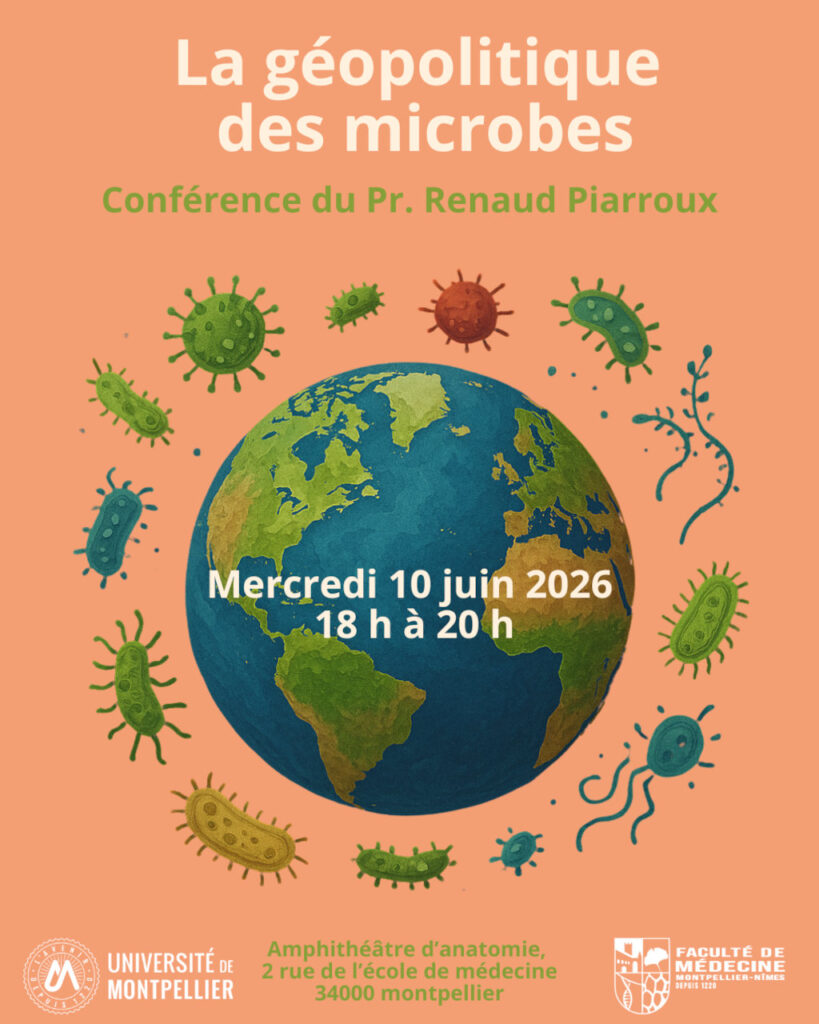
Lecture by Renaud Piarroux, professor at the Sorbonne University School of Medicine, department head at the Pitié-Salpêtrière Hospital, and researcher at the Pierre Louis Institute of Epidemiology and Public Health, affiliated with INSERM.
He is the author of several books and participated in nine seasons of the series “Mécaniques des épidémies” on France Culture. He recounted his humanitarian missions with Médecins du Monde in various African countries, his experience in Haiti during the cholera epidemic, and his research on tuberculosis, the plague, smallpox, AIDS, malaria, and COVID-19.
Receive a weekly summary of theUM 's schedule
* By entering your email address, you agree to receive a weekly summary of the “UM ” calendar via email and acknowledge that you have read ourprivacy policy. You can unsubscribe at any time by using the unsubscribe linkor by contacting us via email.
News
Teacher Training: Emmanuel Macron Chooses Mende to Roll Out His Reform
Published on: September 11 , 2026
To mark the start of the school year, French President Emmanuel Macron,…