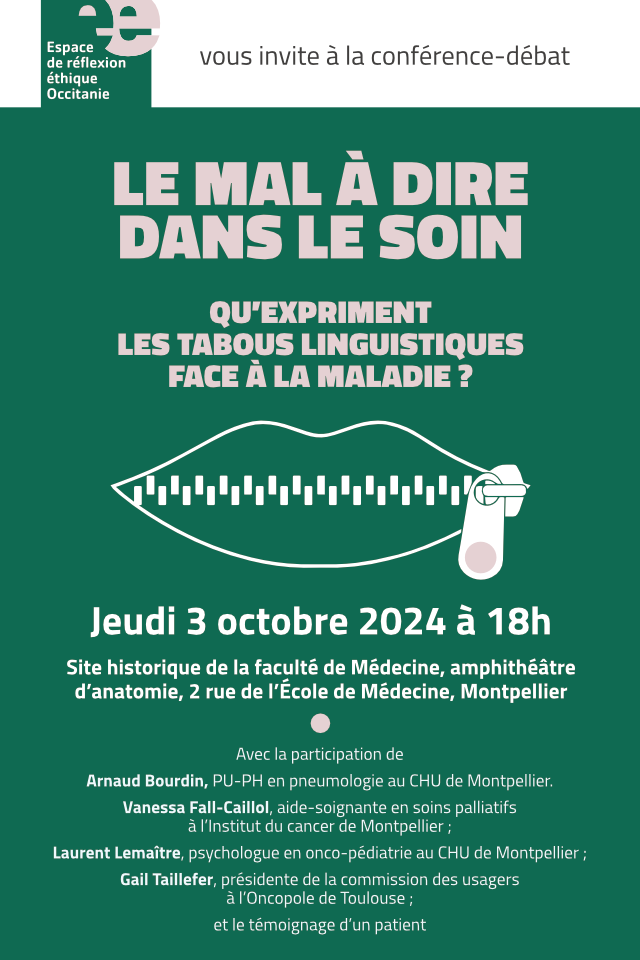
“The Difficulty of Speaking in Healthcare: What Do Linguistic Taboos Reveal About Illness?”
This event has already taken place!
As we know, talking about death doesn’t kill anyone. And yet, it’s never easy. Death remains something unspeakable, especially when faced with a serious illness. Hence the use of metaphors, circumlocutions, euphemisms, and other discursive strategies of avoidance.
What do the taboos of our society—from which death has been banished—tell us? If language reflects our perceptions, what are the implications of such a concealment in healthcare?
Cancer is a prime example. The very word is shocking, devastating, and terrifying when delivered as a medical diagnosis. Even in obituaries and memorials, it is often replaced by the standard phrase “long illness.”
Does naming things—and their ills—give them a longer life, or can it bring relief to someone at the end of life by allowing them to speak freely? How can we be sincere without sacrificing gentleness? Does glossing over reality or masking its harshness amount to choosing a certain kind of serenity?
At the risk of misunderstandings, is ambiguity appropriate for maintaining relationships in healthcare? In the dynamic between sick children, parents, and caregivers, the taboo surrounding death is often heightened. Does avoiding the topic risk placing additional burden and pressure on a child at the end of life?
These are all questions we will raise with the guest speakers at this meeting.
Starring:
- Vanessa Fall-Caillol, palliative care aide at the Montpellier Cancer Institute;
- Laurent Lemaître, a pediatric oncology psychologist at the Montpellier University Hospital;
- Gail Taillefer, chair of the patient advocacy committee at the Claudius Rigaud Oncopole in Toulouse;
- an oncologist;
- and testimonials from two patients.
Receive a weekly summary of theUM 's schedule
* By entering your email address, you agree to receive a weekly summary of the “UM ” calendar via email and acknowledge that you have read ourprivacy policy. You can unsubscribe at any time by using the unsubscribe linkor by contacting us via email.
News

Self-Employed Workers with Disabilities: Be Aware of the Risk of Burnout
Published on: September 14 , 2026
In France, nearly 80,000 people with disabilities are self-employed,…