The Signal in the Noise: Size and Dynamics of Topological Domains Based on DNA Fluctuations
This event has already taken place!
Within the cell, long DNA molecules carry genetic information and must be stored while remaining accessible so they can interact with various biomolecules that control the reading and processing of this information. DNA-binding proteins often play a role in these processes by bringing two distant sites on the DNA closer together, thereby inducing transient topological domains.
The work presented in this seminar shows how taking into account fluctuations in DNA stretch, in addition to the average stretch, provides additional information about protein-DNA interactions that cannot otherwise be detected.
The NUMEV Seminars are open to a broad audience of students and researchers from all disciplines who wish to learn more about the current research areas of the NUMEV-MIPS community (Mathematics, Computer Science, Physics, and Systems) or about opportunities to develop their skills and expertise.
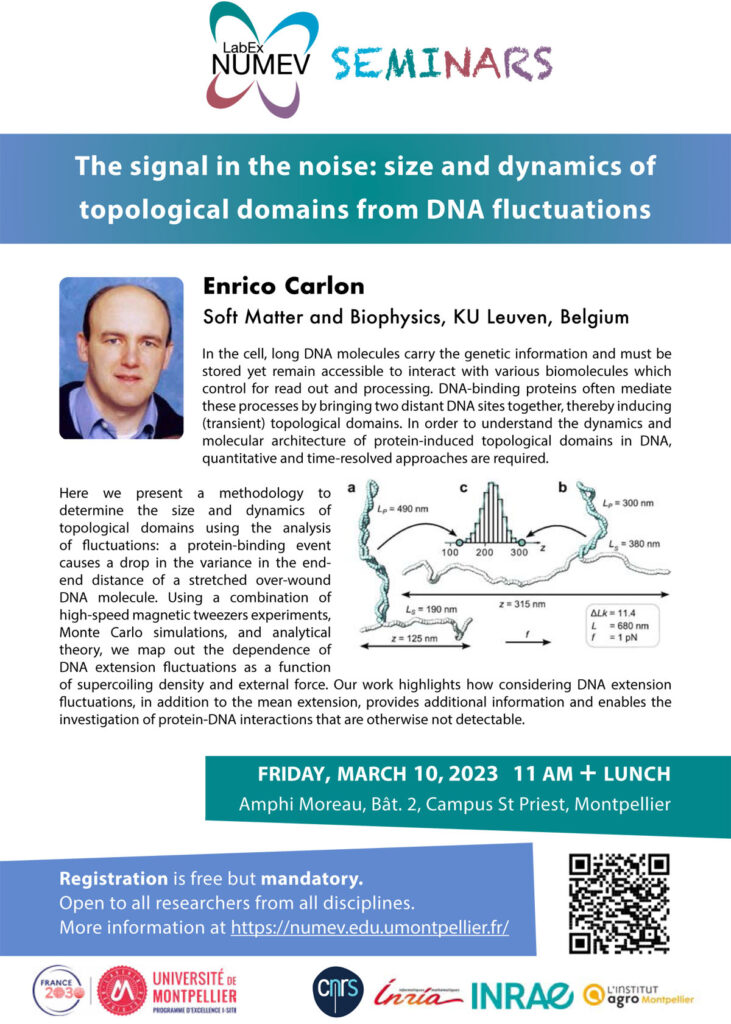
"The Signal in the Noise: Size and Dynamics of Topological Domains from DNA Fluctuations"
Enrico Carlon, Soft Matter and Biophysics, KU Leuven, Belgium
Abstract
Within the cell, long DNA molecules carry genetic information and must be stored while remaining accessible to interact with various biomolecules that control their readout and processing. DNA-binding proteins often mediate these processes by bringing two distant DNA sites together, thereby inducing (transient) topological domains. To understand the dynamics and molecular architecture of protein-induced topological domains in DNA, quantitative and time-resolved approaches are required.
Here we present a methodology for determining the size and dynamics of topological domains through the analysis of fluctuations: a protein-binding event causes a decrease in the variance of the end-to-end distance of a stretched, over-wound DNA molecule. Using a combination of high-speed magnetic tweezers experiments, Monte Carlo simulations, and analytical theory, we map out the dependence of DNA extension fluctuations as a function of supercoiling density and external force. We demonstrate how transient (partial) dissociation of DNA-bridging proteins leads to dynamic sampling of different topological states.
Our work highlights how taking into account fluctuations in DNA extension—in addition to the average extension—provides additional information and enables the investigation of protein-DNA interactions that would otherwise be undetectable.
Receive a weekly summary of theUM 's schedule
* By entering your email address, you agree to receive a weekly summary of the “UM ” calendar via email and acknowledge that you have read ourprivacy policy. You can unsubscribe at any time by using the unsubscribe linkor by contacting us via email.
News
Nemesis: An Exceptional ERC Synergy Project That Is Starting to Prove Its Worth
Published on: September 3 , 2026
Two years after its official launch, the first scientific report from the Nemesis project…