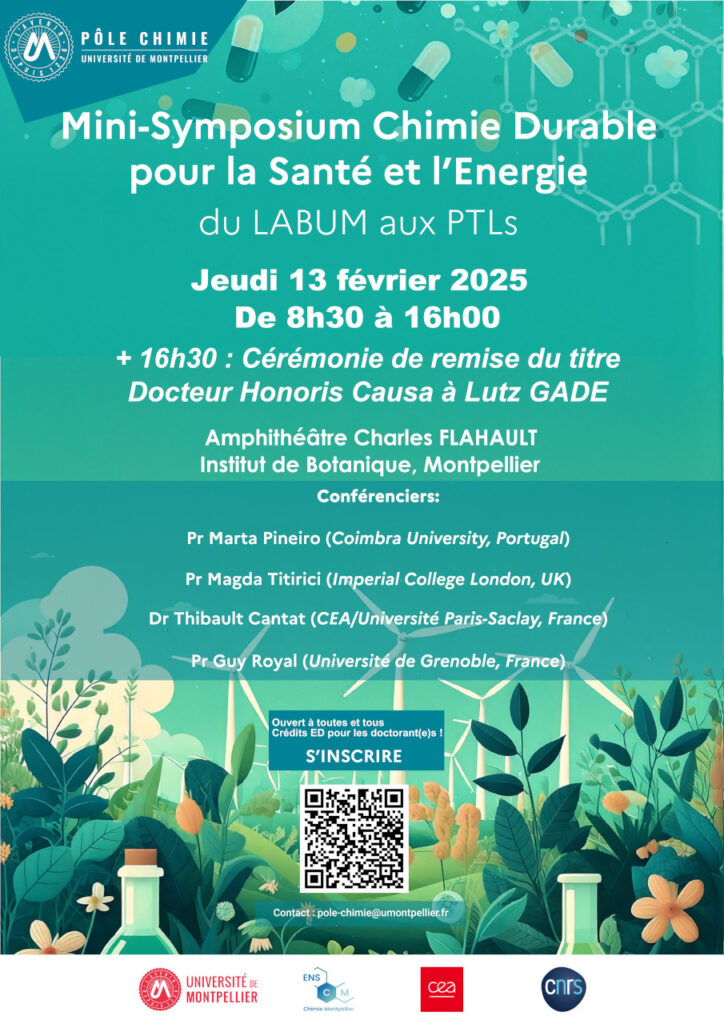
Mini-Symposium on Sustainable Chemistry for Health and Energy: From LABUM to PTLs
This event has already taken place!
This mini-symposium will serve as the official launch of the Chemistry Cluster’s Long-Term Thematic Projects (PTL): CARLA and CHIMENE. It will provide an opportunity to present the themes of both PTLs through presentations by national and international researchers, and to foster discussion among participants.
The event will be followed by theceremony conferring anhonorary doctorate from the University of Montpellier onProfessor Lutz Gade(University of Heidelberg, Germany).
Program
8:30–9:00 a.m.: Welcome coffee
9:00–9:45 a.m.: Introduction
- Chair UM : Philippe Augé, Jacques Mercier, François Pierrot
- Labex/LabUM Director: Stéphane Pellet-Rostaing
- Director of the Chemistry Division: Joulia Larionova
9:45–10:00 a.m.: Presentation on PTLs
10:00 a.m.–11:00 a.m.: Plenary Session with Marta Pineiro (University of Coimbra, Portugal)
11:00 a.m.–12:00 p.m.: Plenary Session with Thibault Cantat (CEA Saclay)
12:00 p.m.–1:30 p.m.: Lunch cocktail reception
1:30–2:30 p.m.: Plenary Session with Guy Royal (University of Grenoble)
2:30–3:30 p.m.: Plenary Session: Magda Titirici (Imperial College, London)
3:30–4:30 p.m.: Break – coffee
4:30 p.m.–6:00 p.m.: Ceremony to confer the honorary doctorate on Lutz Gade
6:00–7:00 p.m.: Cocktail reception
Guest speakers:
- Prof. Marta Pineiro(University of Coimbra, Portugal); “In Search of Sustainable Methods for the Synthesis of Unique Heterocycles”
- Dr. Thibault Cantat(CEA, Atomic Energy and Alternative Energies Commission, IRAMIS Institute, NIMBE, France; “Catalysis for a circular carbon economy: CO2 chemistry and chemical recycling of waste plastics”)
- Prof. Guy ROYAL (University of Grenoble, France); “Perfluoroalkyl and Polyfluoroalkyl Substances (PFAS): Issues and Current Research Activities”
- Prof. Magda Titirici(Imperial College London, UK); “Sustainable batteries and electrocatalytic processes”
About the speakers:
Dr. Marta Pineiro earned her bachelor’s degree in chemistry from the University of Santiago de Compostela in Spain. During her final year of undergraduate studies at the University of Coimbra (UC) as part of the Erasmus Program, she laid the groundwork for her Ph.D. in organic synthesis, which she completed in 2002 at UC. Since 2010, she has held a tenured position at UC, where she is currently an associate professor with habilitation.
Throughout her career, she has consistently taken an interdisciplinary approach to both research and teaching. As an assistant professor in the UC Department of Chemistry, she continued her research on the synthesis of tetrapyrrolic macrocycles and their biological applications, and explored Green Chemistry technologies for sustainable organic synthesis. Her research in this area led to the establishment of the Green Chemistry group at the Coimbra Chemistry Center (CQC), which she currently coordinates. Marta’s commitment to Green Chemistry aligns with its pivotal role in global sustainability. Her multidisciplinary background enables her to engage in collaborative projects both within and beyond the CQC. She has published more than 100 papers in international journals, 10 book chapters, and 3 patents. Marta has supervised over 40 internships, 16 master’s theses, and 8 doctoral dissertations. Additionally, her involvement in scientific outreach includes organizing scientific events and contributing to the promotion of chemistry in secondary schools.
Marta served as Vice President of the Scientific Board of the Department of Chemistry and as Assistant Director of the Department of Chemistry (currently). She served as Assistant Secretary General and Deputy Director of the journal *Química*, published by the Portuguese Chemical Society (SPQ), where she currently serves as Treasurer. Since 2009, she has been a member of the scientific council of the Department of Chemistry at the UC, and since 2014, a member of the scientific committee of the CATSUS (catalysis and sustainability) Ph.D. program.
Dr. Thibault Cantat is a group leader at the French Alternative Energies and Atomic Energy Commission (CEA). He earned his Ph.D. in chemistry in 2007 from the École Polytechnique in France. He then received a Director’s Postdoctoral Fellowship at Los Alamos National Laboratory to study uranium and thorium chemistry. Upon returning to France in 2009, he established a research group at CEA Saclay focused on the activation and recycling ofCO₂, the depolymerization of waste plastics, and the valorization of wood lignin. He has published over 120 research articles and has received three grants from the European Research Council. Since 2020, he has served as Program Leader for the Carbon Circular Economy at CEA.
Professor Guy Royal is a professor at the University of Grenoble Alpes and conducts research at the University of Savoie Mont Blanc. Professor Royal completed his Ph.D. in 1998 at the University of Burgundy (Dijon) under the supervision of Professor Roger Guilard, focusing on organic synthesis and coordination chemistry (an industrial project in collaboration with Air Liquide). He then moved to the United States for a postdoctoral fellowship in the field of electrochemistry at the University of Houston (USA) in the laboratory of Professor Karl Kadish. In 1999, he became an associate professor and was promoted to full professor in 2009 in Grenoble. He is currently a member of the Department of Molecular Chemistry, founded by Professor Pascal Dumy, at the University of Grenoble Alpes.
His research activities are multidisciplinary: organic synthesis, coordination chemistry, electrochemistry, and photochemistry in solutions and solid materials. Initially, he developed electrochemical sensors and later worked in the field of molecular switches (systems that can reversibly switch under the influence of external stimuli), including photochromic compounds (for electronics and healthcare applications). Today, he is conducting research at the Edytem Laboratory at the University of Savoie Mont Blanc, which focuses on mountain and environmental studies. In collaboration with a Grenoble-based company (as part of a joint ANR laboratory), Professor Guy and his team are developing PFAS sensors.
Professor Royal has been a member of the UFR Chemistry and Biology Council since 2012 and has served as Deputy Director and then Director of the Doctoral School of Chemistry and Life Sciences (approximately 400 doctoral students) for 11 years. He has also been a visiting professor in China since 2016. Professor Royal has over 100 peer-reviewed publications, 3 book chapters, and is the co-inventor of 7 patents.
Prof. Magda Titirici earned her B.S. from the University of Bucharest, her M.S. jointly from the University of Rostock and the University of Bucharest, followed by a Ph.D. that she began at Johannes Gutenberg University Mainz and completed at the University of Dortmund in 2005. She spent two years as a postdoctoral researcher at the Max Planck Institute of Colloids and Interfaces in Potsdam, near Berlin, before becoming an independent group leader at the same institute. Magda obtained her German “Habilitation” in 2013. She then moved to the UK to take a “Reader” position at the School of Engineering and Materials Science, Queen Mary University of London, and was promoted to “Professor” just one year later. In 2019, Magda joined the Department of Chemical Engineering at Imperial College London as Chair in Sustainable Energy Materials. Magda holds an RAEng Chair in Emerging Technologies. She also served as “Director of Research” for the Department of Chemical Engineering from 2020 to 2022. She is the President-Elect of the Materials Chemistry Community Council at the Royal Society of Chemistry, a Wallenberg Initiative Materials Science for Sustainability (WISE) Guest Professor at Stockholm University, and an International Principal Investigator at the Advanced Institute for Materials Research (AIMR) at Tohoku University in Sendai, Japan.
Magda’s research focuses on sustainable materials for energy storage and conversion; she has published approximately 400 papers and has been listed among Clarivate’s “Highly Cited Researchers” since 2018. Her research has been recognized with numerous awards, including the 2018 Corday-Morgan Prize from the Royal Society of Chemistry; the 2016 Rosenhain Medal and the 2021 A. Griffith Medal and Prize from the Institute of Materials and Mines; the 2021 Royal Society Kavli Medal from the Royal Society; and the 2023 Imperial College President’s Award for Excellent Research Team, among others.
Magda leads a large (40-person) and very diverse research team (50% women) at Imperial College London. In 2023 alone, four members of her groups were awarded prestigious fellowships (Royal Society Research Fellow, Imperial Fellowship, Royal Academy of Engineering Fellowship) and academic positions at esteemed universities in the UK. She has secured numerous grants and is involved in many projects with the developing world, and she is an active member of the Africa Materials Research Society (MRS).
Magda has received over 20 million in funding from RAEng, EPSRC (principal investigator of a program grant and a strategic equipment grant on automation for energy research), the Faraday Institution (LISTAR, NEXGENA), the Royal Society, the EU, and industry (collaborations with BP, Shell, Petronas, Sinopec, Total, Toyota, etc.).
Join us for this inspiring and collaborative day where the pursuit of excellence and sustainable innovation come together to tackle the challenges of tomorrow!
Free event open to everyone
Opportunity for doctoral students to earn course credits!
Receive a weekly summary of theUM 's schedule
* By entering your email address, you agree to receive a weekly summary of the “UM ” calendar via email and acknowledge that you have read ourprivacy policy. You can unsubscribe at any time by using the unsubscribe linkor by contacting us via email.
News

The AAP TALENTS – PTL CARLA and CHIMENE from the Chemistry Division
Published on: October 6 , 2026
As part of the I-SITE Program of Excellence (PEI) at the University of Montpellier (UM) and the…