What Does the Future Hold for Socio-Ecological Transformation? Solutions, False Solutions, and Alternatives
This event has already taken place!
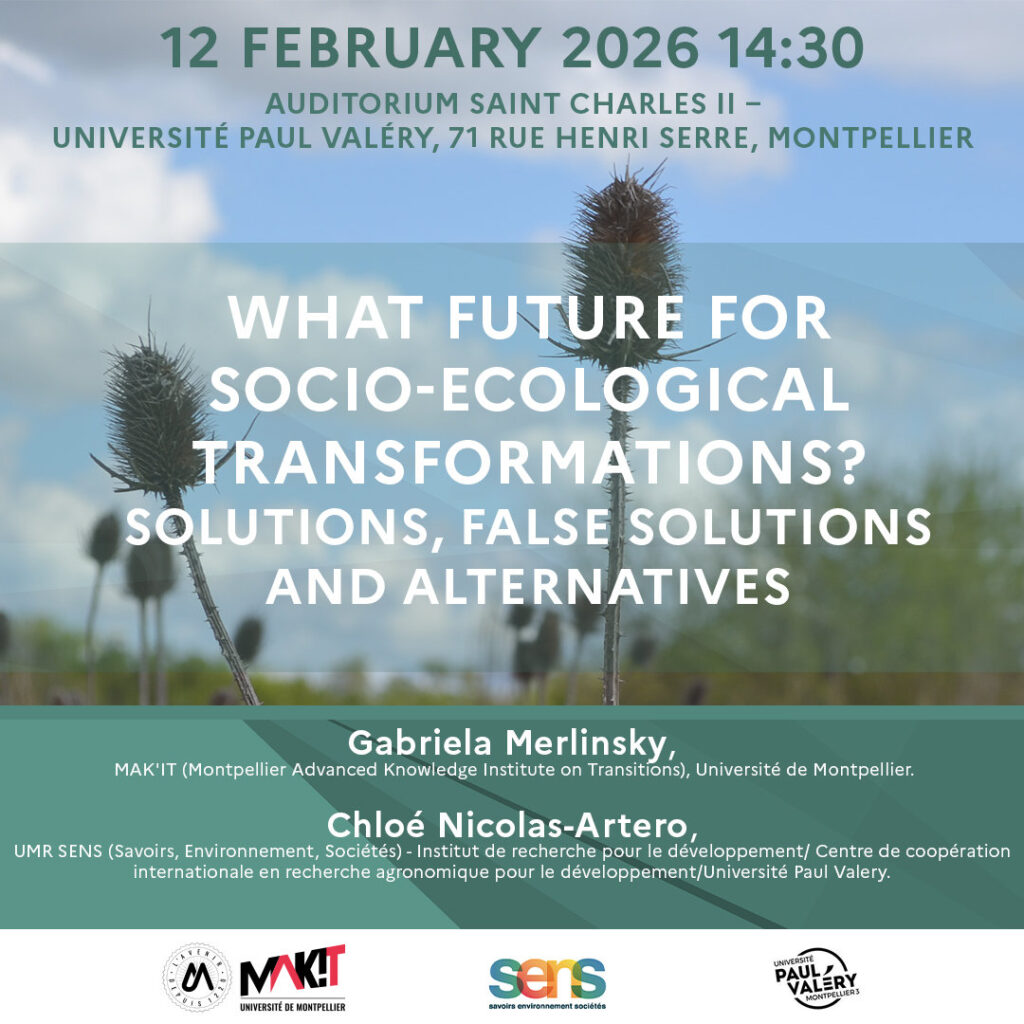
The MAK’IT Institute for Advanced Studies is pleased to invite you to the seminar organized by Gabriela Merlinsky, currently a researcher at MAK’IT and full professor of environmental sociology at the Faculty of Social Sciences at the University of Buenos Aires.
About this conference
Over the past decade, discussions about socio-ecological transformation have garnered growing interest due to the collapse of the agreements that underpinned global governance, the increasing overlap of social, political, health, geopolitical, economic, and ecological crises, and the emergence of Green New Deal (GND) proposals.
The major debate of our time centers on the significance of the socio-ecological crisis and how to address it. The prevailing view focuses on ensuring access to raw materials for certain countries or regions. In this context, decarbonizing the economy implies decoupling economic growth from resource use and its environmental impact. However, it is far from clear how the necessary absolute reduction could be achieved within the framework of the economic growth paradigm.
Three key points deserve clarification. First, it is imperative to challenge the reductionist view that socio-ecological transformation is exclusively linked to the debate on the energy transition. Second, it is essential to examine how the energy transition is being implemented and who will bear the costs. In the current context of the global crisis, it is crucial not to limit ourselves to the authoritarian solutions being proposed. It is imperative to explore alternatives to ensure effective and sustainable management of the situation.
The aim of this seminar is to bring together existing research from Latin America and Europe in order to explore scenarios for socio-ecological transformation that take into account complex social and political implications. As part of this effort, we will conduct a joint examination of the social, economic, and cultural changes required to achieve a just and pluralistic society.
Receive aUM summary of theUM calendar
* By entering your email address, you agree to receive a weekly summary of theUM calendarUM email and acknowledge that you have read ourprivacy policy. You can unsubscribe at any time by clicking the unsubscribe linkor by contacting us via email.
News
Rouages: “I feel like I’m breaking through deadlocks”
Published on: May 29 , 2026
Yvan Duhamel is a mechanical manufacturing engineer at the Pro 3D platform of the unit…