HiPhiS Seminar: “The Science of Law and Causality”
This event has already taken place!
Tuesday, December 12, 2017, from 5:30 p.m. to 7:30 p.m.
School of Law, Lecture Hall 001 Pétrarque, Ground Floor, Building 2
Free admission
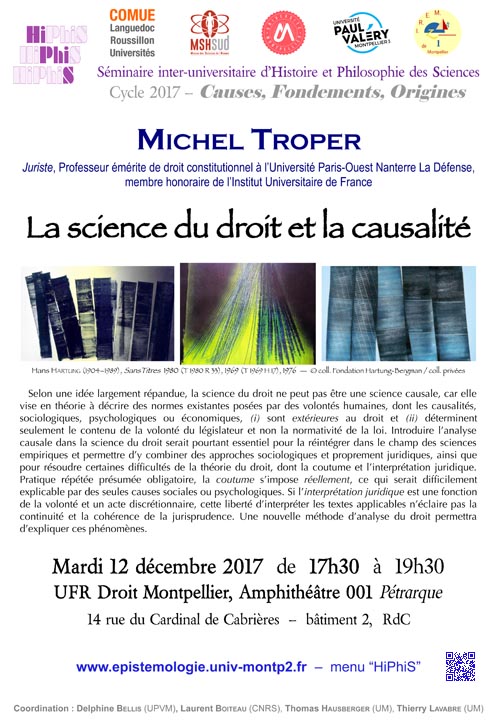 Interuniversity Seminar on the History and Philosophy of Science, 2017 Series: “Causes, Foundations, Origins.”
Lecture presented by Michel Troper, legal scholar, Professor Emeritus of Constitutional Law at the University of Paris-Ouest Nanterre La Défense, and honorary member of the IUF.
Abstract:
The title of this presentation may seem to contain a contradiction in terms. Indeed, there is a significant school of thought that challenges the very idea of a science of law, but among those who accept it, there is a debate between scholars who believe that law is a science and others who argue that, while law itself may not be a science, it can be the subject of a specific science. In either case, it cannot be a causal science. For if law itself is a science, it is because jurists (particularly judges) would be capable of discovering the just solution in every case, but the process of discovery would owe nothing to causal analysis.
On the other hand, a science of law would have to limit itself to describing existing norms—that is, norms established by human will. These acts of will are certainly the product of a series of causes; however, on the one hand, these causes are sociological, psychological, or economic in nature and therefore lie outside the realm of law, and on the other hand, they determine only the content of the will and not its normativity. This explains the formation of the legislator’s will, but not the binding nature of the law, which results solely from conformity with the constitution, whereas the constitution itself cannot be considered the cause of the law.
The introduction of causal analysis into legal science would, however, be of great importance, both for reintegrating legal science into the realm of empirical sciences, for enabling the combination of the sociological approach with the strictly legal approach, and for resolving some of the difficulties in legal theory. These include, in particular, custom and interpretation. Custom is a repeated practice, regarded as binding, which becomes legally binding in fact. However, while repetition or the belief in its binding nature can be easily explained by social or psychological causes, its actual binding nature cannot be explained in this way. It is now widely accepted that legal interpretation is, at least to a large extent, a function of will and a discretionary act. Yet, if the interpreter is free to ascribe any meaning they wish to the applicable text, it is difficult to understand the continuity and coherence of case law.
We will therefore present a method of legal analysis that accounts for and explains these phenomena.
Learn more
News

A “liminal space” between humans and AI: Will the boundary be less distinct than we might think?
Published on: October 14 , 2026
There is something strangely reassuring about the way we keep talking…