When Science Takes Center Stage
This event has already taken place!
The Science Film Festival Sud de Sciences is back for its5th edition. Seven feature-length films—most of which were co-produced by research organizations—as well as six short films directed by students will be in competition this year. The screenings are free and open to the public and will take place in Clapiers, Montpellier, and Sète.
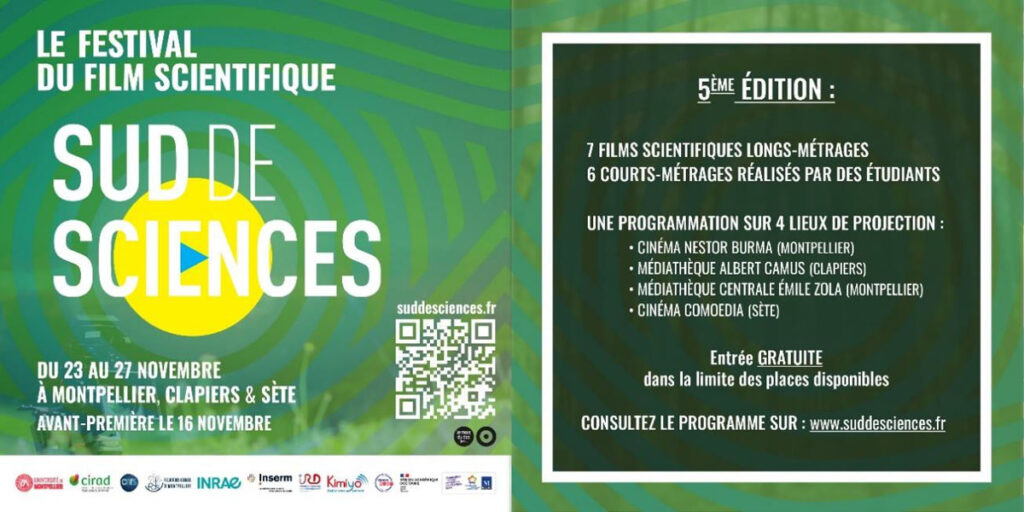
Dengue, chikungunya, Ebola, and of course COVID-19—the number of emerging diseases has been on the rise over the past forty years. How can we explain this increase? That is the question the documentary *La fabrique des pandémies* sought to answer. The film was screened on November 16 at the Nestor Burma municipal theater as part of the preview for the Sud de Sciences festival, which will take place from November 23 to 27.
Launched in 2018 in Montpellier, Sud de sciences follows in the footsteps of the Paris Sciences science film festival, with the added goal of “being entirely free and accessible to everyone,” emphasizes Agnès Pesenti, head of science communication at the University of Montpellier. “Through this event, the university reaffirms its commitment to strengthening the relationship between science and society through screenings of science films followed by discussions with researchers,” she adds. Sud de sciences is also part of the program for Mois du doc, a national event held every November to promote documentary film to the general public.
Seven documentary films
For this fifth edition, seven feature-length documentary films in the professional category were selected by a steering committee composed of researchers fromIRD, CIRAD, CNRS,INRAE, andINSERM—the five partner organizations of this festival and co-producers of some of the documentaries featured in the program. “The films were chosen based on their documentary and cinematic quality, of course, but also on how well they align with the major research areas being developed in Montpellier,” explains Agnès Pesenti.
Each screening will be followed by a discussion with a researcher from Montpellier who specializes in the subject, to answer questions from the audience and put current events into perspective. The magnificent documentary *Mamody, the Last Baobab Digger*, filmed in southwestern Madagascar, raises the issue of access to water. *When Man Is Not There, the Animals Dance* shows how wildlife was able to reclaim cities during the few weeks of lockdown. *Climate: My Brain Is Burying Its Head in the Sand* questions our inaction in the face of the looming ecological catastrophe…
Student Short Films
A major new feature of this year’s festival is the introduction of a new award in the “Student Film” category. As a result, each feature film will be preceded by a short film directed by science students. “We issued a national call for films and selected six in total,” continues the head of science outreach. “As with the feature films, the short films will be put to a public vote (see box) and awarded a prize at the festival’s closing ceremony.”
Another new feature for 2022: the screening venues. “Thanks to a strengthened partnership with the City of Montpellier and the Montpellier Metropolitan Area, this year we’ll be screening films at venues that allow us to welcome a larger and more diverse audience,” says Agnès Pesenti. The festival will kick off on Wednesday, November 23, with a screening at the Clapiers media library, before moving to the Emile Zola media library in Montpellier for the rest of the week. On Sunday, a final screening will take place at the Comoédia cinema in Sète with a repeat showing of *Mamody, the Last Baobab Digger*.
News
"Mosquito-repellent clothing": myth or reality?
Published on: July 24 , 2026
With the arrival of summer, they’re back—insatiable biters, as elusive as a summer breeze…