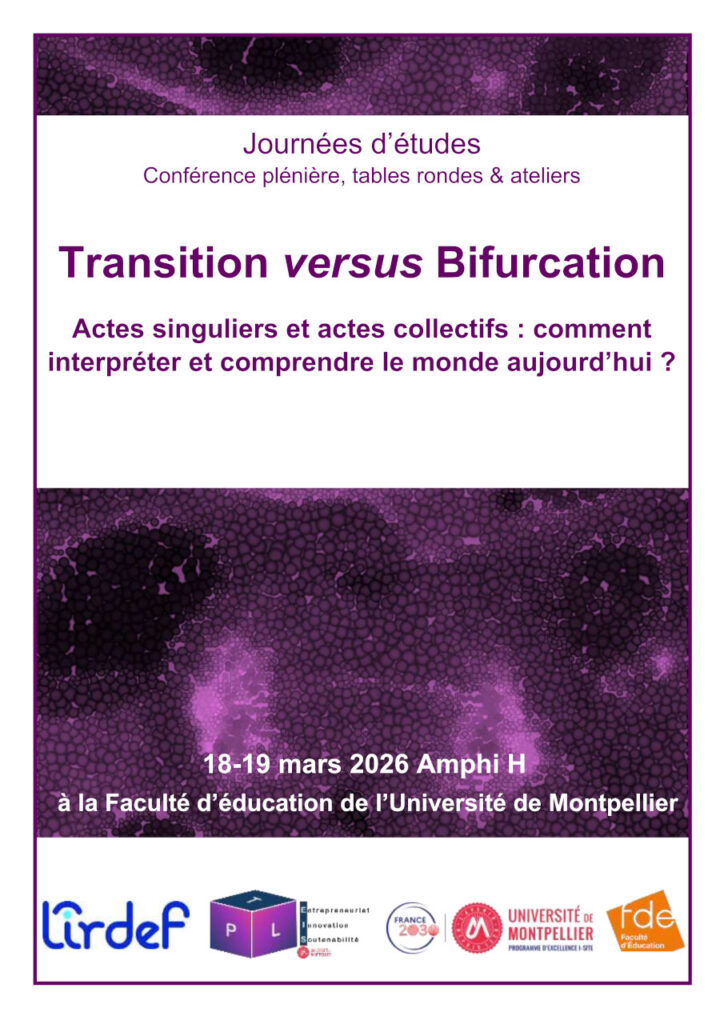
Transition versus Bifurcation: “Individual and Collective Actions: How Can We Interpret and Understand the World Today?”
This event has already taken place!
The concepts of transition and bifurcation now occupy a central place in scientific, political, and institutional discourse on ecological, technological, and social transformations. Transition is generally understood as a gradual, linear, and manageable process based on societal adaptation.
Conversely, a fork in the road refers to dynamics of disruption, characterized by uncertainty, nonlinearity, and choices that are difficult to reverse.
Drawing on critical scholarship in the humanities and social sciences, we find that the dominant narrative of transition tends to obscure the political conflicts, normative choices, and power relations at work in contemporary transformations. These trajectories are not merely technical adjustments, but involve institutional trade-offs and sociotechnical imaginaries that render certain futures more legitimate than others.
The study days thus aim to examine these analytical frameworks by fostering a dialogue between the sciences, the arts, and public engagement, in order to better understand and respond to a context of systemic crisis. They highlight the contribution of artistic practices and responsible innovation to reflecting on situations of upheaval, strengthening individual and collective agency, and developing a critical and sensitive approach to transformation.
Receive a weekly summary of theUM 's schedule
* By entering your email address, you agree to receive a weekly summary of the “UM ” calendar via email and acknowledge that you have read ourprivacy policy. You can unsubscribe at any time by using the unsubscribe linkor by contacting us via email.
News

The AAP TALENTS – PTL CARLA and CHIMENE from the Chemistry Division
Published on: October 6 , 2026
As part of the I-SITE Program of Excellence (PEI) at the University of Montpellier (UM) and the…