45 Measures for Greater Inclusion of People with Disabilities
Success, competence, and commitment: these are the three pillars of the new disability master plan approved by the University of Montpellier’s Board of Trustees. It will take four years to collectively implement these 45 new measures designed to promote the inclusion of people with disabilities. Interview with Agnès Fichard-Carroll, Vice President for Social Responsibility.
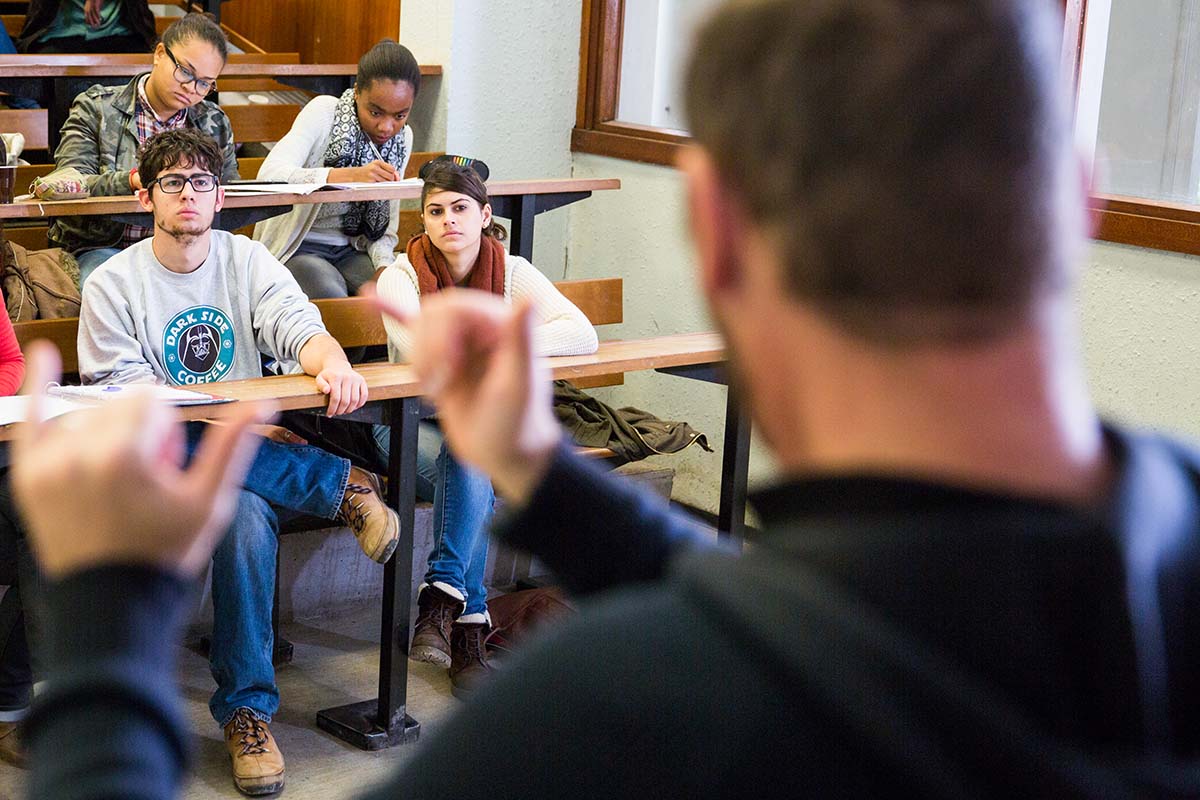
Support session for people with hearing impairments. Alexis and Charlène are taking a “Système Terre” class, accompanied by an interpreter. Triolet Campus. © UM- David Richard / Transit
To begin with, perhaps, what exactly is the purpose of a disability master plan?
Implementing a disability master planis a legal requirement, but it is also an opportunity—an opportunity to reflect on our attitudes and practices regarding disability, to set goals for improving them, and then, over the course of four years, to achieve them. I don’t think you’ll find anyone who says they don’t want to include people with disabilities, but in reality, challenges persist. We need to adopt a proactive policy in this area to make progress.
Which departments were involved in developing this new master plan?
The Handiversité Department within the Campus Life Division is the department leading this project. It is responsible for welcoming, supporting, and promoting the inclusion of students and staff with disabilities. The Joint Office for Preventive Medicine and Health Promotion (SCMPPS) obviously plays a crucial role, as does the Human Resources Department when it comes to staff. We have highly competent and dedicated departments. But disability is a truly cross-cutting issue, and I would say that virtually all departments and divisions, as well as the academic units (UFRs), schools, and institutes, are involved within the university. I am delighted by their participation and commitment to developing this plan. And, of course, we have met with people with disabilities themselves—both students and staff.
This is the university’s second master plan. What was the outcome of the first one?
The previous one covered the 2016–2019 period and proposed 73 actions. Thanks to the involvement of the university’s departments and units, more than sixty measures have been implemented or are currently being implemented. About ten others proved difficult to implement but, more often than not, have become irrelevant over time. Without wanting to sound self-congratulatory—since there is still a long way to go—the results are encouraging: we have put in place measures that are working, we are seeing the positive effects of the actions taken, and this is particularly evident in the increase in the number of students and staff with disabilities at the university.
How many people with disabilities does the university employ?
We are among the universities with the highest percentages of employees with disabilities. The figure stood at 4.58% in 2018, up from just 3.31% in 2016. This is a positive trend that is gradually bringing us closer to the 6% mandated by law, but we must not rest on our laurels. We still have work to do, and several factors now help us better understand the challenges we face in reaching this threshold. Among them is the high percentage of highly qualified individuals at the university, while it is well established that people with disabilities often lack adequate training. We do not always have direct control over these issues, but there are steps we can take to address them.
And how many students?
The average percentage of students with disabilities at universities was 1.64% (learn more) in 2020. The University of Montpellier saw this figure rise from 1.6% for the 2015–2016 academic year to 2.31% in 2018–2019, and this number continues to grow. This is a source of satisfaction for us and proof that the support measures we’ve put in place are helping more students gain access to higher education. In turn, this increase compels us—and has encouraged us—to take the proposed measures even further.
What exactly is new in the second disability master plan?
45 new measures that we must collectively implement over the next four years to ensure the successful inclusion of every person with a disability. We’ve titled it “Success, Competence, and Commitment.” These are action-oriented terms—positive words to describe disability. We want to talk about the success of students with disabilities and the skills of our staff members with disabilities. They are here to learn or to carry out a task for which they are qualified; it’s up to us to provide them with the right conditions to do so.
What are the key initiatives aimed at students?
Some are specific to the University of Montpellier, such as the development of the second phase of the Handy app [see box] and the provision of internship stipends for master’s students. The Student Services Office (UM ) is also a partner in the “New University Curriculum” project, known as Aspie Friendly, for students with Asperger’s syndrome. While this affects only a small number of students, we hope that the measures put in place will also be applicable to other types of disabilities. In collaboration with the Student Vice President, we offer specific forms of financial aid. We are also strengthening our support for students who are hospitalized.
Is there a specific program for first-year students?
Student support is one of the cornerstones of the initiatives designed for all students with disabilities, and of course we pay a little more attention to first-yearstudents. Starting college can be a bit overwhelming for all young people, whether they have a disability or not. We need to make sure we smooth out the difficulties.
For students with severe disabilities, specialized support from educational assistants will continue, as will disability-specific tutoring. Our goal, however, is to support them on their journey toward the greatest possible independence.
Does this include study abroad programs, since they are also covered by this master plan?
Yes, students with disabilities who wish to study abroad or come to France as exchange studentsUM should receive special attention, which theUM intends to promote within the framework of, for example, the Erasmus+ or CHARM-EU programs.
Regarding staff, what are the new developments or measures that have been extended?
For staff, we have made it easier to implement remote work in situations where it is necessary. We are offering faculty members with disabilities a reduction in teaching load modeled after the policy applicable to other faculty members. One of the challenges, as I mentioned earlier, is recruiting highly qualified personnel; despite the annual opening of reserved positions, this remains difficult. This is an area of focus, and we intend to work specifically on recruiting Category A staff. We also offer social assistance programs that are working well and which we have therefore expanded. It is also our practice, whenever institutional guidelines are proposed, to take into account the needs of people with disabilities.
Does this also apply to research?
The institution has made a significant investment in recruiting doctoral students. Of the 25 doctoral contracts funded annually by the Ministry under the disability program, the “UM ” has been able to secure one each year. This is thanks to the scientific quality of the proposed projects, of course, but also to the support provided by our departments (DRED, DVC, etc.) in putting together the applications, in particular. And every year, the “UM ” also funds a doctoral contract under the disability program. In total, the University has 7 doctoral students with disabilities who benefit from a disability-based doctoral contract. We also have leading research teams working in the field of disability, and every year we organize a highly successful conference featuring one of our researchers.
Have special efforts been made in the areas of communication and information?
Yes, communicating about rights and the services offered by the university is essential. For staff members, an informational brochure on declaring a disability was created and sent to all employees. Whenever we send out this type of information—whether regarding social initiatives or disability—we receive inquiries from staff members; it’s very important to raise awareness of existing resources through various channels. We know that even today, some people are hesitant to register their disability; we understand this—it’s a strictly personal choice. We simply believe it’s important to inform them about the benefits this registration could provide. Ideally, no one should face difficulties in their job due to a disability.
The third component of the master plan actually focuses on the inclusion of people with disabilities and raising awareness among those who work or study with them.
Yes, our goal is to help change perceptions of disability, which are often biased in all of us—and this is particularly true for invisible disabilities. All too often we still hear: “But there’s nothing wrong with him!” Yet it’s important to know that motor disorders account for only 17% of disabilities among students. Language and speech disorders—which account for about 30% of the disabilities we encounter among students—as well as mental health disorders (12%) are common conditions. These disabilities—and other equally invisible types—can lead to misunderstandings. It is essential to train and raise awareness among all teaching, administrative, and technical staff by offering workshops and targeted presentations. An awareness-raising initiative is also being carried out in collaboration with student organizations.
And regarding the inclusion of people with disabilities in university life more generally, where does the University stand?
Access to social events—whether large or small—access to sports, libraries, and artistic, scientific, and technical culture, as well as access to campus facilities, of course, must be a constant priority. The Campus Life Division, which houses the Handiversity Office, is particularly vigilant in ensuring that the activities offered by its departments—whether in Quality of Life at Work, Social Services, Student Life, or Art & Culture (such as the “culturesponsable” program)—are accessible. The SUAPS also offers adapted sports activities. The university has also implemented a planned accessibility agenda, led by the DPI, regarding real estate, and the DAGI has worked to make theUM ’s procurement policy more responsible. I cannot name every department, but I would like to take this opportunity to thank them all; as I mentioned, this is an issue in which everyone is involved.
How are these measures funded?
The university is committing the necessary human and financial resources to implement this policy, and that is another reason why progress is being made.
The "Handy" app
Conceived and developed by the Information Systems and Digital Technology Division, the Handiversité Office, and the Occupational Health Office at the University of Montpellier, the Handy app is the only one of its kind in France. It enables these two departments to centralize, process, and archive requests for academic and exam accommodations from students with disabilities, and to automatically send the corresponding notifications to academic units while strictly maintaining an appropriate level of confidentiality. This is a key asset in ensuring data reliability and the transmission of information between departments and academic units.
Launched in January 2020, this application continues to evolve and will, in particular, allow students to submit their requests for accommodations directly starting in early July. A second version, offering new features for academic departments, is expected next October. Reliability, efficiency, and simplicity for users, administrative offices, and teaching staff are the key strengths of this new application.