At theUM Science [S02-ep20]: The “My Thesis in 180 Seconds” Contest
This week on *A l’UM * science, Pauline Bron, Julie Bas, and Julie Cailler—all three winners of the regional finals of *My Thesis in 180 Seconds*—share their experiences in this science communication competition.
And today, I invite you to play “Question for a Champion.”
I'm… Great!
- I am a competition that began in 2008 in Queensland, Australia; I…
- A Kangaroo Contest!
- No… No, that's not it. Let me start over. In 2012, my concept was adopted in Canada before being…
- A Poutine Contest!
- No, not yet… Before it was taken over in 2013 by the University of Lorraine…
- Quiche…
- Not the quiche lorraine! In 2014, the competition expanded beyond France and took on an international dimension with the creation of a Francophone grand finale bringing together Canada, Belgium, France, and Morocco. In 2015, Senegal, Burkina Faso, Tunisia, and Cameroon joined the competition, followed by Benin, Indonesia, and Switzerland in 2016…
- A banking competition!
- No! This is an internationalscience communicationcompetition open toFrench-speakingdoctoral studentsfrom around the world. The task I propose to the candidates is to present their research in French to a diverse, non-specialist audience in the form of a clear, concise, and compelling presentation, using just one slide.
- … A slide show contest?
- Often approached with a sense of humor and using references topopular cultureand a variety ofmetaphors, I prepare future researchers to speak in public through coaching provided to the candidates by the doctoral colleges, which organize the regional finals. My name comes from the time limit imposed on each candidate to summarize their thesis in 180 seconds: I am… I am…
- Um… My thesis in 180 seconds!
- Yeees!!!
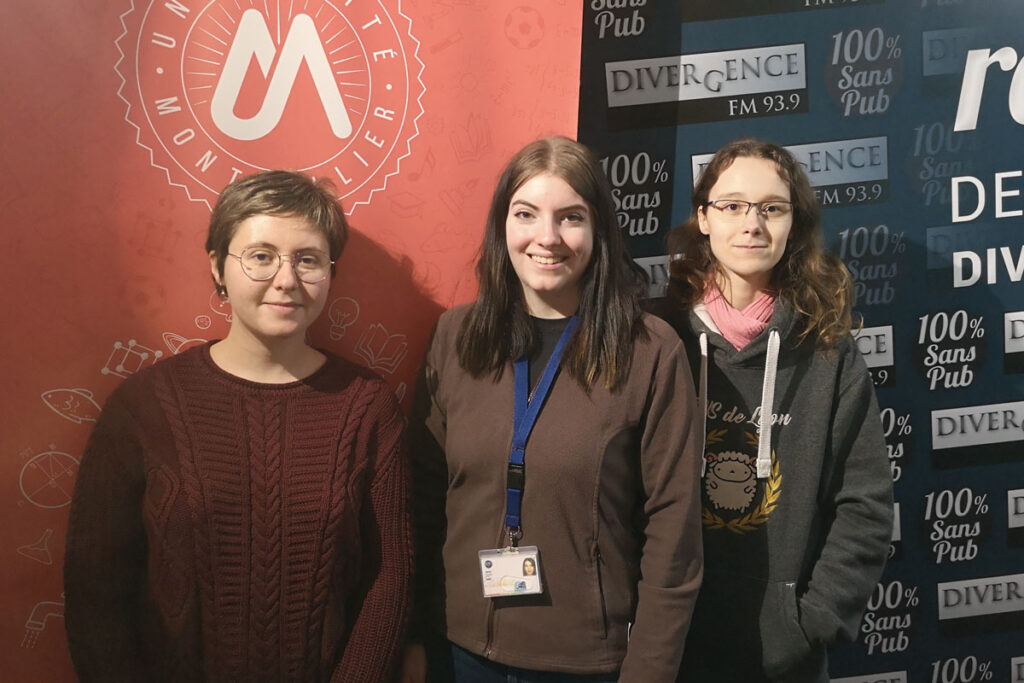
As you can see, today we are welcoming the winning contestants from the University of Montpellier—all of whom are women—from the regional finals of this competition, which took place in Nîmes on March 17.
Julie Bas is a doctoral student at the IGF, the Montpellier Institute of Functional Genomics, and wonsecond prize from the jury.
Julie Cailler is a doctoral student at LIRMM, the Montpellier Laboratory of Computer Science, Robotics, and Microelectronics. She received the jury'sthird prize.
Finally, Pauline Bron is a doctoral student at the ICGM ( Charles Gerhardt Institute) in Montpellier, and she received the People’s Choice Award and earned the right to compete in the national semifinals held in Paris on March 28.
We spent the next 30 minutes with her, and before we knew it, my three minutes were up.
And what about the jury’sfirst prize? It was awarded to Flo Sordes, a doctoral student at the University of Nîmes, whom we salute and congratulate.
At "UM : Science," here's the lineup—let's get started!
Co-production: Divergence FM / University of Montpellier
Host: Lucie Lecherbonnier
Interview: Lucie Lecherbonnier / Aline Périault
Directed by: Bruno Bertrand / Tom Chevalier
Listen to the show “A l’UM la science” on Divergence FM 93.9
Check out theUM podcasts, now available on your favorite platform (Spotify, Deezer, Apple Podcasts, Amazon Music, etc.).