UM atUM [S03-ep10]: Politics in Spain
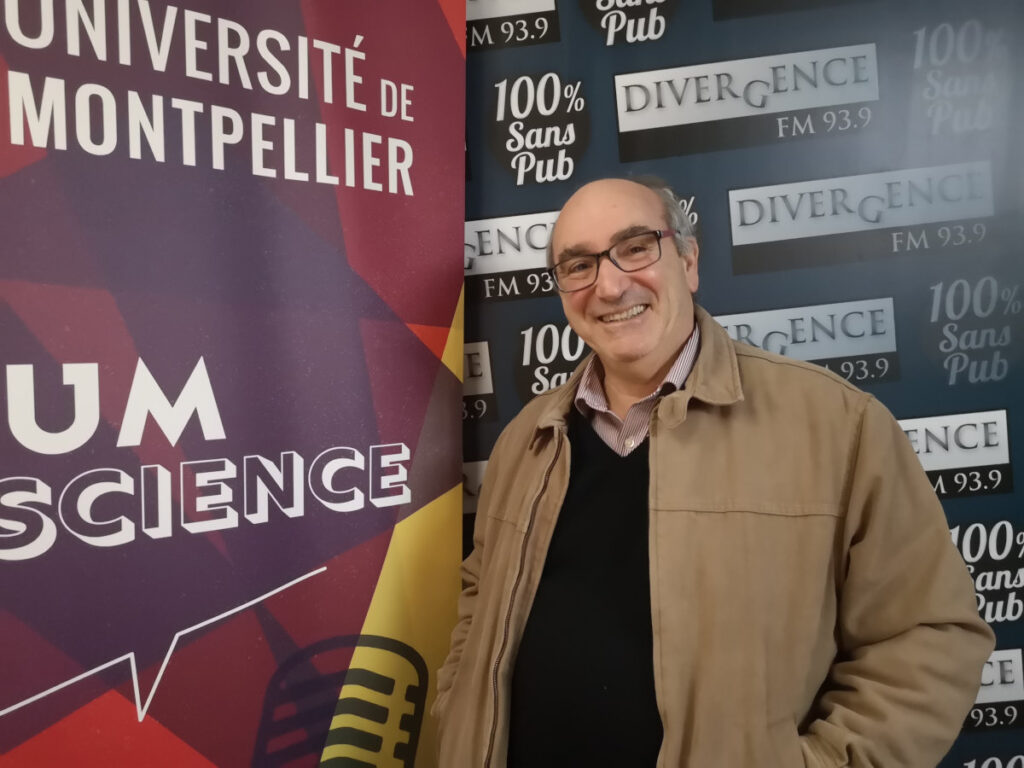
This week on *AUM science*, Hubert Peres, a researcher at Cepel—the Center for Political and Social Studies, which is celebrating its 40th anniversary this month—talks to us about his book *Politics in Spain*. Our last-minute guest is Christine Lerrede, who will introduce us to the upcoming OREME conference. A program co-produced with Divergence FM and broadcast every Wednesday at 6 p.m. on 93.9.
Forty years ago, CEPEL was founded in Montpellier. Established in 1983 under the leadership of Paul Alliès, a well-known figure in the Faculty of Law and Political Science, it was initially known as the “Center for Comparative Studies of Public Policy and Local Areas.” In 1999, Jean-Pierre Gaudin took over as director, and two years later, CEPEL became the “Center for Political Studies of Latin Europe,” thereby reflecting the close ties that the researchers in this team maintain with academic subjects and networks in Southern European countries.
In 2003, Hubert Peres took over as director of the laboratory. He was replaced in 2014 by William Genieys, but CEPEL has not yet completed its transformation. It was in 2020, under the leadership of Emmanuel Négrier, that CEPEL became the Center for Political and Social Studies to better accommodate the sociologists, philosophers, ethnologists, and even epidemiologists who had joined the team.
To celebrate 40 years of research, exchange, and collaboration, CEPEL is organizing an international conference on December 14 and 15 titled “The Territory in All Its Forms,” featuring a dozen presentations whose wide-ranging themes highlight the diversity of research topics at this 40-year-old research center.
And to join in the celebration, we’ve decided to invite a leading figure from CEPEL today: Hubert Peres, a political science researcher and former director of the laboratory. And the timing couldn’t be better, since he has just published a book titled *Politics in Spain* with La Découverte.
How did the Spanish nation come into being? How did the transition to democracy unfold after Franco? How did the push for independence and the push for autonomy develop? How has the current political landscape been reshaped? We’ll be discussing all these questions with him over the next 20 minutes.
Recommended reading:
- The chapters of the book *Politics in Spain* on Cairn.info.
- The Spanish General Election of April 28–November 10, 2019, in Pôle Sud, 2019.
- The Catalan elections of December 21, 2017, in Pôle Sud, 2018.
Our last-minute guest is Christine Leredde, a geophysicist at the Géoscience Montpellier laboratory. She introduces us to the next installment of the short lecture series hosted byOREME, the Montpellier Environmental Research Observatory, which will take place onThursday, December 14, from 1:00 to 2:00 p.m. on the Triolet campus, on the topic: Global Warming: Talking About It to Take Action.
AtUM , you’ve got the program—let’s get started!
Co-production: Divergence FM / University of Montpellier
Host: Lucie Lecherbonnier
Interview: Aline Périault / Lucie Lecherbonnier
Production: Alice Rollet
UM podcasts areUM available on your favorite platform (Spotify, Deezer, Apple Podcasts, Amazon Music, etc.).