At theUM of Science [S03-ep26]: 60 billion combinations of genetic variants
This week on *A l’UM *—the science segment—Gabriel Krouk, a biologist atIpsim, and Andre Mas, a mathematician atImag, talk to us about a world first: mapping the interactions between genetic variants in a plant. Caroline Ducourau, head of the Heritage Department, is our last-minute guest. She introduces us to the exhibition *Chongqing: On the Four Banks of Passing Time* by Cyrus Cornut, on view at the Orangerie in the Jardin des Plantes. A program co-produced with Divergence FM and broadcast every Wednesday at 6 p.m. on 93.9.
From the introduction of the concept of the gene and the laws of heredity in 1865, through the discovery of the structure of DNA by Rosalind Franklin, Watson, and Crick in 1953, to the breakthroughs of modern genomics, genetic research has never been able to shake off the fantasies it evokes in the general public. From *Welcome to Gattaca* to *Equilibrium* in film, or Orwell and Huxley in literature, dystopias that portray humanity in a eugenics-driven society have continually fueled our imaginations.
Paradoxically, in recent years, the internet has seen a proliferation of offers from American companies—such as MyHeritage and 23andMe—that claim to provide a detailed breakdown of your ethnic origins based on a DNA analysis or to reveal your own fate by predicting diseases hidden in the folds of your genes. “Oh, really? You can do that?” Yes, you can—and we won’t be explaining today why this recreational use of DNA isn’t medicine or just how likely your data is to be sold or hacked. Instead, we’ll explain how scientists can analyze the markers in our DNA to predict our diseases or trace our origins.
Even better! Our guests today will explain how they managed to develop—using plant DNA—a method that combines mathematics, genetics, and high-performance computing to create maps detailing tens of billions of interactions between genetic variants for a specific trait—a world first published in the journal *Genome Biology* on March 25.
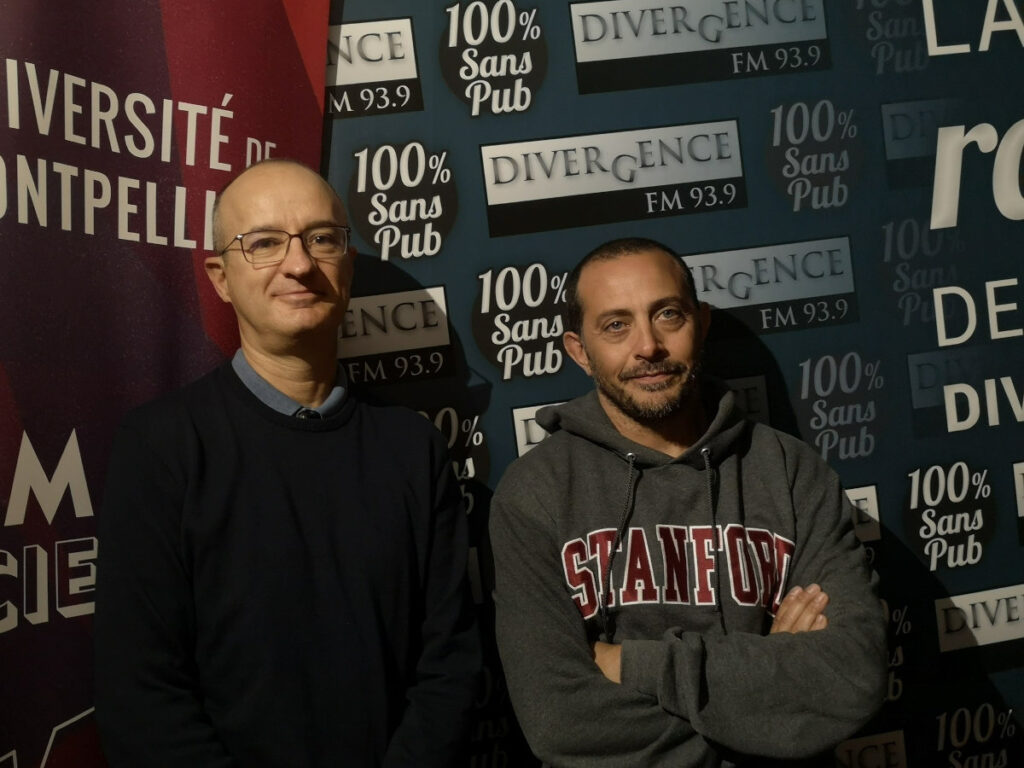
In the studio with Gabriel Krouk, a researcher at the Montpellier Institute of Plant Sciences, and Andre Mas, a researcher at the Montpellier Alexander Grothendieck Institute.
Recommended Reading:
- CNRS press release: A method for studying combinations of genetic variants specific to a particular trait.
- The publication in *Genome Biology*: Next-Gen GWAS: Full 2D epistatic interaction maps recover part of the missing heritability and improve phenotypic prediction
Our guest for the final three minutes will be Caroline Ducoureau, head of the Heritage and Scientific Culture Department. She will introduce us to the latest exhibition on view at the Jardin des Plantes through May 26: “Chongqing: On the Four Banks of Time,” by Cyrus Cornut , which can be seen through May 26 as part of the Boutographies photography festival.
At "UM : Science," here's the lineup—let's get started!
Co-production: Divergence FM / University of Montpellier
Host: Lucie Lecherbonnier
Interview: Aline Périault / Lucie Lecherbonnier
Directed by: Alice Rollé / Tom Chevallier
Listen to the show “A l’UM la science” on Divergence FM 93.9

Check out theUM podcasts, now available on your favorite platform (Spotify, Deezer, Apple Podcasts, Amazon Music, etc.).