"UM : Science" [S04-ep23]: Three Years of Thesis Work Summarized in Three Minutes
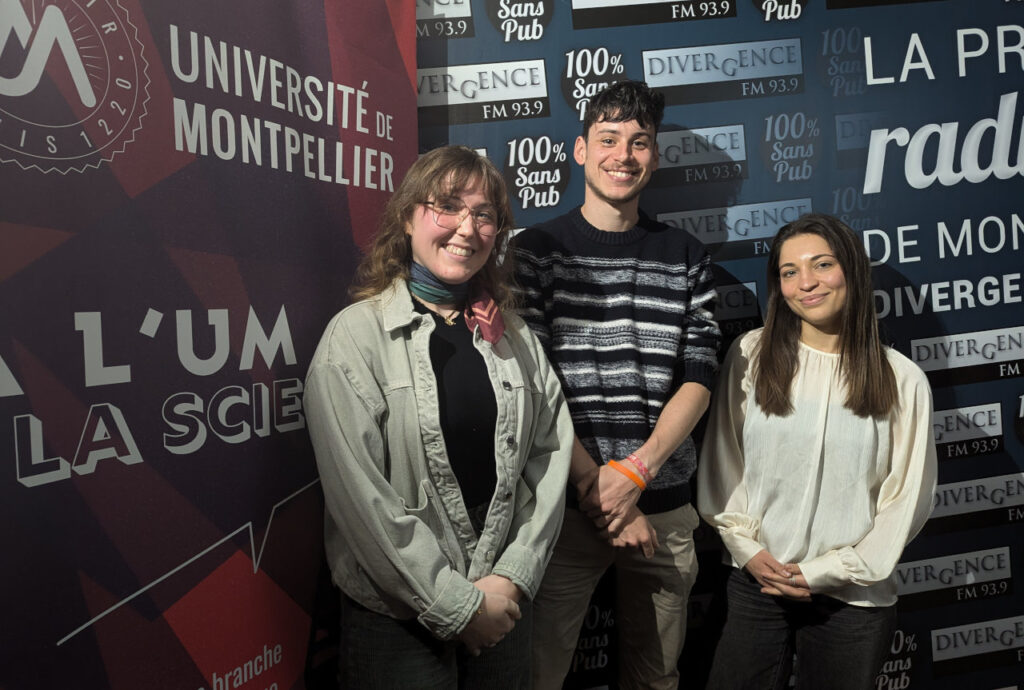
This week on *A l’UM * Science, doctoral students Jérémy Defrance from the Center for Functional and Evolutionary Ecology (Cefe), and Klara Asselin from the Infectious Diseases and Vectors: Ecology, Genetics, Evolution, and Control Laboratory (Mivegec), and Sandra Victor from the Montpellier Laboratory of Computer Science, Robotics, and Microelectronics (Lirmm) talk to us at length about the "My Thesis in 180 Seconds" competition, which they were the proud winners of. A show broadcast every Wednesday on the radio station Divergence.
In 2024, approximately 64,000 students were enrolled in doctoral programs. Forty-two percent of them had parents who were executives or worked in intellectual professions, 3.6 percent came from working-class backgrounds, and only 1.3 percent were children of farmers. This situation has, in fact, changed very little since Pierre Bourdieu’s early work on the subject in the 1960s. The reasons for this include, of course, social reproduction—which leads to selection based on social, economic, and intellectual capital—but also, perhaps, a lack of understanding among the general public of what a dissertation entails and what research is all about more broadly.
To make this ultimate academic exercise more accessible and popular, several initiatives have emerged, including “My Thesis in 180 Seconds.” Inspired by “Three-Minute Thesis,” which was created in Australia in 2008, the French-language version of this scientific competition was launched in Quebec in 2012 before making its way to France in 2014. The concept is simple: as the name suggests, present your thesis in 3 minutes using a single slide and in front of a non-specialist audience. Humor plays a major role, as do references to popular culture.
In 2020, Deborah Faucon, an expert in titanium—the material used to make airplane doors—won the Occitanie regional final with her entry, “Welcome aboard Flight MT 180.” Before her, Yassin Tachikart, a doctoral student in biology and pharmacy, compared senescent cells “to that neighbor who turns the music up full blast at 4 a.m. and wakes up the whole building.” In 2021, Mathilde Guérin charmed the audience with a performance straight out of an Asterix comic, in which the druid Pronostix saved his patient “from the bacteria trying to invade the village of Open-Wound-That-Hurts.”
This year, it was the song of a chickadee that captivated the audience and the jury at MT 180. Behind that song is Jérémy Defrance, a doctoral student at CEFE, the Center for Functional and Evolutionary Ecology. He is studying the role of resources in the reproduction of great tits in urban and forested environments.
Watch Jérémy Defrance's presentation
The jury awarded second place to Klara Asselin of the Mivegec Laboratory for Infectious Diseases and Vector Ecology, Genetics, Evolution, and Control. Her research focuses on the impact of sexual reproduction on the vertical transmission of cancers.
Watch Klara Asselin's presentation
Sandra Victor of the Montpellier Laboratory of Computer Science, Robotics, and Microelectronics (Lirmm) took third place with a presentation on modeling hybrid behaviors during interactions with intelligent automated agents—in this case, an autonomous car.
Watch Sandra Victor's presentation
At "UM : Science," here's the lineup—let's get started!
Co-production: Divergence FM / University of Montpellier
Host: Lucie Lecherbonnier
Interview: Lucie Lecherbonnier / Aline Périault
Director: Alice Rollet
Listen to the show “A l’UM la science” on Divergence FM 93.9
Check out theUM podcasts, now available on your favorite platform (Spotify, Deezer, Apple Podcasts, Amazon Music, etc.).