In Perpignan, the RN has also won over the middle class
Louis Aliot’s victory in Perpignan is notable not only for the city’s size (121,681 residents). In fact, the head-to-head victory (against incumbent Mayor Jean-Marc Pujol of Les Républicains) in the second round is exceptional for the National Rally (RN): in 2014, only Cogolin (Var) had been won in this manner, also against a right-wing slate.
Nicolas Lebourg, University of Montpellier
However, winning this contest requires forging a temporary alliance among citizens with divergent socioeconomic interests. The RN typically enjoys strong support among the working class but is significantly weaker in other social sectors: in the recent European elections, it received 40% of the vote from blue-collar workers and 30% from households living on less than 1,200 euros per month (while La République en Marche received only 11% in those same groups).
The capture of Perpignan is therefore particularly significant as evidence of a successful merger of the right-wing parties, achieved by transcending the popular base of Le Penism.
The Support of the Wealthy Classes
As early as 2014, the list led by Louis Aliot had achieved notable success in Perpignan’s affluent neighborhoods. At polling station No. 52—located in the Mas LLaro neighborhood, a very upscale area on the eastern edge of the city known for its villas with secure swimming pools and lacking ethnic or social diversity—his share of the vote was 50.6 percent.
Had another sociological factor shifted the vote further to the right, the result could have been even more significant: in the residential neighborhood of Las Cobas, polling place No. 48—which had 10.6% “pieds-noirs” on its voter rolls (based on dates and places of birth)—voted for Aliot at a rate of 55.4%, while their less affluent counterparts in the Moulin à Vent neighborhood did not vote for Le Pen as strongly.
An appealing liberal argument
Cross-referencing the FN’s membership list, the price per square meter at polling places, and the comparative results of Marine Le Pen and Louis Aliot sheds light on one particular point:
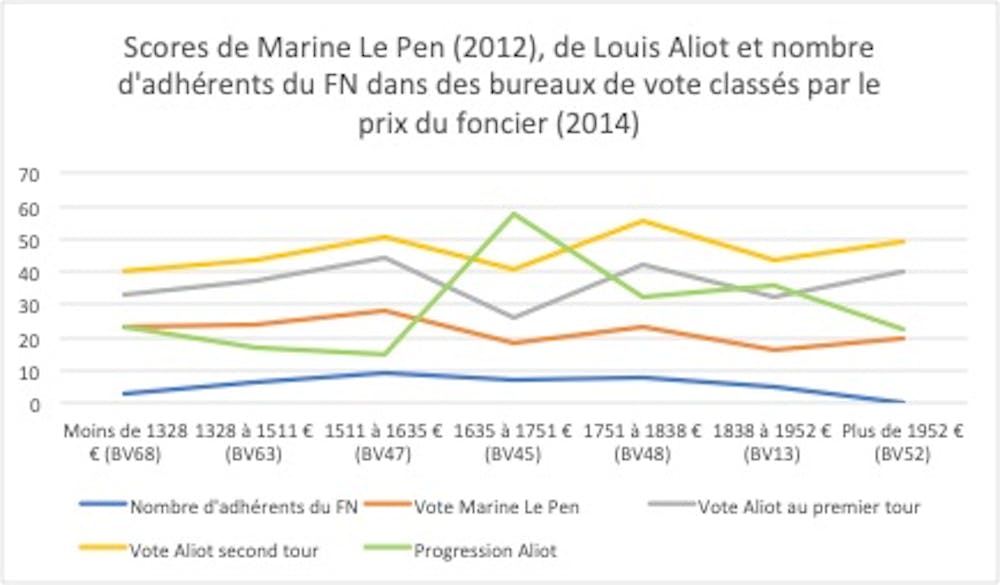
Nicolas Lebourg, Author provided
It is clear that Louis Aliot brings added value to the local community—a fact that, as in 2020, his opponents Jean-Marc Pujol and Romain Grau (LREM) continued to deny throughout the campaign.
The downsized middle class provides the bulk of the party’s activists and does indeed help normalize the party’s presence: its vote share in this group is correlated with this trend. However, in the wealthiest segment, the picture is different: while District 52 has no activists, “Aliotism” does have a solid base there, albeit with less room for growth than in the middle class.
The political cost of direct involvement with the FN (through membership) was still too high, though that did not prevent one from sharing its views.
In 2020, by enlisting prominent figures from the right, emphasizing the themes of security and a return to prosperity, and adopting a liberal stance far removed from that of Marine Le Pen, Louis Aliot came out on top by successfully uniting the working class and the affluent.
A New Champion
In short, Louis Aliot’s candidate list and campaign played the same role among the higher socioeconomic classes as activists do in less affluent communities. This adaptation is not limited to the party itself, as evidenced by the shift in the percentage of votes cast for Mas Llaro (polling station 711, following the redistricting of polling stations):
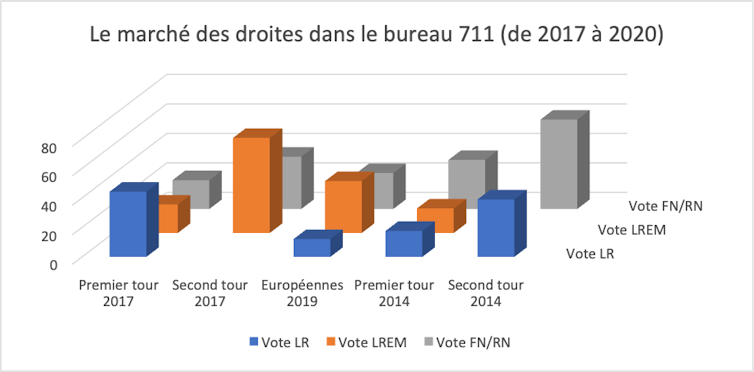
Nicolas Lebourg, Author provided
This Fillon-supporting electorate, which had overwhelmingly backed Emmanuel Macron in the second round of the presidential election, maintained its support for LREM in the European elections but returned to its pro-Aliot stance in 2020.
Here we have a “pro-order” faction on the right that is looking for a champion. It does not consider the National Rally’s platform credible, as it is too anti-business, but nevertheless sees Louis Aliot as the political option that guarantees cultural conservatism, security and ethnic order, and economic liberalism.
A merger of right-wing factions is taking place, demonstrating how the decision by three running mates from Romain Grau’s ticket to join Louis Aliot between the first and second rounds of voting is not merely a matter of individuals, but rather reflects the convergence of a political platform and social demand.
A Concrete Plan for Safety
Once elected, Louis Aliot announced that he would take direct charge of the issue of public safety. This issue has always been central to all of the National Front’s municipal campaigns in Perpignan, but this was the first time the party’s slate presented a concrete platform, outlining a series of specific measures. While the city saw a significant decline in non-violent thefts during the previous term, crimes against persons continue to rise, particularly assaults, which have increased by 24.4% since 2013.
In January 2020, an IFOP-Semaine du Roussillon-Sud Radio poll showed that 48% of Perpignan voters surveyed considered “the safety of people and property” to be a key factor in their voting decision.
Let’s take, for example, the western neighborhood of Bas Vernet, a modest area among the city’s priority neighborhoods, which does indeed face real safety issues, particularly in the Cité des Oiseaux sector.
61% of residents in Bas Vernet Ouest considered safety to be an important factor in their voting decision. And, indeed, the corresponding polling place gave 61.65% of its votes to Louis Aliot in the second round.
A convergence between working-class and affluent neighborhoods
Les Oiseaux and Mas Llaro, though socially very different, thus converged in the top three polling places that supported Aliot. While Marine Le Pen defeated Emmanuel Macron in only one polling place in Perpignan during the second round of the presidential election, this convergence made it possible to build a political majority.
But this did not happen without divisions within the working class. Indeed, the city has poor neighborhoods with a high concentration of people from the southern shore of the Mediterranean—particularly in the run-down historic center and in the northern neighborhoods.
In 2014, it was these voters of North African descent who saved the incumbent mayor. Although they usually vote for the left, they rallied behind the right-wing mayor in the first round and turned out in even greater numbers in the second.
The 2020 campaign was thus structured around a strategy aimed at navigating this sociological landscape. Jean-Marc Pujol’s teams did everything they could to mobilize the northern neighborhoods and their residents of North African descent. Louis Aliot, for his part, took care not to scare them.
Although he launched his campaign with the support of Éric Zemmour in a hall packed with a very “bourgeois” audience, he subsequently took great care to avoid the topics of Islam and immigration.
In the housing projects, mobilization is no longer enough
The election results can be illustrated by the example of the polling station in the Cité Clodion.
With the highest percentage of Arab-Muslim first names on its voter registry in the entire city (54.4%) and only one registered National Front member, it gave Jean-Marc Pujol his best result of 2014 (44.4%) and his biggest gain in the second round (up 34.7 points).
In 2020, the party’s new local chapter saw its share of the vote increase by 13 percentage points in the second round, and Louis Aliot achieved a minimum vote share of 20.45% there. The momentum was significant… but not enough, as it was too concentrated in a specific area: most working-class neighborhoods were not sufficiently mobilized by the presence of a gentrified RN candidate.

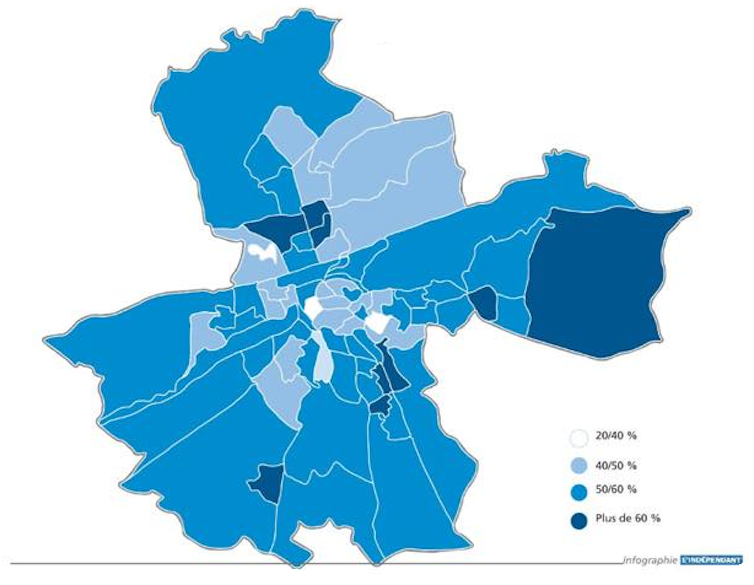
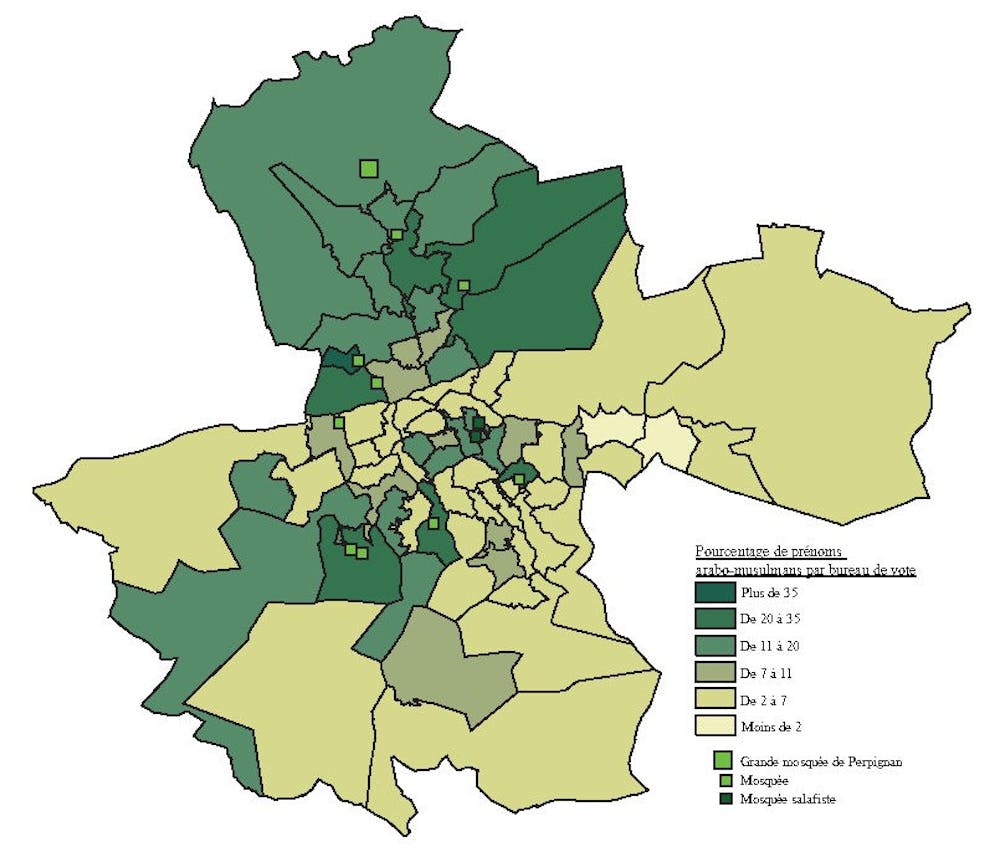
The issue can actually be understood by comparing three maps:
- the Aliot vote in the second round of 2014, broken down by the main working-class neighborhoods
- that of the proportion of Arab-Muslim first names and the presence of Muslim places of worship, both studies conducted by geographer Sylvain Manternach
- the Aliot vote, as reported by the regional daily L’Indépendant the day after the 2020 runoff election.
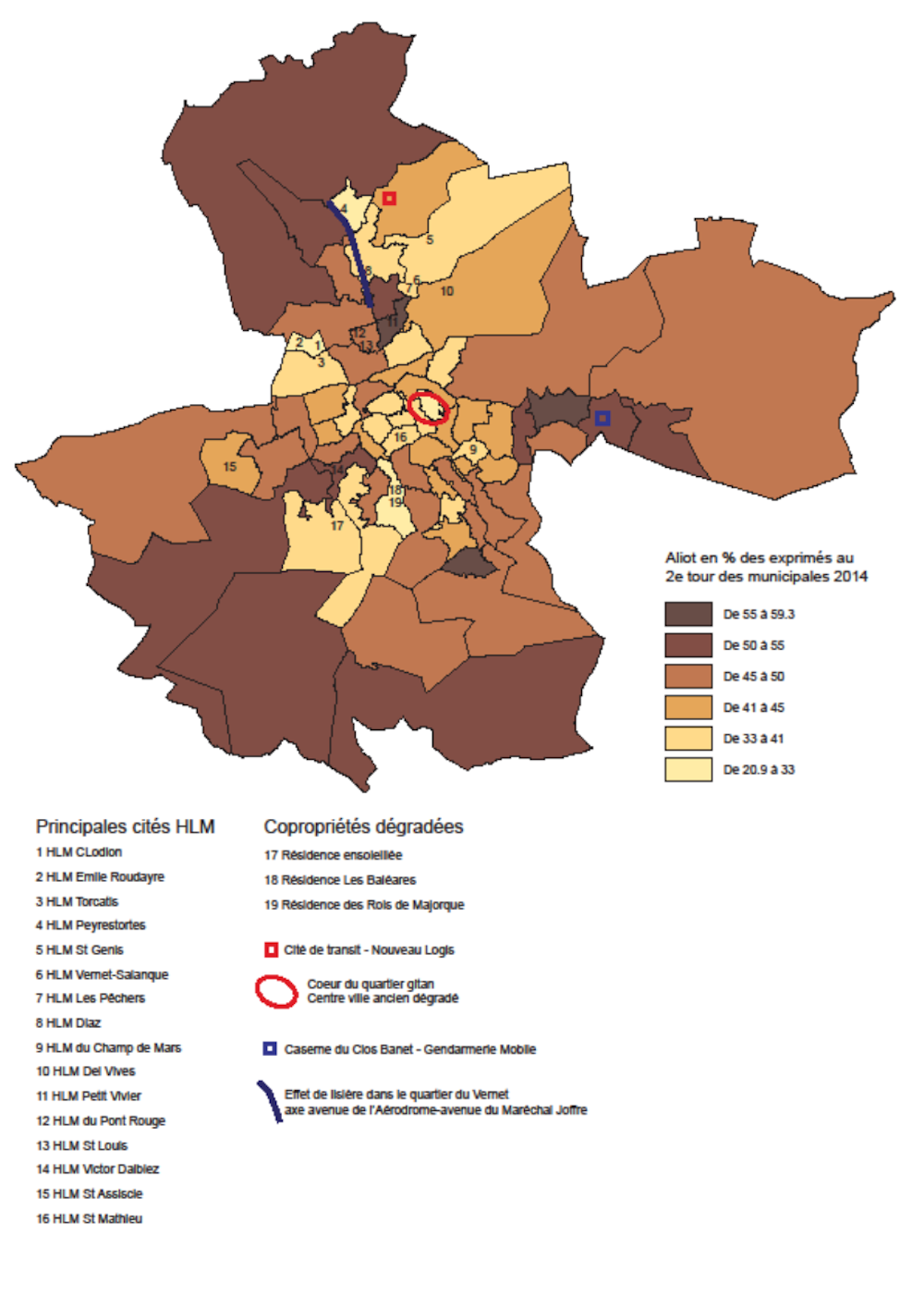
Citizenship Chair, Author provided
L’Indépendant
Citizenship Chair, Author provided
The pattern that emerges is the opposite of that described by proponents of the “peripheral France” theory.
The RN vote did not take root in working-class neighborhoods as a result of multicultural society, but rather on the fringes of those neighborhoods, peaking in affluent areas, in opposition to a multiethnic society deemed responsible for financial waste and insecurity; meanwhile, the collapse of the patronage system caused working-class areas to lose their support for the party and prevented a surge in voter turnout from occurring this time around.
Insiders and Outsiders
A natural objection to our argument would be that the shifts in voter behavior were a consequence of the voting conditions brought about by the coronavirus crisis and an excessively long interval between the two rounds of voting, which demobilized entire segments of the electorate, as political scientist Céline Braconnier has shown. We can demonstrate that the issue is structural using a few diagrams.
Half of Perpignan’s electorate consists of people born in the department, while the other half comes from other departments in metropolitan France. In everyday Perpignan parlance, this distinction is summed up as “Catalans” versus “Gavatx”—those “native to the region” and those who came from beyond the village of Salses. These “outsiders,” as non-native Perpignan residents are often called, tend to live in the affluent neighborhoods:

Citizenship Chair, Author provided
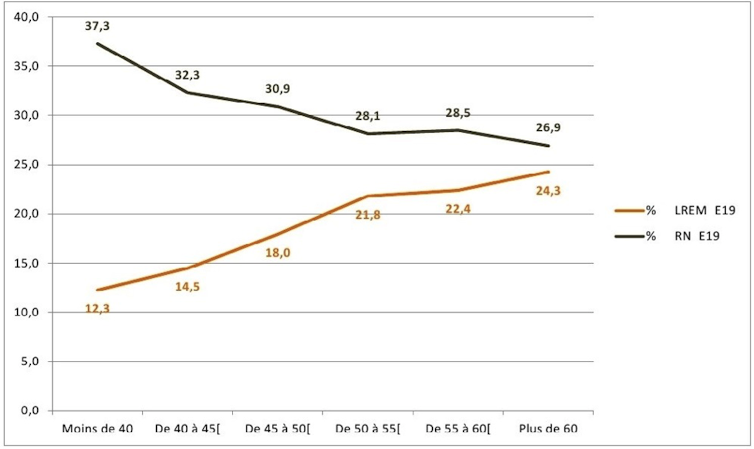
As we demonstrated, along with Jérôme Fourquet and Sylvain Manternach, in our study on cities for the Citizenship Chair at Sciences Po Saint-Germain-en-Laye, these immigrants vote in a significantly more liberal manner than native-born citizens:

Citizenship Chair, Author provided
Citizenship Chair, Author provided
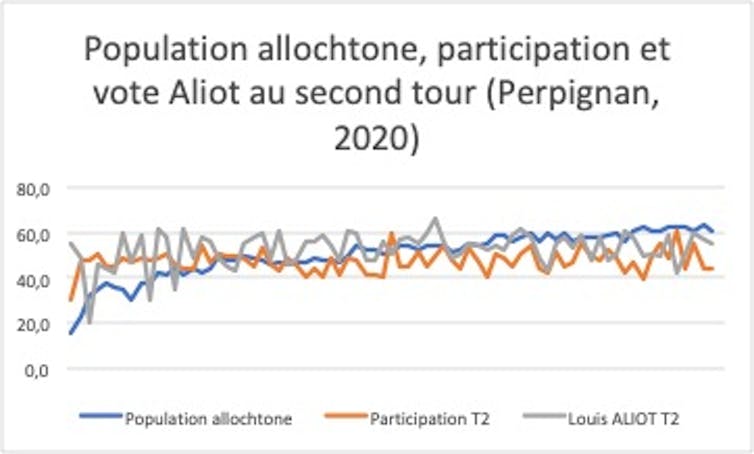
However, it turns out that these individuals—who are more integrated into the economic system and less so into the local sociocultural system—were more active in the municipal elections.
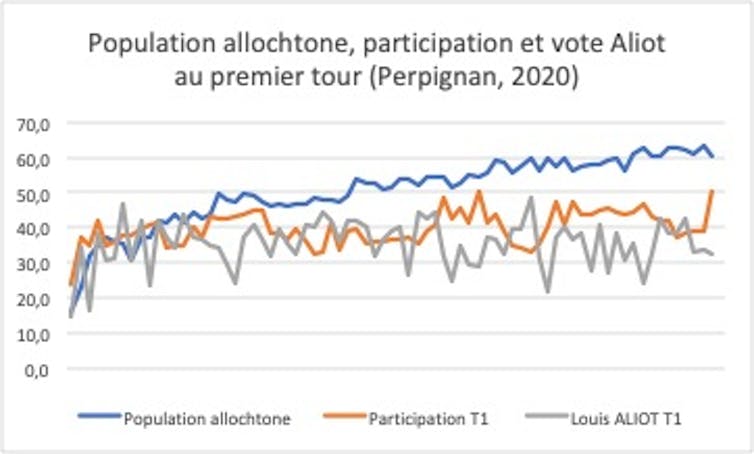
If we analyze the election results by ranking polling places according to voter turnout:

N. Lebourg, Author provided
Since we’re categorizing offices by the percentage of the immigrant population:
N. Lebourg, Author provided
N. Lebourg, Author provided
It appears that the Aliot ticket initially suffered in the first round from a lack of turnout among the native electorate that typically supports it. Although it nearly doubled Jean-Marc Pujol’s vote total at that time, this figure masks a differentiated abstention rate against it, due to the greater civic engagement of immigrants, who are less likely to vote for the National Rally and more likely to turn out at the polls.
Admittedly, the return of first-time voters to the second round allowed Louis Aliot to regain some support, but he also owes his victory to the segment of the liberal-conservative electorate from mainland France that has now turned to him, contrary to previous trends.
There has indeed been a convergence of the right in Perpignan—ideologically, sociologically, and electorally. The alliance between the local working classes and the affluent metropolitan classes is forming a social bloc that is likely to have a significant impact on the National Rally in the near future, since in previous departmental and regional elections, the party achieved excellent results in the first round by capturing the working-class vote but was unable to attract enough additional support to secure a majority in the second round. The victory in Perpignan is no accident, and the possibility of a strategy that breaks the National Rally’s isolation has been raised.
Nicolas Lebourg, Researcher at CEPEL (CNRS-University of Montpellier), University of Montpellier
This article is republished from The Conversation under a Creative Commons license. Readthe original article.