[LUM#9] Pain Relievers and Pregnancy: A Dangerous Combination
A study bythe Institute of Human Genetics (IGH) reveals that taking acetaminophen and nonsteroidal anti-inflammatory drugs during pregnancy affects the fertility of unborn children. These alarming findings call for limiting the use of these medications in pregnant women.
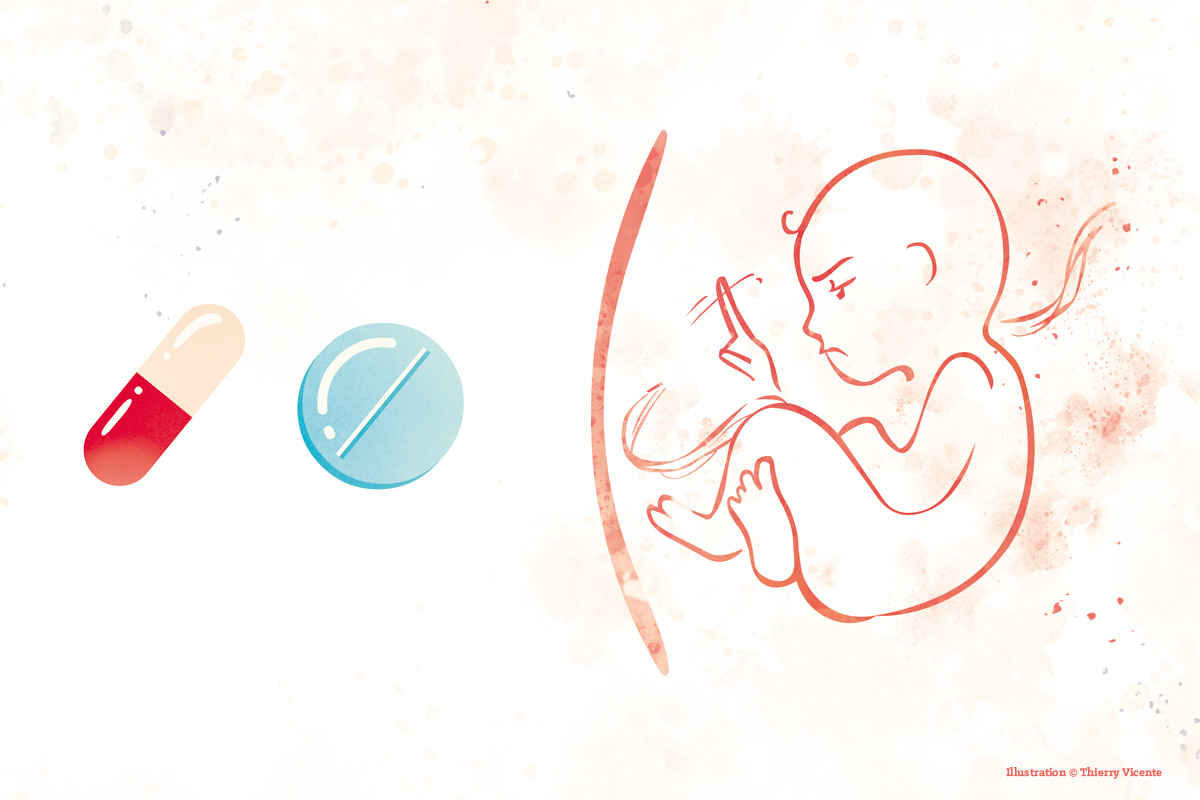
To relieve pain, many pregnant women continue to take acetaminophen combined with a nonsteroidal anti-inflammatory drug such as ibuprofen during their pregnancy. “It is estimated that 4% of women use this combination of drugs, ” explains Brigitte Boizet-Bonhoure. This combination is sold over the counter and is often considered harmless, but it should in fact be prohibited for pregnant women, as demonstrated by the research of theIGH biologist.
“Numerous studies have already shown that exposure to these molecules early in gestation increases the risk of genital malformations such as cryptorchidism or hypospadias in newborn boys, but the consequences for the development of the reproductive organs and the fertility of the offspring were not known,” explains Brigitte Boizet-Bonhoure.
Early Pregnancy: A Critical Period
To address this knowledge gap, the researchers administered acetaminophen and ibuprofen to mice in early pregnancy. “If we draw a parallel with humans, this is equivalent to a pregnant woman taking these two medications at the doses typically approved between the fourth and sixth weeks of pregnancy, bearing in mind that acetaminophen is approved for use throughout pregnancy and that ibuprofen is contraindicated only after the sixth month, ” explains Brigitte Boizet-Bonhoure.
This very early stage of gestation is, however, a particularly sensitive phase: it is during this stage of early embryogenesis that the reproductive system develops, with the formation of embryonic ovaries or testicles. “This embryonic period shapes the entire future sexual life; if these processes are disrupted, it can lead to fertility problems in the offspring.”
And that is precisely what the researchers found. “When we analyzed adult mice that had been exposed in utero, we found that the males produced fewer sperm. ” Even more concerning: when the exposed animals breed with one another, their offspring have less motile sperm, leading to a decline in fertility in male mice as early as 6 months of age—which corresponds to about 40 years in humans.”
Review medication recommendations
Are there also effects in female mice? “We are currently analyzing this data, but we have already observed that the fertility of females exposed in utero is also affected; in particular, they are at risk of early menopause, ” explains Brigitte Boizet-Bonhoure.
Can these results obtained in mice be extrapolated to humans? “Even if we can’t apply them 100 percent, there is currently enough data showing that these treatments have an impact on fertility to warrant a review of drug recommendations,” warns Brigitte Boizet-Bon-houre, who has expressed her concern to the French National Agency for Medicines and Health Products Safety.
These findings are all the more concerning because they show that taking acetaminophen and ibuprofen affects not only rodents exposed in utero but also their offspring, who were not exposed to these drugs during gestation. “This suggests that exposure to these molecules induces intergenerational effects that could affect the genome and gene regulation in germ cells—just as endocrine disruptors do—and have consequences spanning several generations!” the biologist warns. Against a backdrop of steadily declining human fertility (see sidebar), this is yet another factor to consider in order to protect reproductive health. “Pregnant women need to be warned that taking acetaminophen and ibuprofen—even in the very early stages of pregnancy—is not a harmless act.”
Fertility in Free Fall
1 in 6. That’s the proportion of couples who are unable to conceive without medical assistance. It’s an alarming figure, “and one that continues to rise, ” warns Professor Samir Hamamah, head of the Department of Reproductive Biology at Montpellier University Hospital. According to the specialist, this decline in fertility is partly attributable to the chemicals we are exposed to every day from the moment we are born… and even long before that. “The fetus is already exposed to these substances in the womb, which can impair the fertility of the unborn child.” Endocrine and environmental disruptors, pesticides, volatile organic compounds… in total, there are more than a hundred molecules toxic to reproductive health that we handle every day, often without even realizing it. “If you put on lipstick, you’re coating yourself with glycol ether; when you heat up a frozen meal in the microwave, you’re ingesting phthalates”—all of these dangerous substances are hidden even in the most innocuous everyday products.
Check out theUM podcasts, now available on your favorite platform (Spotify, Deezer, Apple Podcasts, Amazon Music, etc.).