Nexus Doctoral Project Call for Proposals – 2024 Cycle
ExposUM is an initiative of the University of Montpellier and its partners1 aimed at establishing an off-campus, interdisciplinary institute for the study, training, and science-society interaction regarding the environmental determinants of human health. As a recipient of the ExcellenceS (PIA4) call for proposals and supported by the Occitanie Region, ExposUM is receiving €46.4 million in funding for the period 2022–2030.
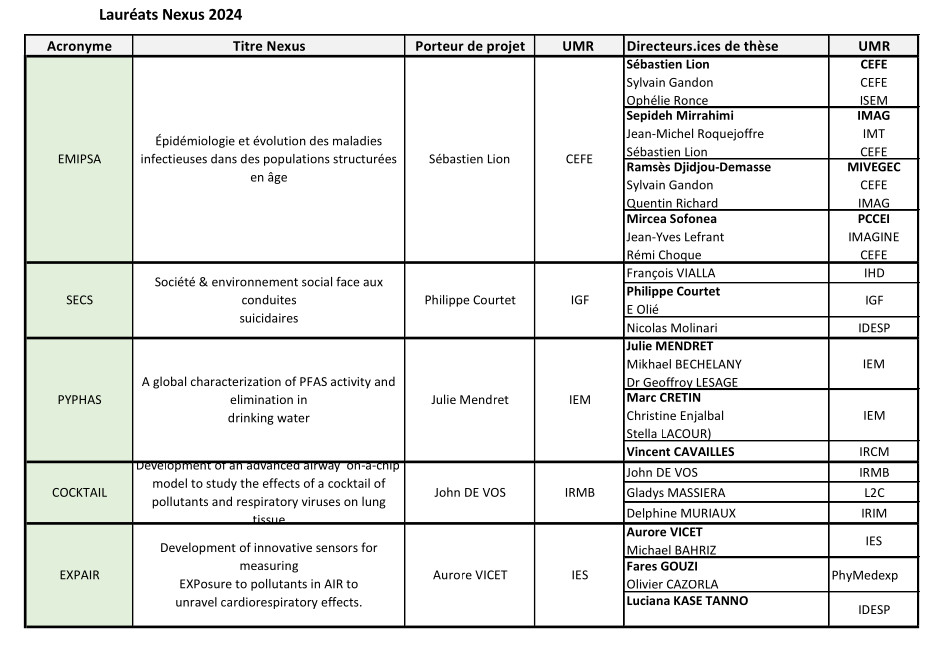
Winners of the 2024 Call for Proposals
Scientific Scope
The exposome refers to the set of environmental and social factors whose specific effects, combined with individuals’ intrinsic characteristics, underlie the onset, progression, and severity of infectious and noncommunicable diseases in humans. In this sense, it is the environmental counterpart to the genome, with which it interacts throughout an individual’s life.
Objectives of the Call for Proposals
The training component of the ExposUM Institute aims to:
- Breaking Down Barriers in Education (Interdisciplinarity)
- Help improve skills
- Further strengthen ties with countries in the Global South
To this end, several initiatives will be organized, including the funding of doctoral fellowships as part of a program that organizes them into interdisciplinary networks, hereinafter referred to as Doctoral Nexus.
The Doctoral Nexus are networks of 3 to 4 doctoral students from different disciplines (e.g., social sciences—mathematical modeling—biology) and affiliated with at least two different research units. They will be funded based on:
- a joint research project, developed by the principal investigator in collaboration with the participating thesis advisors, encompassing all disciplines, and aimed at studying one or more aspects of the exposome as defined above,
- an individual, discipline-specific thesis topic for each doctoral student involved
Each dissertation will be funded from the outset for a period of four years. This additional year is justified by the implementation of specific training initiatives and the time allocated to interdisciplinary work. In particular, opportunities for collaboration between laboratories will be encouraged.
The doctoral programs atthe ExposUM Institute will be strengthened by the implementation of an additional joint educational program focused on methodology and skills development—particularly in interdisciplinarity and transdisciplinarity—conducted within the framework of the ExposUM Institute, without replacing the training organized by the doctoral schools. As part of this initiative, doctoral students in the network will be tasked, during their third year, with organizing a one-day conference (handling both the scientific and logistical aspects). They will receive a grant from the Institute to support this effort.
Calendar
- Doctoral NexusRound 2 Call for Applications: December 15, 2023
- Deadline for submitting proposals: February 4, 2024, 2:00 p.m. CET
- Announcement of results: second half of February 2024
- Candidate interviews: mid-April 2024
- Start of thesis work: September–December 2024
Financing Terms
For the2024 cycle(the second round of this call for proposals), the Institute proposes awarding a maximum of 15 grants (for example, 5 Nexus projects, each consisting of 3 dissertations), using funding from the ANR and the Occitanie Region.
This funding covers the salaries of doctoral students over four years (approximately 167k€) as well asoverhead costs. These include the costs of additional training programs organized by the Institute—such as the seminar—and operating expenses. The allocation of the operating budget within the Nexus is determined by the project leader, who coordinates its distribution within the Nexus—for example, €60,000 for a Nexus with three doctoral students or €80,000 for a Nexus with four doctoral students (a total of €20,000 per doctoral student).
Eligibility Criteria
Please note that failure to meet these criteria will result in the automatic disqualification of the application.
- The project must beled bya permanent or contract employee affiliated with a UR, UMR, or UMI2 that is part of the ExposUM Institute consortium and employed by one of the consortium’s partners3. The UARs, UExp, UPS, and US4, in particular, are not eligible to apply for this call for proposals.
- All doctoral students must be enrolled at the University of Montpellier as their primary institution. Consequently, thesis advisors must be affiliated with one of the doctoral schools of theUM listed in this call for applications5 AND applicants must be enrolled in a field of study for which the University of Montpellier (UM ) can award a degree.
- The project must involve collaboration between at least two different research units (UR, UMR, or UMI from the ExposUM Institute consortium).
- Thesis advisors must be different for each thesis (in the exceptional case of an international joint supervision arrangement, the same co-advisor for two theses may be accepted upon justification).
- Proposed dissertation projects must be four years in duration.
- Doctoral contracts must begin in September or December 2024; staggered start dates will not be accepted.
- Each doctoral student's dissertation work must be conducted on a full-time basis
- The project should aim to generate knowledge related to the exposome —that is, any environmental determinant of human health in the broadest sense.
It is possible to apply for this call for proposals in conjunction with an application for the “ Research ” ExposUM call for proposals. However, the project must be viable even without receiving funding Research.
Submission Guidelines
The project must be written in French or English based on the simplified application form, following the instructions provided therein.
The primary applicant must submit the application by email, copying the unit director and the advisor for each thesis, and including [AAP Doctoral Nexus 2024] in the subject line.
Before February 4, 2024, at 2:00 p.m. CET.
Selection Process
Complete applications will be evaluated based on the quality of the scientific project and the individual research topics proposed, as well as their alignment with the Institute’s priorities and research areas (see Selection Criteria). This evaluation will be conducted by a committee composed of cluster directors or doctoral school directors and representatives from the ExposUM Institute’s CoDir or COSS. The principal investigator is asked to provide a brief justification of the relevance of the proposed Nexus in light of these selection criteria.
The results will be announced in mid-February to allow time for the evaluation of applications.
The selected Nexus grant recipients agree to take all necessary steps to identify candidates to fill the thesis topics that will be funded.
The selection of doctoral students will be approved by the doctoral schools and requires the publication of the proposed topics in advance. The Institute will publicize the thesis topics by forwarding them to the doctoral schools for publication on their respective websites and on the ADUM, as well as by posting them on the Nexus Call for Proposals page on the website of theUM. To facilitate the identification of candidates, we encourage the relevant thesis advisors to circulate their thesis project descriptions within their usual networks (master’s programs, etc.).
Candidates wishing to apply for a project will be asked to submit their application materials to the relevant Nexus project leader, with the ExposUM Institute copied on the email. Contact information for submitting applications will be provided in the project descriptions.
The program coordinators will conduct an initial screening of candidates in consultation with the Nexus thesis advisors (a minimum of 2 and a maximum of 4 per topic), who will then be interviewed by a committee composed of representatives from the doctoral schools; the committee will rank the candidates in mid-April.
Selection Criteria
- Clear identification of the scope of the exposome being explored.
- An original and relevant interdisciplinary approach to the topic: in this regard, the involvement of various doctoral schools within a network will be valued.
- Methodological qualities.
- Potential impacts (both fundamental and applied).
- Feasibility (scientific and financial resources already secured to ensure the successful completion of the dissertation).
- Coordination of individual projects.
- Relevance in light of the ExposUM Institute’s strategic priorities (establishing new partnerships, the One Health approach, Global Health and Southern Health, and promoting the involvement of the humanities and social sciences).
Program to Support the Integration of the Humanities and Social Sciences
If prospective Nexus founders would like support in integrating the humanities and social sciences into their Nexus, Research Area 2 of the ExposUM Institute and its director, Aurélie Binot, offer support and incubation services.
You can request this support by sending an email (subject line: [Nexus SHS]).
Contact
For any information regarding this call for proposals, please send an email to the following address (subject line: [Contact Nexus]).
Obligations of the Bearer
The porters agree to:
- Organize regular meetings (at least three times a year) with Nexus thesis advisors and doctoral students, and provide an annual report on the activities carried out at the Institute.
- To adhere, in the design and implementation of the project submitted in response to this call for proposals, the values and principles of scientific integrity intended to ensure the honesty and scientific rigor of all research work, as referred to in Article L.211-2 of the Research Code and set forth in the National Code of Ethics for Research Professions and the University of Montpellier’s Charter on Scientific Integrity.
- Comply with the Nagoya Protocol, if applicable.
- Include the logos of the University of Montpellier, France 2030, the ExposUM Institute, the Occitanie Region, and/or the ERDF in all documents related to the project’s implementation. Project leaders will be provided with specific instructions regarding their communication requirements.
- Please send to the Institute (), an annual report, and a final report no later than two months after the project’s completion (financial statement and summary report), which may be used in the University’s communications materials in accordance with a provided template. A project guide detailing management procedures and reporting requirements will be sent to the selected project leaders.
- Apply the current UM publication guidelines to all scientific outputs; comply with the provisions related to open science and the Law for a Digital Republic ( open-access publication). The directors of laboratories under the supervision of UM will deposit the full text of publications in the open archive (https://hal.umontpellier.fr).
- Take the necessary steps to obtain the required research authorizations and approvals in regulated areas (genetically modified organisms, the use of animals for scientific purposes, health data, the use of genetic resources and the resulting benefit-sharing, bioethics, etc.).
Complete list of research institutions that can contribute to the ExposUM Institute6 :
ABSYS, AGAP, AIDA, AMAP, ANALYSES, ART-Dev, ASTRE, BC2M, BCM, BioWooEB, BRM, CBGP, CBS, CDE, CEE-M, CEFE, CEMIPAI, CEPEL, CERCOP, ChimEco, CRBM, CREAM, DEFE, DGIMI, DIADE, DiaScope, DMEM, ECO&SOLS, ECOTRON, EDPFM, EDSM, ESPACE-DEV, EuroMov DHM, Forests and Societies, G-EAU, GECO, Génopolys, GM, HortSys, HSM, IATE, IBMM, ICGM, ICSM, IDEDH, IDESP, IEM, IES, IGF, IGH, IGMM, IHD, IHPE, IMAG, IMAGINE, INM, INNOVATION, INTERTRYP, IPSiM, IRCM, IRIM, IRMB, ISDM, ISEM, ITAP, L2C, LBE, LBN, LDP, LEPSE, LICeM, LIRDEF, LIRMM, LISAH, LMGC, LPHI, LSTM, LUPM, Maraîchage, MARBEC, MISTEA, MIVEGEC, MMDN, MoISA, MRE, MRM, MSH Sud, OREME, PCCEI, Pech Rouge, PHIM, PhyMedExp, QualiSud, Recycling and Risk, SantESiH, SELMET, SENS, SPO, Sys2Diag, TETIS, TransVIHMI, Vassal, VBIC
Governance of the ExposUM Institute
Executive Committee (CoDir): Éric Delaporte (chair), Aurélie Binot (interfaces), Charlotte Boullé (training), Mircea Sofonea (research).
Operations Team: Morgane Cottin, Camille Couralet, Noémie Moret, Elodie Suttling (project manager).
Scientific andStrategic Advisory Board(COSS): Jacques Mercier (Chair),Amaria Baghdadli, Bernadette Bensaude-Vincent, Pascal Demoly, Delphine Destoumieux-Garzon, Hélène Fenet, Didier Fontenille, Sylvain Gandon, Julie Pannequin, Denis Pesche, Coumba Toure Kane, Muriel Vayssier-Tarissat, Laurent Visier.
Research ’s Guidance and Evaluation Council (COER): Manouk Abkarian, Anne-Muriel Arigon, Charlotte Boullé, Anca-Mirela Chiriac, Constance Delaby, Gauthier Dobigny, Elena Gomez, Christelle Gramaglia, Antoine Gross, Alexandre Hobeika, Nadine Laguette, Georges Lutfalla, Antonio Maraver, Anatja Samouelian, Mircea Sofonea (chair), Jérôme Thireau, Annelise Tran.
- UM, Occitanie Region, CNRS, IRD, INRAE, CIRAD, INSERM, Montpellier University Hospital, ICM, Institut Agro Montpellier, ENSCM, Ifremer, INRIA. ↩︎
- Research Unit, Joint Unit Research, International Joint Unit. ↩︎
- The applicant must already be an official member of the organization in question—or must become one by October 2024 at the latest—and, for contract staff, their contract with that same organization must remain in effect until the project’s scheduled end date. The project may have one or more partner organizations. However, only organizations included on the list of eligible organizations for this call for proposals may receive funding under the project. ↩︎
- Research Support Unit, Experimental Unit, In-House Service Unit, Service Unit. ↩︎
- ED 58 Languages, Literatures, Cultures, and Civilizations [LLC]
ED 60 Territories, Time, Societies, and Development [TTSD]
ED 166 Information Structures and Systems [I2S]
ED 168 Chemical and Biological Sciences for Health [CBS2]
ED 231 Economics and Management [EDEG]
ED 459 Chemical Sciences Balard [SCB]
ED 461 Law and Political Science [DSP]
ED 463 Human Movement Sciences [SMH]
ED 584 GAIA (Biodiversity, Agriculture, Food, Environment, Earth, Water) ↩︎ - As a reminder, only UR, UMR, and UMI units may apply for this call for proposals. The UAR, UExp, US, and UPS units mentioned in this general list are not eligible for this call. ↩︎