[LUM#16] Aquifer! Aquifer! Do I look like an aquifer?
What if what matters most were indeed invisible to the eye? In France, about 75 percent of the water we consume comes from groundwater. With water crises on the horizon, aren’t these vast reservoirs—known as aquifers—an underappreciated and underutilized resource? Between a lack of awareness here and ecological risks elsewhere, the sustainable management of aquifers is still a work in progress.
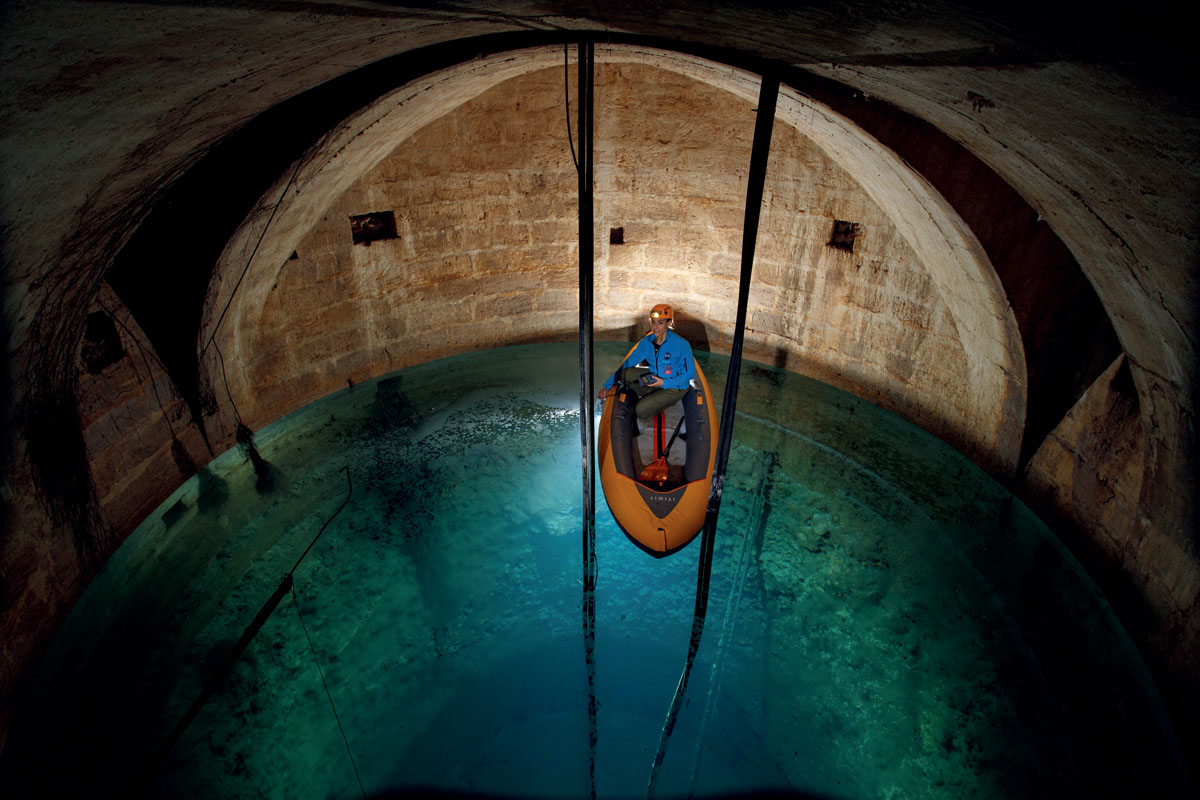
The Amazon, the Nile, the Congo, and the Yangtze—all rivers whose sheer size fascinates as much as it frightens. And yet, “the water contained in streams, rivers, and lakes accounts for barely 1% of the Earth’s liquid freshwater supply,” explains Séverin Pistre, a researcher at HydroSciences Montpellier*. So where exactly is the remaining 99% of water? Right beneath our feet! More precisely, in the Earth’s crust, which—with a water content of approximately 20 to 25%—forms the planet’s largest freshwater reservoir. This is a high-quality resource, often far less polluted than surface water because it is sheltered within what experts call aquifers.
Folded into karst formations
Forget the seas and vast underground lakes described by Jules Verne; the term “aquifer,” which literally means “water-bearing,” refers instead to rock formations into which rainwater seeps and flows. There are three types, depending on the nature of the soils in which they form: “There are aquifers where water penetrates the pores of rocks, such as gravel or sand,” explains the hydrologist, “and others where it flows through harder rocks, traveling through fissures or settling into interstices.” While these two types of aquifers are the most common worldwide, there is a third type, well known in the region: karst aquifers.
Let’s turn the clock back 250 million years. At that time, the region was covered by a deep ocean. As the ocean receded, it left behind thick layers of sediment that, over time, would form limestone. “In these easily soluble carbonate rocks, water carves out its own spaces, forming drainage channels, underground rivers, and then springs like the Source du Lez. The Demoiselles and Clamouse caves, for example, were filled with water before the water level dropped,” explains Séverin Pistre. Aquifers like these are also found in China, Vietnam, Brazil, and elsewhere. Worldwide, one in four people drinks karst water.
Aquifers: What Should We Do?
So there’s water everywhere—and in vast quantities! But you still have to go find it, and to do that, it helps to have brushed up on your geology. France alone has more than 30,000 registered wells; in India, that number rises to over 2 million. The drilling methods differ depending on whether the target aquifer consists of sand or hard rock. “If we’re dealing with hard rock—known as ‘bedrock’—we know the water is contained in fissures; we could miss it by as little as 5 meters,” explains the researcher. “In sand or gravel, the water table is widespread, so the drilling location can be less precise.” ”If the nature of the soil is not already known—which is quite rare in France today—the geologist can turn to geophysics. One of the best-known methods involves sending an electric current through the ground to measure its apparent resistivity. “If the current passes through rocks containing water—since water is conductive—there will be low resistance. ” Another option is to locate a borehole or a well drawing water from the same aquifer in order to analyze the water. As the water passes through rock, it dissolves it and becomes enriched with ions along the way; analyzing these ions will reveal the types of rock from which they originated. “We have thus observed that the chemistry of the Lez spring changes slightly between winter and summer, when the uppermost part of the aquifer is depleted and deeper aquifers take over.”
And they pumped and pumped…
As the world prepares to face a water crisis, why not make greater use of this liquid treasure hidden beneath our ground? The primary obstacle to this exploitation is the need to preserve the resource, particularly when it comes to “mining”-style water extraction from aquifers that can take thousands of years to recharge. This can be observed in arid or semi-arid regions that experienced wetter climates tens of thousands of years ago. “If we exploit them, we know the water won’t replenish itself. When German troops from the Afrika Korps drilled wells in North Africa, they found artesian wells from which water gushed forth without the need for pumping. Today, we have to go several dozen meters deep to get it,” continues Séverin Pistre.
Around the Mediterranean, karst aquifers, on the other hand, ensure very rapid recharge of the groundwater table thanks to vast outcrop areas and the porosity of the rocks, which limits runoff. Given that IPCC scenarios predict an increase in episodes of intense rainfall in the region, karst formations could thus become highly valuable water reservoirs—provided certain precautions are taken, because while the permeability of karst formations allows for rapid groundwater recharge, it also offers little protection against pollution. “In France, policymakers often have little understanding of groundwater and show little interest in it. This is a mistake; aquifers must be considered strategic reserves and incorporated into a genuine policy for protecting this resource, as recommended by the water agencies,” concludes the hydrogeologist.
*HSM (UM —CNRS—IRD)
Check out theUM podcasts, now available on your favorite platform (Spotify, Deezer, Apple Podcasts, Amazon Music, etc.).