In Chile, the excesses of the “water markets”
As in many other countries, water in Chile is a public good. But, as in Australia and some U.S. states, its management is entrusted to the holders of “water rights,” and public authorities limit their involvement to the bare minimum.
Elisabeth Lictevout, University of Concepción; Hervé Jourde, University of Montpellier and Véronique Leonardi, University of Montpellier
The legal and institutional framework there continues to be governed by the 1981 Water Code, one of the neoliberal reforms implemented by General Pinochet’s military regime—which was in power from 1973 to 1990. This legislation is based on free-market principles, under which the role of the state is minimized. The role of public authorities—through the General Water Directorate (DGA)—is thus limited to granting “water rights”: these are always tied to a maximum annual volume of water pumped (m³/year) and a maximum instantaneous flow rate (L/s orm³/s). Once acquired, these rights may be sold or transferred without notifying the DGA. The DGA also assesses resource levels and may decide to close, either temporarily or permanently, over-exploited watersheds and aquifers.
“Water rights” are managed like real estate and protected by the Constitution: acquired in perpetuity by buyers, they are transferable and can be used freely. This is because the Water Code does not define any priority uses in the allocation of water: drinking or washing does not take precedence over an income-generating economic activity, since the market—not the government—is supposed to regulate the economically efficient allocation of water.
Some authors do indeed tout the economic success of this approach: water rights provide legal certainty that has encouraged private investment. From a social and environmental perspective, however, it appears unfair.
An Unfair and Inefficient System
Water rights are granted to anyone who applies for them, whether an individual or a corporation. It’s first come, first served, which favors large companies that have the resources to put together the application.
Conversely, small-scale users are often denied access. Sometimes this is simply because they have not applied for it—as is the case with indigenous communities. For them, this resource has been traditionally linked to the land, whereas Chilean law separates land ownership from water rights. Furthermore, the administrative process is complicated and costly. It is also common for small-scale users to sell their water rights to large companies, particularly in watersheds and aquifers that are closed to new water rights—under a declaration of restriction.
When an aquifer is subject to a restriction order, users are theoretically required to form an aquifer management committee. However, since the committee’s board of directors is composed in proportion to water rights, those with the most rights hold the most votes. In the case of the Pampa del Tamarugal, in the north of the country, farmers were thus excluded from the board of directors, which was dominated by a large mining company and the drinking water utility.
Underestimated Water Resources
The system therefore appears to be particularly harmful to the population, especially in the arid regions of northern Chile, where mining operations consume large amounts of water in certain watersheds.
Its operation is based on understanding and assessing the variability of water resources, which are estimated by the DGA through a hydrometric and piezometric network—a system of stations that continuously measure various variables such as precipitation, river flow, and groundwater levels. However, this network has significant shortcomings, both in terms of geographic coverage—it does not account for all water reserves—and in terms of the representativeness and quality of the data.
However, the studies funded by the DGA to estimate the availability of this resource are all based on these data and sometimes reach contradictory conclusions. When this happens, stakeholders rely on the study that best suits their interests. This includes the government, which does not hesitate to support large-scale mining projects… under the guise of stimulating economic growth.
Furthermore, the allocation of water rights in terms of flow rate (volume per unit of time), a lack of information regarding transactions between water rights holders, and limited capacity to monitor water withdrawals make it impossible to determine the actual demand for water or its actual use.
The Case of the Pampa del Tamarugal
The Water Code provides the DGA with several crisis “management” tools, in particular the declaration of a water shortage (for surface water) or of restrictions or bans (in the case of groundwater), which entail a permanent or temporary suspension of the granting of new water rights. However, since the assessments are open to criticism, these decisions are often based on erroneous information.
In the far north of Chile, a study of the Pampa del Tamarugal case showed that the aquifer restriction, declared in 2009, was unjustified. Recent research reveals that the decline in the groundwater level is not widespread and is very moderate relative to the thickness of the aquifer.
Furthermore, the calculations presented by the DGA to justify the restriction order contain numerous biases: among other things, they fail to account for recharge in the availability estimate, and there are errors and uncertainties regarding the terms of the groundwater balance, particularly withdrawals. The decision was therefore made on the basis of highly uncertain data.
Conflicts and the Water Rights Market
As a result, the number of water-related conflicts has continued to rise in recent years. Granting water rights to anyone who requests them without a precise understanding of water resources has led to the overexploitation of certain aquifers, as well as the declaration of water restrictions in more than a hundred of them.
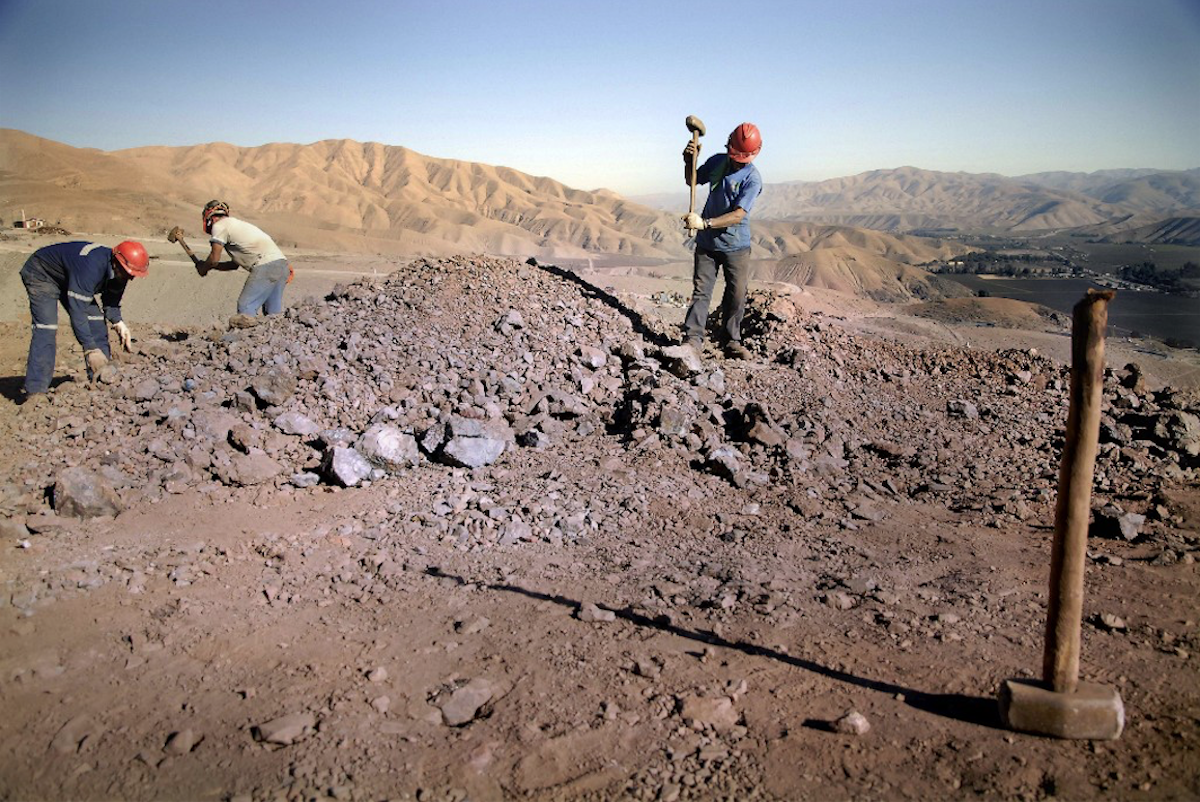
These are concentrated in the arid and semi-arid northern region of Chile. Mining operations—copper in the Andes Mountains, nitrate and lithium in the Atacama Desert—require large amounts of water to process the ore, placing constant pressure on water rights holders, particularly farmers.
A market has thus emerged around these water rights, which are sold at exorbitant prices—one liter per second costs between 80 and 100,000 U.S. dollars. In the cases of the La Ligua Valley, Copiapó, and the Pampa del Tamarugal, highly questionable calculations were used to justify declaring restrictions on the aquifer for the benefit of major economic players, who use them to eliminate their competitors.
Although official estimates of available flow showed that no additional permits could be issued, they did not call into question existing permits and allowed new applications to be approved.
The Need for a Participatory Process
An analysis of the actions taken by the various stakeholders (mines, drinking water utilities, farmers, and Indigenous peoples) revealed that each was pursuing its own strategy, in particular by using the issue of water management and the information available (or unavailable) to further its own interests.
However, the retroactive generation of scientific information has not been able to break this status quo. As a result, many small-scale users remain excluded from access to water and its management.
The establishment of a participatory aquifer management process—now being called for by farmers and Indigenous peoples—based on validated scientific information would make it possible to address the issue of how much water should be extracted from the aquifer.
In this way, it would be possible to define a “desirable” extraction volume based on various development scenarios. To achieve this goal, it will be necessary not only to restore trust between the government and large corporations, on the one hand, and between the government and Indigenous peoples, on the other, but also to amend Chilean legislation.
Elisabeth Lictevout, Researcher, University of Concepción; Hervé Jourde, Researcher, University of Montpellier and Véronique Leonardi, Researcher, University of Montpellier
This article is republished from The Conversation under a Creative Commons license. Readthe original article.