BIM: A Launchpad for Your Ideas
Do you have a potentially innovative idea in the fields of agronomy, the environment, or chemistry? Not sure how to get your project off the ground? On January 11 and 12, the Montpellier Innovation Booster (BIM) is hosting its third session for researchers, staff, and students at I-Site Muse. With workshops, networking events, and conferences, hit the gas and embark on the path to innovation with BIM.
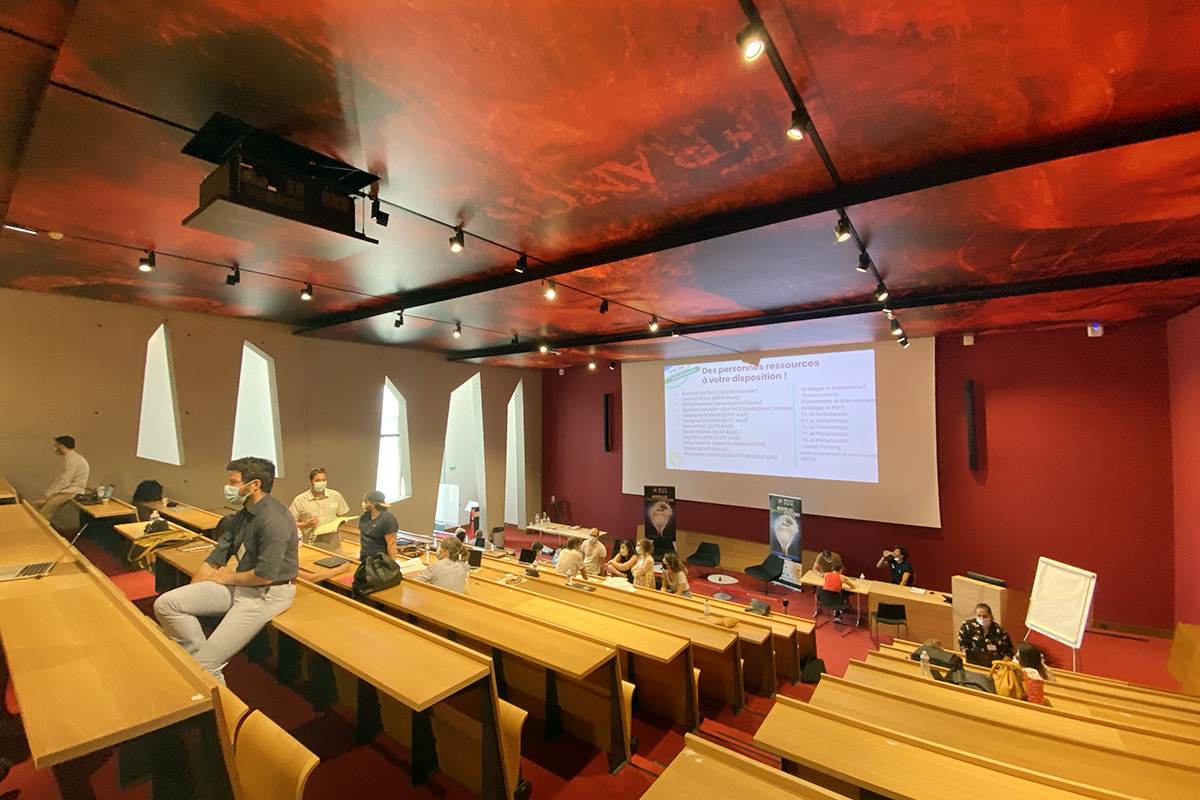
“In France, we certainly don’t lack ideas, but we often lack the structures to believe in them and give ourselves the means to develop our innovations. BIM truly meets this need,” explains Sophie Brouillet. Last June, this in vitro fertilization specialist at Montpellier University Hospital attended a two-day workshop series on the theme of “biology and health” organized by the Montpellier Innovation Booster.
His goal: to develop embryonic organoids in order to improve our understanding of human embryos and increase the chances of pregnancy for infertile couples.“We lack fundamental and medical knowledge about human embryos. The organoids we want to develop cannot result in a baby, but they very accurately mimic the early stages of embryonic development and could therefore teach us what embryos need to develop properly.”
Open to all employees
When she received an email early in the year informing her about these workshops, Sophie Brouillet initially thought her project wasn’t far enough along.“I had the impression it was for extremely advanced projects, with investors already on board, but in the end it was very helpful—it allowed me to avoid certain pitfalls and better understand how the network works.” Open to all I-Site Muse staff members, the BIM’s mission is indeed to support project leaders at a very early stage.“All you need is an idea with innovative potential to participate,” explains Manon Chittaro, skills development manager at Muse.
This support program begins with these two days, during which project leaders will become familiar with tools and concepts they may not yet be familiar with, such as the business model.“Participants will learn to develop an action plan and pitch their project to a panel of scientists and stakeholders from the socio-economic sector. The goal is for project leaders to receive immediate feedback so they can assess their progress—all, of course, in a very supportive environment,” explains Amine Mokri, incubation program manager at I-Site Muse. Satt AxLr, BIC, and AD’OCC are participating in these sessions and offering coaching sessions, among other activities.
Thinking in Terms of the Market
“Our goal during these sessions is also to encourage them to think in terms of the market,” emphasizes Amine Mokri. “Is there something equivalent on the market? Is there a need? And so on.” Habib Belaïd is a postdoctoral researcher at the European Institute of Membranes. He participated in the very first BIM session in 2020 with his project on biomaterials for dental implants.“For me, it was a real springboard toward commercialization and a better understanding of the business world. Thanks to BIM, I also received six months of financial support to work on my prototype.”
This support enabled him to join the University of Montpellier’s incubator for students and recent alumni and to win the I-PhD innovation competition organized by Bpifrance.“Thanks to this competition, I’m receiving 12 months of support from several consulting firms. I should be filing my first patent soon and launching the startup sometime in 2022.”
The first two BIM sessions allowed about twenty project leaders to refine their presentations and pitch to the jury. It was also an opportunity for the University of Montpellier and its partners at I-SITE MUSE to identify promising projects and provide them with support as early as possible.“All BIM participants then receive personalized support, either from Muse’s entrepreneurship or partnership teams, or from their own organization if it has a commercialization department. ” “Whether they want to start a company to commercialize their technology or simply transfer it to an existing company, there is a supportiveinnovation ecosystem in place to make that happen,” adds Amine Mokri.
Next BIM event on January 11 and 12
Finally, by now offering themed sessions, BIM enables project leaders from the same field to meet and discuss their innovations.“In the biology and health workshops, there were many people working on organoids who didn’t know each other. These two days gave them the opportunity to discuss and identify areas where they could collaborate and further promote interdisciplinary work,” concludes Manon Chittaro. The next BIM event will be held on January 11 and 12. Are you in the fields of agronomy, environmental science, or chemistry? Do you have an innovative idea? Don’t hesitate—sign up! The BIM is waiting for you to develop your projects!
How to Sign Up: To register, fill out the registration form. Do you have any questions? Contact us by email.