Carole Delga and Philippe Augé Meet with Social Sciences Students at the University of Montpellier
On Monday, May 22, 2023, Philippe Augé, President of the University of Montpellier; Agnès Fichard-Carroll, Vice President for Academic Affairs and Campus Life; and Amel Qobaa, Student Vice President, welcomed Carole Delga, President of the Occitanie / Pyrénées-Méditerranée Region and President of Régions de France, at the Aimé Shoenig Student Center. Following a tour of the university library on the Richter campus, a roundtable discussion on issues related to education and student life was held between President Carole Delga and social sciences students at the University of Montpellier (law, economics, and business administration).
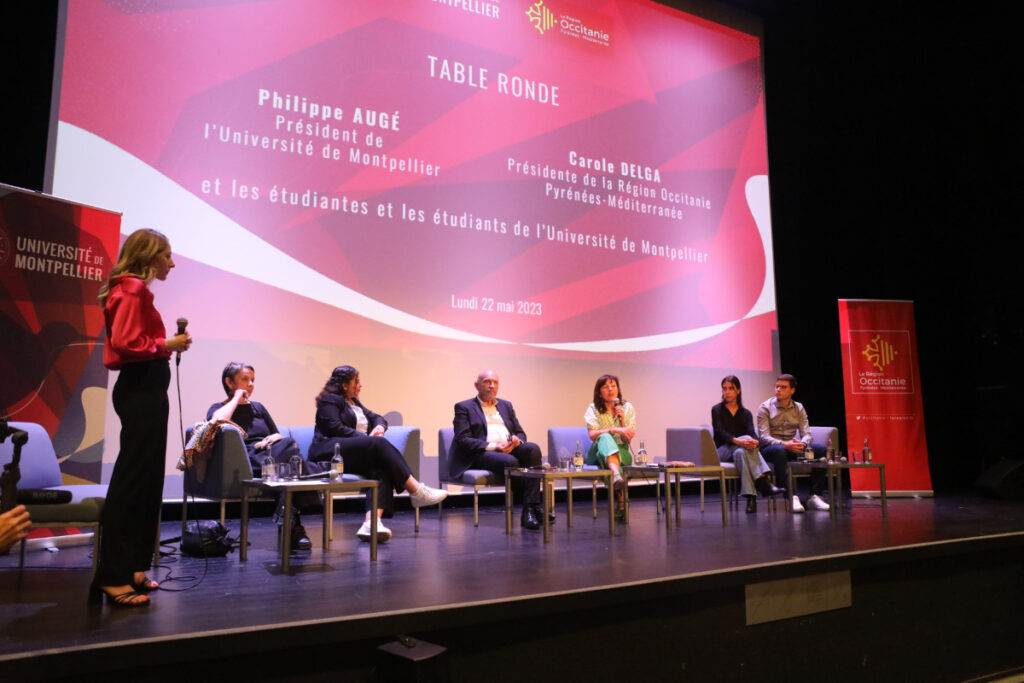
“This meeting is an opportunity to discuss, exchange ideas, and engage with all students at theUM on a wide range of topics, including education, research, and student life. It is important to participate in this roundtable to better understand their expectations and ensure their well-being,” said Philippe Augé, President of the University of Montpellier.
“Listening to the concerns and aspirations of our youth and finding concrete solutions—that is what drives my political work. The choices we make regarding education, training, and, in the future, employment are issues that concern us all. That is why I wanted to come to Montpellier yesterday to meet with students from theUM, who gathered in large numbers for an open and constructive dialogue. Alongside Philippe Augé, president of theUM , I assured them of the Region’s support—we are committed to making access to quality higher education more inclusive, no matter where they live or what their background may be; this includes investments in buildings, decentralized campuses, student housing, and more. Just as we did during the COVID-19 crisis—for example, by providing laptops and 4G data sticks to combat the digital divide—the Region is particularly committed to meeting their needs, whether regarding transportation, educational resources, food, or mental health. “Following this same format, I will soon be meeting with other student communities in Occitanie to continue these discussions,” said Carole Delga, President of the Occitanie–Pyrénées-MéditerranéeRegion.
Commitment, Mobility, and Training
This roundtable discussion provided an opportunity for Philippe Augé and Carole Delga to engage with social science students at the University of Montpellier and answer their questions about education, student life, regional policy in Occitanie, the region’s infrastructure network, mobility, career guidance, transition to the workforce, student engagement, and environmental issues.
Key themes included student life, in which many students seek to become actively involved. The University of Montpellier supports this through tutoring and by promoting student organizations. Mobility was also the subject of many questions; however, the University of Montpellier and the Region are working to facilitate access to education through various modes of transportation (cars, buses, bicycles, and trains).
Education was, of course, the subject of numerous discussions. While the diversity and range of educational opportunities in Occitanie are already substantial, Carole Delga and Philippe Augé hope to continue contributing to the development of a comprehensive educational network across the region.
Student Financial Insecurity and the Environment
The issue of student financial insecurity was addressed, as the University of Montpellier, with financial support from the Region, is implementing solutions. Agnès Fichard-Carroll highlighted the initiatives carried out by theUM , including the Solidarity and Student Initiative Development Fund (FSDIE). Funded by the CVEC, this fund helps finance student projects in various fields (culture, humanitarian aid, sports, solidarity, the environment, civic engagement, etc.) and, in collaboration with CROUS social workers, supports students facing significant hardship or financial insecurity. The issue of period poverty was also discussed, as was the master plan for student life, which includes 73 concrete actions to combat student poverty.
Environmental issues—particularly those related to water resources and the energy transition—were at the heart of the debate. TheUM, ranked among the world’s top universities in environmental studies according to the Shanghai Ranking’s subject-specific rankings, is deeply committed to environmental issues. As a reminder, the university is working to build or renovate many of its facilities to better comply with energy transition regulations (renovation of the STAPS building), and has earned the title “water capital” thanks to the numerous initiatives it has implemented over the past several years (establishment of the UNESCO-ICIREWARD center, the creation of Hydropolis, hosting the Water4Future event, hosting AISH delegations, and organizing the annual Water Week…).
The Occitanie Region is committed to improving its students’ living conditions and helping them succeed
As a leader in higher education, the Occitanie Region is fully committed to providing high-quality educational opportunities throughout the region and meeting the aspirations of Occitanie’s 270,000 students.
At the end of the year, the Region adopted a new regional strategy to make higher education and research one of the drivers of Occitanie’s development and attractiveness policy. To enable all young people to choose and succeed in their studies, the Region supports higher education across all areas, both in the metropolitan areas and in the 18 “University Cities of Balance” in Occitanie.
In total , since 2016, the Region has allocated more than 150M€ to the University of Montpellier and its students , which has made it possible to fund, for example:
- the new University of Medicine (inaugurated in 2017), almost in its entirety (€45.5 million);
- the renovation of university housing and the construction of new housing units, in partnership with the CROUS (since 2016: renovation of 3,095 university housing units and construction of 1,849 new housing units);
- the expansion of psychological support services offered by the “UM ” through the University Health Center (€170,000 since 2020) and the funding of a Student Health Insurance Pass for students receiving financial aid (€100 per year);
- the development of transportation options, including the “+=0” program for 18- to 26-year-olds, which offers free travel on liO trains starting with the 11th trip and will be expanded next school year to include regular bus routes in the liO regional transportation network (40,000 young people benefited, and more than 500,000 tickets were sold in 2022);
- The Youth Ecological Income program, which provides support for training programs (nearly 190 existing programs) or for projects to start or take over a business, and guarantees an income of up to €1,000 per month. Launched in 2022, it already has more than 500 beneficiaries.